Biography
John Almond
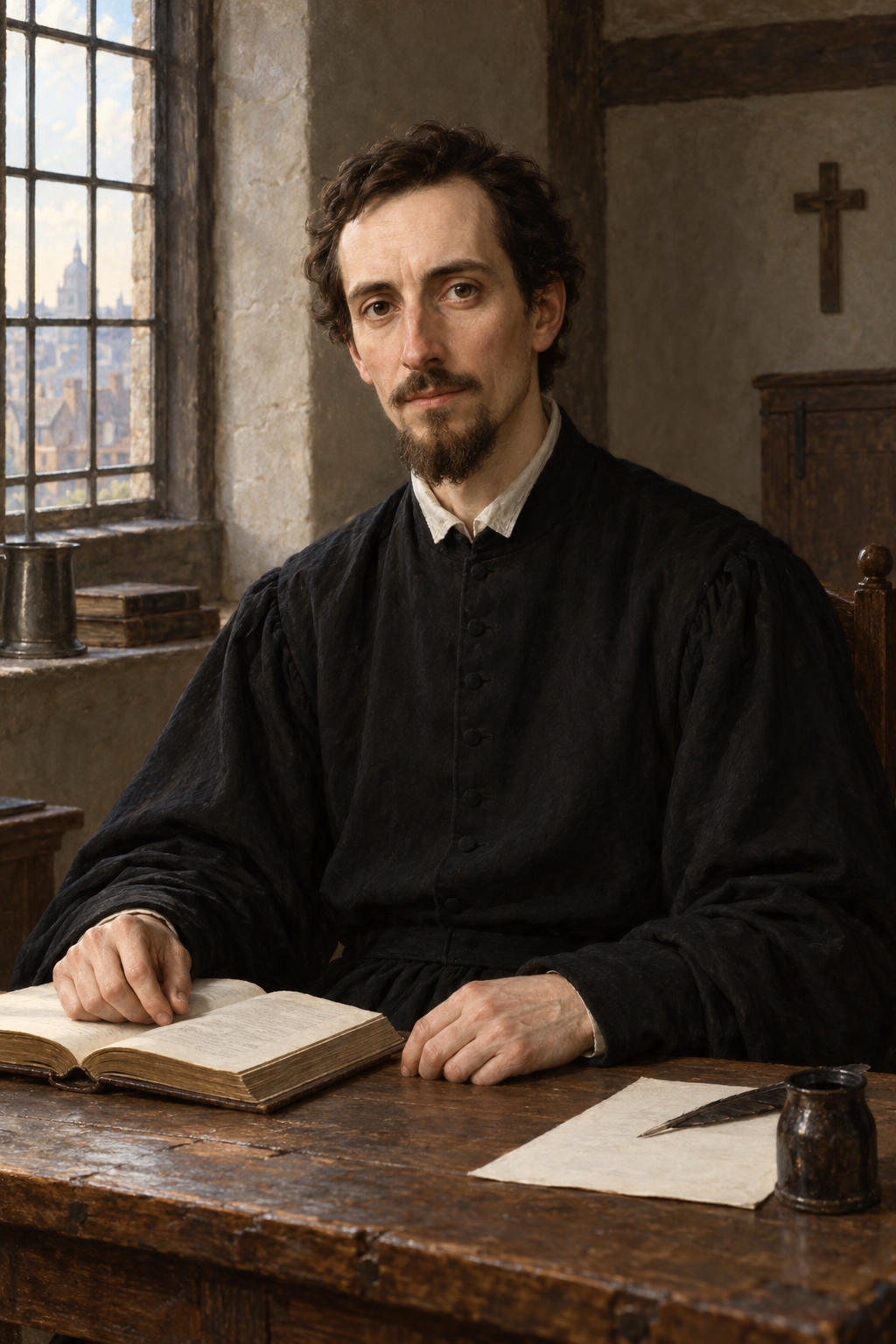
About John Almond
John Almond was born near Allerton in Lancashire around 1577. His first schooling was at nearby Much Woolton, and he spent much of his youth in Ireland before entering the English College in Rome. His later life combined an unusual ability in argument with the less visible work of a missionary priest. The same man remembered for defending theology before cardinals would eventually defend his conscience before the officials who imprisoned him. His ministry ended with execution at Tyburn in 1612.
The college historian William Steele distinguishes what can be recovered from records from what remains uncertain. Almond arrived in Rome as a pilgrim in March 1597 and was admitted as a student the following month. His earlier schooling in Ireland cannot be reconstructed in the same detail. College accounts record a philosophical disputation in 1598, with printed conclusions and a celebration. These details place his studies within the communal and intellectual life of the college, rather than presenting his later reputation for learning without its setting. His later theological disputation took place at the Collegio Romano, following the earlier philosophical exercise.
He was ordained in April 1601. At the close of his studies he defended the wider course of philosophy and theology in the public exercise known as the Grand Act. Ryan’s account remembers Cardinals Baronius and Tarugi presiding and congratulating him warmly. The distinction was a public recognition of sustained study and quick understanding. It did not lead him into a protected scholarly career: his next task was to carry his priestly ministry back to England, where the circumstances of Catholic worship demanded discretion.
Steele follows his departure from Rome in September 1602 and passage through Douai before returning to England. The later mission survives in scattered references rather than a continuous diary. Steele discusses a surviving letter from February 1607–08 concerning his first imprisonment. The discrepancy belongs to the records of the arrest, not to a second missionary with the same name. He was held first at Newgate and then at the Gatehouse, and subsequently returned to ministry.
The Norwegian church notice records him working in Staffordshire in 1609, although it cannot say whether he had escaped or been released from the earlier imprisonment. In 1612 he was arrested again. His reputation for learning and holiness brought repeated attempts to obtain a recantation through religious discussion. The effort failed. The broad course of these years is clear even where individual movements are not: education abroad, a return to pastoral service, imprisonment, renewed ministry and a final confinement.
Fitzherbert’s New Catholic Encyclopedia entry preserves the sharp exchanges of his examination before John King, bishop of London. Asked whether he had been born in Allerton, Almond answered carefully that his birthplace was at its edge. When the bishop mocked the distinction, he answered with a question of his own about what a person could actually remember of his birth. The exchange shows an alert mind under pressure. It also places his learning in an unequal encounter, where an answer could become material for a prosecution.
Almond’s own account of the examination, printed among the contemporary documents, turns from those exchanges to the oath demanded of him. He offered allegiance to James as lawful king while objecting to religious assertions included in the prescribed oath. When the written examination summarized his refusal, he asked for a qualification to be restored so that his reasoning would not be recorded only in part. The official declined. His account presents the dispute as a matter of conscience and the accuracy of the record, as well as personal danger. He ultimately signed, though he protested that the recorded answer gave only half of his position.
The final confinement in Newgate was severe. Fitzherbert describes the danger to prisoners from the dungeon’s conditions and the continuing religious arguments around Almond. He was brought to trial on December 3 under his own name and aliases, and condemned as a Catholic priest. The same entry places his death two days later. Those proceedings brought an end to a decade in which his public academic achievement had given way to travel, concealment and pastoral work, interrupted by imprisonment.
The contemporary execution relation remembers Almond asking permission to speak without attacking the king or state. He denied treason and distinguished repentance and forgiveness from permission to commit a crime. He prayed for the royal family and acknowledged his own sins. As death approached, he wished to die invoking Jesus. These details preserve both his defense of his ministry and the prayers with which he met its end.
Almond was beatified in 1929 and canonized by Paul VI on October 25, 1970, among the Forty Martyrs of England and Wales. The Catholic Church in Norway lists their shared commemoration on October 25. His remembrance brings the student, disputant, travelling priest and prisoner together in one life. The surviving accounts allow his learning and courage to be seen alongside the repeated practical uncertainty of a mission that could not be carried on openly.
Wondering how to weigh the stories and sources? Learn how to read a saint biography.