Biography
John Bosco
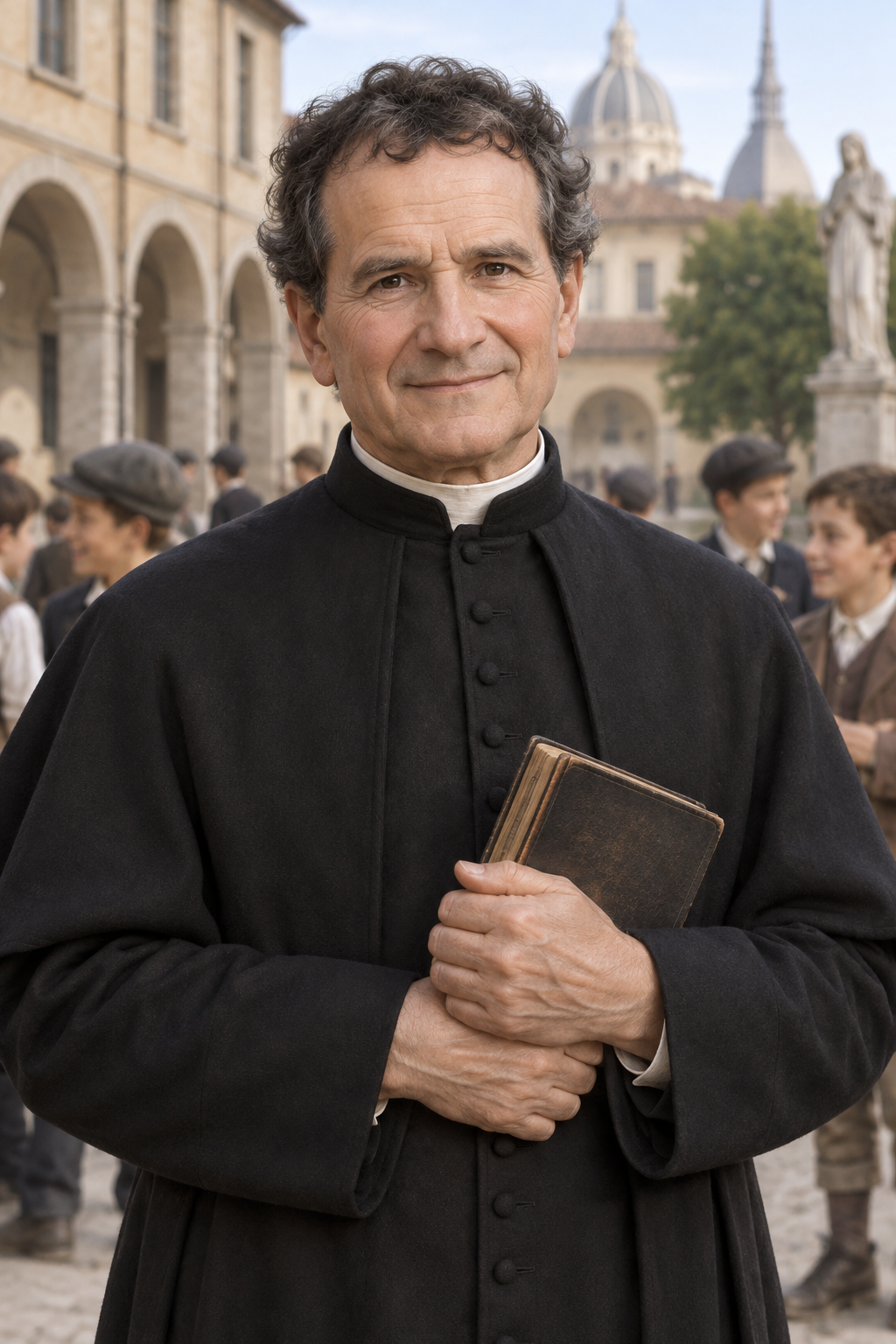
About John Bosco
John Bosco built places where young people could learn a trade, practise their faith, and find adults willing to remain alongside them. Born on 16 August 1815 at Castelnuovo d'Asti, he grew up in a poor farming family and lost his father while still a small child. His mother Margaret raised three sons amid considerable hardship. His own preparation for the priesthood included learning practical trades while earning money for his studies.
His memoirs remember schooling fitted around the demands of farm work. He attended lessons at Capriglio during the winter and worked in the fields in summer. Later, studying with a local priest, he used walks and rest breaks to continue his grammar exercises.
Ordained in 1841, Bosco continued his formation at Turin's Convitto Ecclesiastico. In his later memoirs, he credited Joseph Cafasso with guiding his decisions and taking him into the city's prisons. He recalled meeting boys whose hunger, confinement, and repeated imprisonment troubled him deeply. Some returned to prison soon after release, and he came to think that a dependable friend outside might make a difference. His work consequently extended beyond Sunday gatherings: he visited young workers in factories and workshops during the week. Saturday prison visits offered a chance to befriend boys and encourage them to come to the Oratory after their release.
The city around him was changing rapidly as people moved from the countryside in search of work. John Paul II's account places Bosco among the educators and charitable workers responding to unemployment, exploitation, and the isolation of uprooted young people. The Oratory began with religious instruction, but its activities widened as other needs became apparent. Lodging answered the need for a home, while workshops and vocational teaching helped boys prepare to earn a living. Classical schooling also offered a path toward further study and a religious vocation. Music, theatre, and outings belonged to this expanding work alongside worship and teaching.
The work acquired a settled base at Valdocco in 1846. Printing became another means of reaching readers: the Catholic Readings began in 1853. On 18 December 1859 a founding group established the Salesian Society. The women's institute associated with Bosco and Mary Domenica Mazzarello held its first religious professions in 1872. His projects also reached beyond Italy: the first Salesian missionaries departed in 1875, arriving in Argentina that December. The Salesian Bulletin followed in 1877, connecting the growing network through a regular publication.
Bosco's correspondence shows that the language of kindness did not mean an absence of sanctions. In a November 1859 letter to Baron Feliciano Ricci, he explained why he had expelled boys who left the Oratory against his orders. He described their refusal to return when summoned, followed by a late arrival after drinking. The baron had asked him to help one of those boys, Rossi. Bosco agreed to keep Rossi a few days longer while trying to find him employment. The letter records both an exclusion and an attempt to provide a next step; its account of the boys' conduct is Bosco's own.
He set out his educational principles in The Preventive System in the Education of the Young. Instead of waiting to catch faults and punish them, educators were to explain expectations and remain present as friendly guides. Reason, religion, and loving-kindness were the system's stated foundations. This required work from adults: the director was to stay available, and teachers needed to know their pupils rather than govern only through reprimands. Games, music, drama, and walks had a place in the programme. Confession, Communion, and Mass were central, but the essay instructed educators to encourage participation rather than compel it.
His Letter from Rome of May 1884 returned to the distance that could grow between teachers and pupils. Composed by his secretary Lemoyne from Bosco's dictated outline, it uses a dreamlike conversation to contrast two scenes of recreation. In one, adults share the boys' games and conversation; in the other, they stand apart. The text argues that exhausting oneself on pupils' behalf is not enough if the pupils cannot recognize the affection behind that effort. Joining their interests could open a relationship in which study, discipline, and difficult duties became easier to accept. The problem it addresses is therefore not simply disobedience, but a damaged confidence between generations.
Bosco's religious purpose remained integral to this practical work. In his bicentenary address, Pope Francis identified trust in providence, service to disadvantaged young people, and loyalty to the Church as connected features of his vocation. He presented the founder's perseverance through obstacles as inseparable from the tenderness of his approach. The educational inheritance was not confined to classrooms: Francis named oratories, youth centres, vocational institutes, schools, and colleges. He urged their continuation while directing attention back toward the young people for whom they existed.
Bosco died on 31 January 1888. Pius XI canonized him on 1 April 1934.
Wondering how to weigh the stories and sources? Learn how to read a saint biography.
Explore similar vocations
Prayers for John Bosco
John Bosco: petition for service
grant, we pray, that, aflame with the same fire of love, we may seek out souls and serve you alone.