Biography
John Eudes
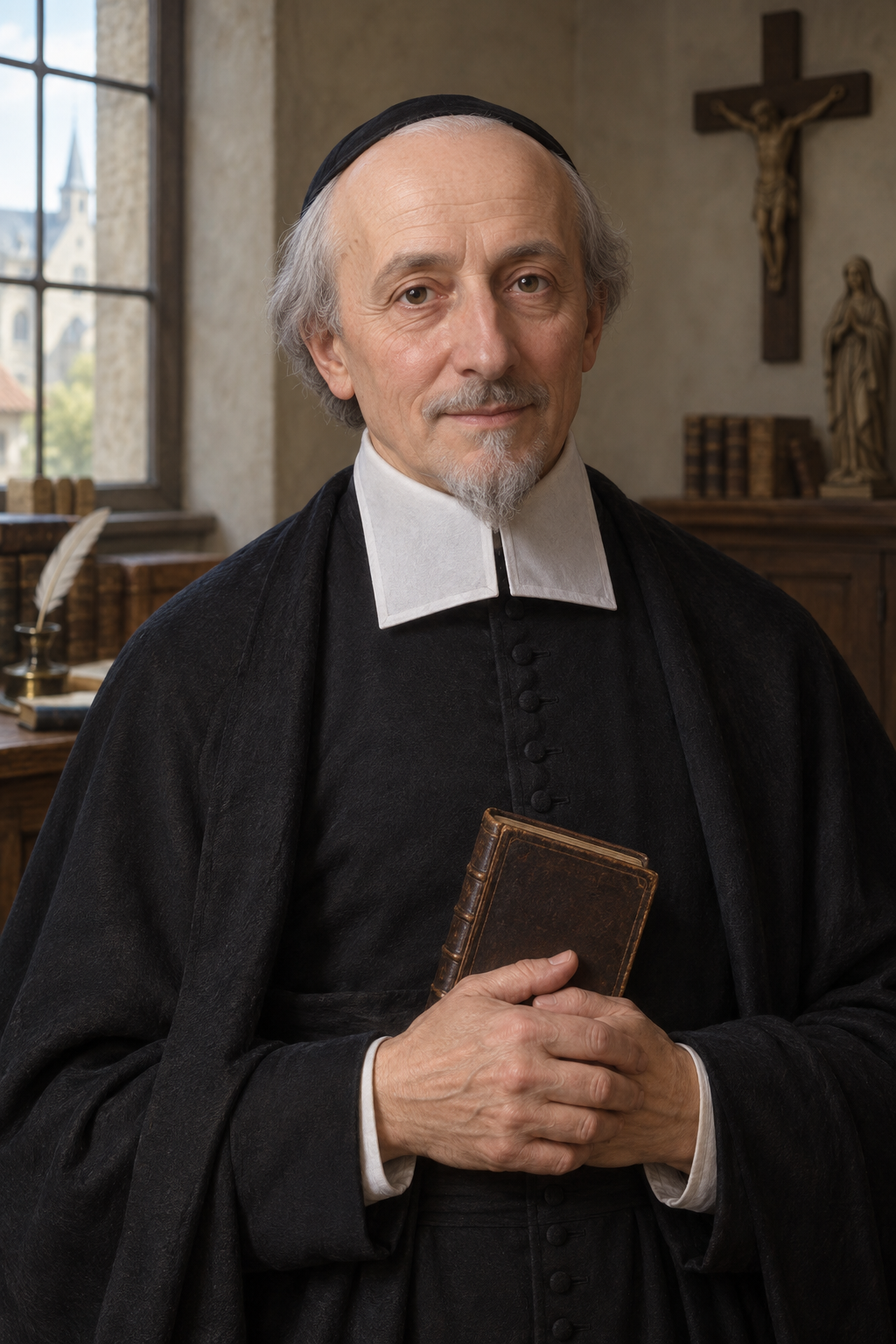
About John Eudes
John Eudes joined village preaching to care for people in distress and the preparation of priests. Born at Ri, near Argentan, on 14 November 1601, he studied with the Jesuits at Caen and later entered the French Oratory. After his ordination in 1625, enforced rest gave him time for extended religious study. His studies took him through the Oratorian houses at Marines and Aubervilliers, with Bérulle himself introducing him to their understanding of Christ and priesthood. In 1627 a letter from his father brought news of plague around Argentan and people dying without the sacraments. Eudes went to minister there before joining the Oratory at Caen.
Within the Oratory, Pierre de Bérulle and Charles de Condren helped shape his formation. He became a mission preacher whose work took him through Normandy and beyond, including Paris, Versailles, and Saint-Germain. The Catholic Encyclopedia records more than a hundred missions over his career. Normandy remained his principal field of work.
Some of the women Eudes encountered needed more than exhortations to begin again. The congregation descended from his foundation describes women seeking to leave poverty, prostitution, and exploitation. In 1641 he founded Our Lady of Charity of the Refuge to offer shelter and other possibilities. The work made provision for women a lasting institutional concern rather than only an individual encounter with a travelling preacher. He gave its sisters an additional vow committing them to the salvation of those they served. In the community's understanding, practical refuge and spiritual care belonged to the same mission.
The refuge depended on collaborators as well as its priestly founder. Marie-Françoise Le Brizaut's history names Jean de Bernières, who undertook to find a house and pay its rent, and the Camilly household, which helped with practical arrangements. Eudes sought the necessary permissions and brought in Marguerite Morin to direct the house. It opened at Caen in November 1641. The house's first Mass was celebrated on 8 December, and Carmelite sisters provided a statue of Mary and the child Jesus for its chapel. The first arrangements proved fragile. Morin wanted the future community shaped in the Ursuline tradition; relations deteriorated, and she left with companions in March 1644. Eudes and his supporters then turned to the Visitation. Three sisters arrived that August to help sustain a house still lacking resources.
His plans for priestly formation met resistance from his Oratorian superiors. The French province's biography describes a period of prayer, consultation, and waiting before he finally left the Oratory. The decision separated him from the community in which he had been formed.
Another problem lay within the clergy who would continue caring for people after a mission ended. The Council of Trent had called for diocesan seminaries in 1563, but implementation remained slow in France. Benedict XVI's account of Eudes emphasizes the consequences of inadequate intellectual and spiritual preparation for priests. Eudes's response took institutional form in a seminary at Caen, followed by foundations in other dioceses. The purpose extended beyond completing studies or learning the administration of a parish. Future priests were to acquire a spiritual life capable of sustaining their ministry to others. Training the clergy and renewing Christian communities were therefore closely connected tasks.
He left the Oratory and established the Congregation of Jesus and Mary on 25 March 1643. His writings also addressed the work of priests, including books on confession, preaching, and ecclesiastical life. The Catholic Encyclopedia also credits him with composing liturgical offices and Masses for devotion to the hearts of Jesus and Mary.
The religious conviction behind these projects is visible in his own spiritual writing. In The Life and Kingdom of Jesus, he presents Christian life as participation in the life of Jesus, not merely admiration from a distance. The relationship was to change a person's intentions and actions. Prayer and ordinary work both appear in his explanation: each could continue, in the believer's life, the activity of Jesus. He also describes the formation of Jesus within the Christian as a central work of grace. This teaching addresses baptized Christians generally, rather than reserving spiritual seriousness for priests and religious communities.
Published in 1637, The Life and Kingdom of Jesus gave enduring written form to his preaching. His later development of liturgical devotion to the hearts of Mary and Jesus brought related themes into public worship. At Autun in 1648, an office and Mass of Mary's heart were celebrated at the close of a mission. In Joseph Caillot's interpretation, this Marian emphasis remained centred on Jesus: Mary's life showed the Christian response that Eudes wanted his hearers to make. A celebration of the heart of Jesus followed in 1672. Near the end of his life, Eudes completed The Admirable Heart of the Most Holy Mother of God. The book appeared after his death, in 1681.
Eudes died at Caen on 19 August 1680.
Pius XI canonized him on 31 May 1925, together with John Vianney.
Wondering how to weigh the stories and sources? Learn how to read a saint biography.
Explore similar vocations
Prayers for John Eudes
John Eudes: Ave Cor petition
En lui, vis et règne, maintenant, toujours et à jamais.