Biography
John Jones
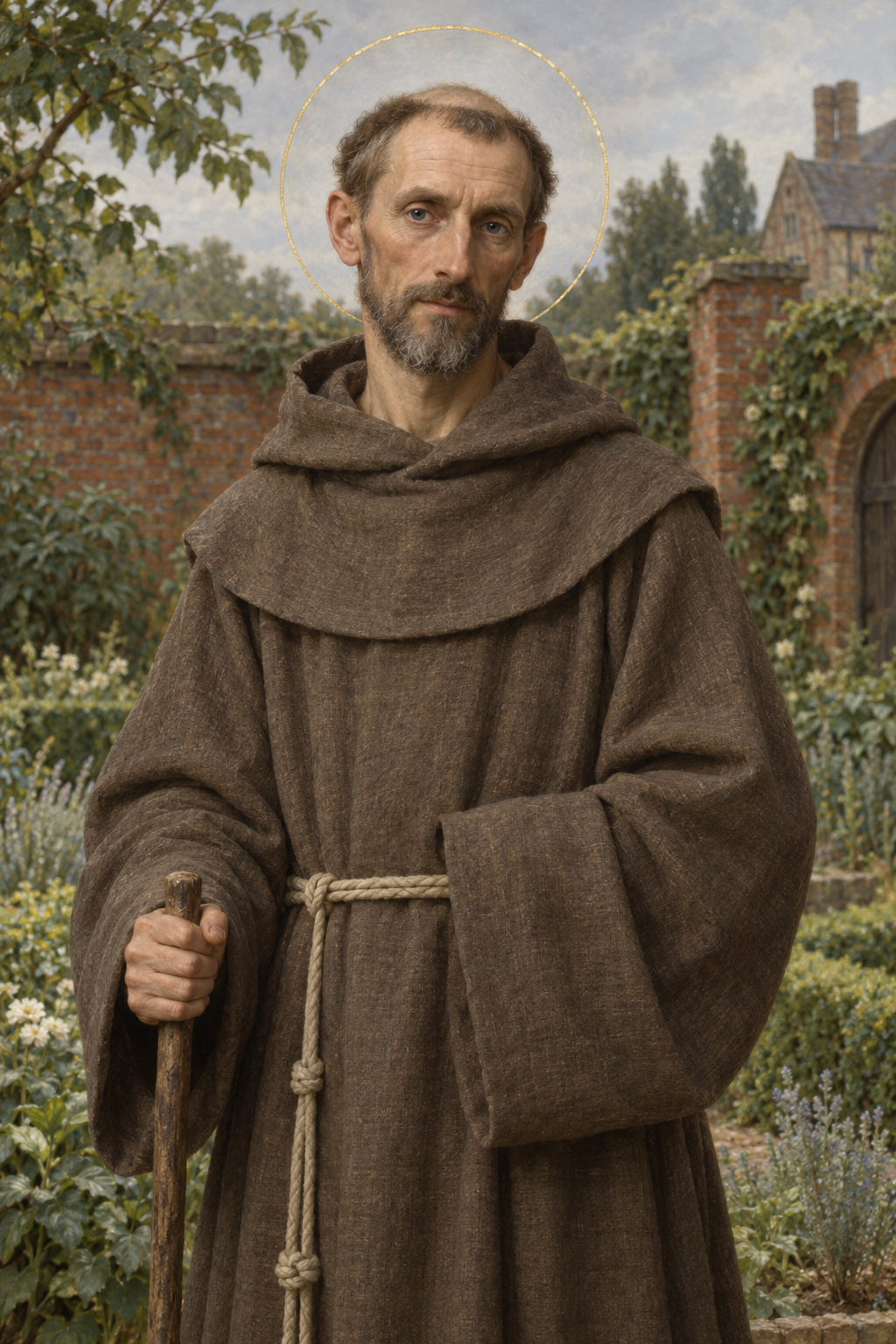
About John Jones
John Jones was a Welsh Franciscan priest who returned to England to minister to Catholics and was executed in London on July 12, 1598. He is also remembered as John Buckley or John Griffith, and his name in religion was Godfrey Maurice. His birthplace is given as Clynog Fawr in Caernarvonshire. The different names belong to one missionary, whose final years brought him from a religious community in Rome to service in England, imprisonment and a trial for returning as a priest ordained abroad.
The chronology of his early life is unsettled. The Norwegian church biography gives 1559 as his birth year, while a Franciscan University account places it around 1530. The university explicitly acknowledges disagreement about when and how he entered the Franciscans. Both accounts associate him with religious life in France and Rome before his English mission, but they do not establish one continuous early history. These differences affect his age and the length of his religious life; they cannot be resolved simply by joining every reported episode into one timeline.
The older Dictionary of National Biography presents a different early sequence. It places him among the friars at Greenwich before that community’s dissolution in 1559, followed by profession at Pontoise in France. It also rejects accounts of imprisonment in the Marshalsea in 1582–84 and at Wisbech in 1587, tracing those claims to confusion with Robert Buckley, a Benedictine monk. The shared surname had allowed another religious man’s experiences to enter Jones’s story. This criticism is significant because a priest’s assumed name could obscure the distinction between separate lives.
His association with the Roman Franciscan community is firmer. Brown’s Catholic Encyclopedia account places him at Ara Coeli and says that in 1591 he joined the Roman province of the Reformati, attracted by stricter observance of the Franciscan life. He asked permission to undertake the English mission, received his superiors’ consent and obtained a blessing from Clement VIII. Brown then places his arrival in London near the end of 1592, with an initial stay in a house that John Gerard had provided for missionary priests. From there he began work beyond that first shelter.
The mission is remembered as pastoral work carried out under assumed names among Catholics under Elizabeth I. The Franciscan University account describes his ministry in the English countryside and his arrest at Richard Topcliffe’s instigation in 1596. It also reports a specific difficulty in the accusation: he was said to have celebrated Mass for people at their home when those people were themselves imprisoned. Even within a brief narrative, the account distinguishes an allegation about a particular visit from the broader charge attached to his priesthood.
Other accounts date the arrest to 1597. Fitzherbert’s New Catholic Encyclopedia entry links the eventual prosecution to Robert Barnes and Jane Wiseman, who were accused of sheltering him. It records an indictment in February 1598 and a postponed trial later that year. Witnesses and the interests of the pursuivants formed part of these proceedings; Topcliffe was directly involved. Jones’s own charge remained that, as a priest ordained outside England, he had returned to exercise ministry there. His companions faced accusations arising from their assistance to him, rather than the same priestly status.
The sentence was death. At St.Thomas Waterings on the Old Kent Road, the execution was delayed because the hangman had not brought the rope. Fitzherbert remembers Jones praying and addressing those who waited. He denied intending treason against queen or country and presented his coming to England as the work of a priest. He was then executed by hanging, drawing and quartering. The delay has remained one of the most frequently retold parts of his death, a final occasion on which he could explain the religious purpose he claimed for his mission.
Brown adds that Catholic gentlemen removed the displayed remains from the roads to Newington and Lambeth. One of those involved was subsequently imprisoned for the act. The recovery of his remains thus became part of the story of those who continued to honor him after execution.
His memory was recorded quickly. The Dictionary of National Biography identifies a report by Henry Garnet written three days after the execution and later published in Diego Yepes’s history of the English persecution. It also preserves the tradition that a portion of his remains eventually reached Pontoise. These later records connected the missionary’s death in England with the religious community on the Continent that remembered his profession.
The Irish Franciscans remember Jones on July 12 together with John Wall, another Franciscan priest executed in England in a later generation. Their paired remembrance does not mean they died together: Wall’s death followed in 1679. Both were canonized by Paul VI in 1970 among the Forty Martyrs of England and Wales. The shared observance places Jones within his order’s memory of service and witness across different periods of religious persecution.
Wondering how to weigh the stories and sources? Learn how to read a saint biography.