Biography
John Kemble
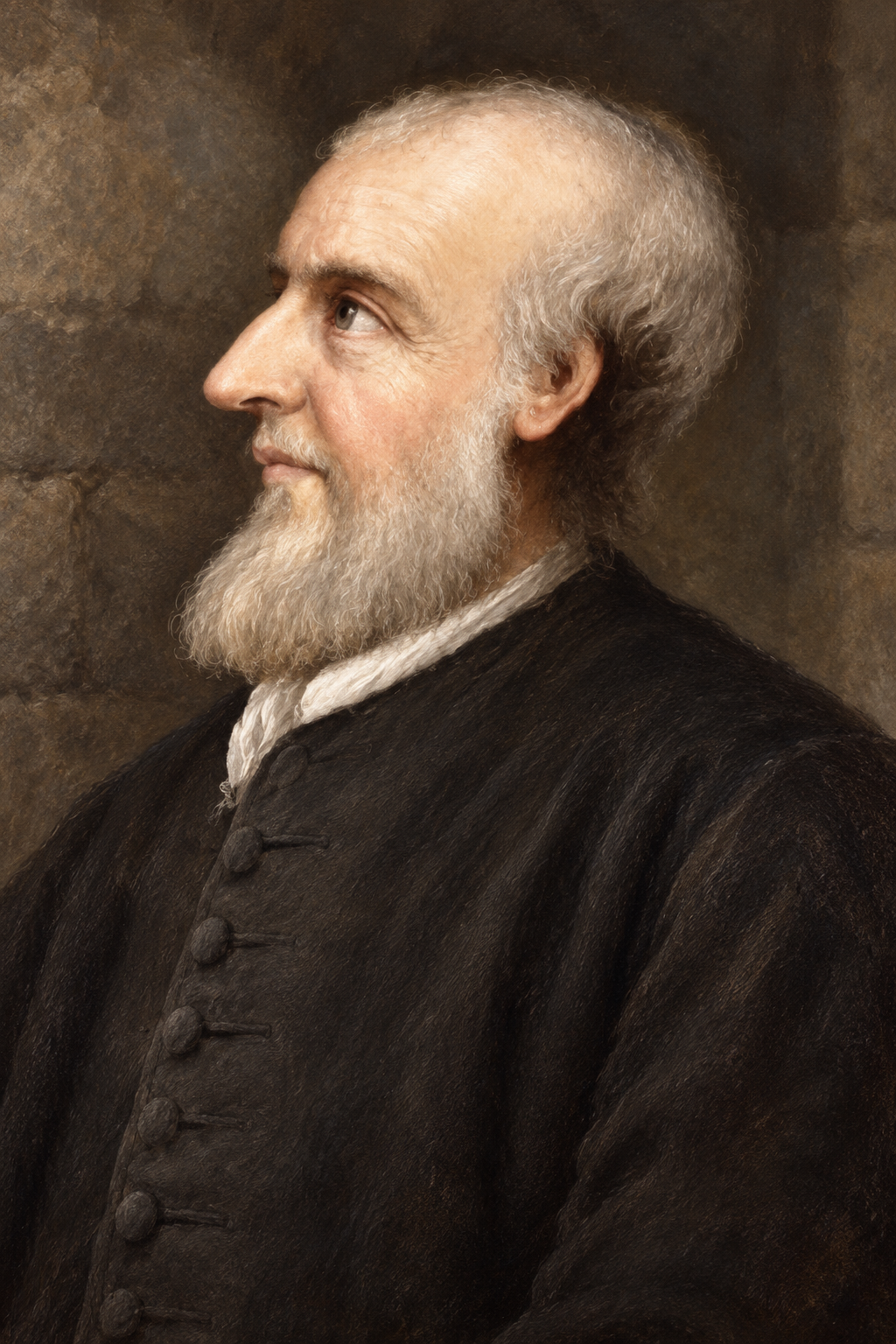
About John Kemble
John Kemble spent more than fifty years serving Catholics in the English and Welsh border country. Educated for the priesthood at the English College in Douai, he returned to a mission that depended on private houses and the help of Catholic families. His long ministry ended during the panic surrounding Titus Oates’s fictitious Popish Plot, when an elderly priest who had survived decades of religious conflict was arrested and condemned.
He was born at Rhyd y Car Farm in St Weonards, Herefordshire. Reference works place his birth in 1599 or 1600, and disagree about some of his family relationships. Those uncertainties do not alter the main outline of his priestly life. He was ordained at Douai on February 23, 1625, and sent back to his native region that June. He also used the name John Holland.
Pembridge Castle became an important base for his work. Its history helps explain the setting without making the castle his home throughout his entire mission. Herefordshire Council’s account describes a royalist stronghold captured during the Civil War, later sold to George Kemble. It records an oratory associated with John’s ministry. The building’s changing fortunes belong to the political upheavals through which local Catholics continued their religious life.
A surviving object gives a more tangible glimpse of that ministry. The Catholic heritage survey Taking Stock identifies an oak table at St Mary’s in Monmouth as an altar at which Kemble celebrated Mass at Pembridge. Formed from two superimposed benches, it could be dismantled quickly in danger. Its present arrangement includes later additions: the nineteenth-century priest Thomas Abbot joined the older table to other woodwork. The whole display should therefore not be mistaken for an unchanged altar from Kemble’s lifetime.
In November 1678 Captain John Scudamore arrested him at Pembridge, and he was confined in Hereford gaol. The Catholic Encyclopedia records his condemnation under the Elizabethan law against seminary priests in March 1679. He was then taken to London and held in Newgate, where Oates and other informers questioned him. His sentence arose from his status as a priest, rather than proof that he had taken part in the alleged conspiracy.
The journey to London was painful. According to the New Catholic Encyclopedia, he suffered from an ailment that made riding difficult, yet was strapped to a horse for the journey. Neither Oates nor his associate Bedloe could produce a charge connecting him to their plot. He was returned to Hereford, where he waited for execution.
Accounts of his final morning remember a strikingly ordinary farewell: time for prayer, a pipe and a drink with the undersheriff. The Catholic Encyclopedia connects this story with the local expressions “Kemble pipe” and “Kemble cup” for a parting smoke or drink. Such remembered details belong to the tradition surrounding his death; they are not a surviving transcript of his last conversation. He was executed at Widemarsh Common, Hereford, on August 22, 1679.
His grave remains at St Mary’s in Welsh Newton, whose parish description identifies it as the resting place of the Catholic martyr.
Devotion also continues through pilgrimage. A Belmont parish notice in August 2026 invited pilgrims to Mass in Monmouth, a walk to Welsh Newton and prayer at the grave. The notice documents the invitation and planned observance, rather than proving who attended.
Paul VI canonized Kemble with the Forty Martyrs of England and Wales on October 25, 1970. His individual commemoration is associated with August 22, while October 25 recalls the group’s canonization. His remembered witness is that of a priest whose decades of service preceded the final trial for which he is best known.
Wondering how to weigh the stories and sources? Learn how to read a saint biography.