Biography
John of Capistrano
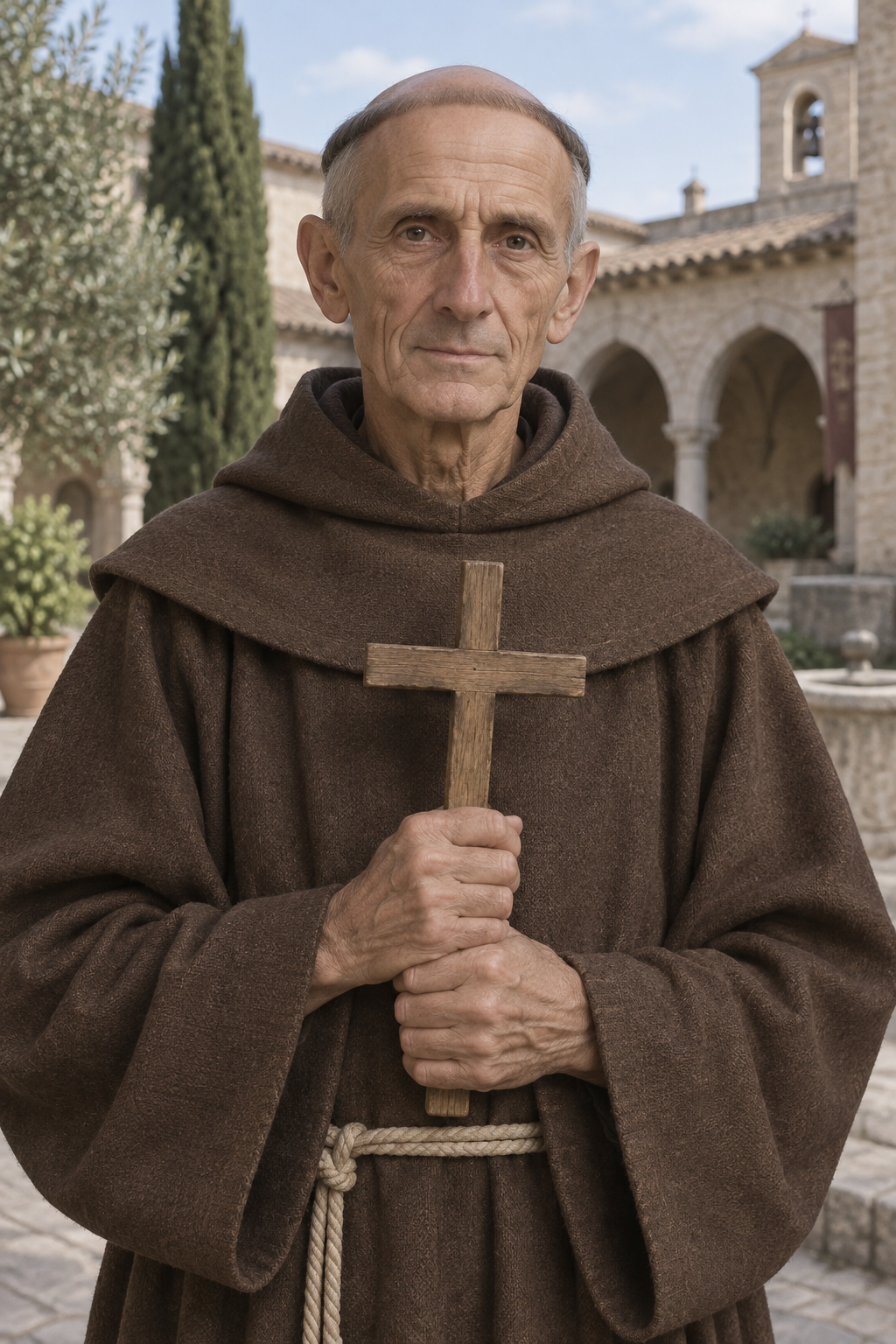
About John of Capistrano
John was born at Capestrano, near L'Aquila in the Kingdom of Naples, on June 24, 1386. His father, Antonio, came from beyond the Alps in the service of Louis I of Anjou; John's own later recollection connected him with the Angevin court. His father and other relatives were killed during a local feud while John was a child. Around 1405 or 1406, John went to Perugia to study civil law. University records place him at the city's Sapienza college and identify Pietro di Angelo degli Ubaldi among his teachers. He completed a licentiate rather than a doctorate. In 1413 he served as a civil judge for Perugia's Santa Susanna quarter, an office tied to the city's Angevin government.
Political change overturned that career. After hostile forces took Perugia in 1416, John was imprisoned at Torgiano because of his association with the former regime. Early Franciscan biographies say that two visions of Francis of Assisi during this captivity called him to change his life. The imprisonment and the change of vocation are historical; the visions are a received hagiographic account rather than independently documented experiences. After a ransom secured his release, John returned to Perugia and entered the Observant Franciscan community at Monteripido. He also ended a marriage that the early sources describe as unconsummated. He became a cleric in 1417, began preaching probably that year, and was ordained a priest sometime after November 14, 1418.
John brought a lawyer's habits into religious life. He wrote on conscience, church government, and legal procedure, preached across Italian cities, and accepted commissions from successive popes. He also became a leading organizer of the Franciscan Observance, the reform movement that sought stricter communal practice within the order. In 1443 he was named vicar general of the Cismontane Observants and drafted constitutions for their communities. His work helped secure greater autonomy for the Observants in 1446, decades before their final separation from the Conventual branch. He also gathered evidence and support for the canonization of his mentor, Bernardine of Siena.
The same career joined pastoral reform to coercive religious policy. John held papal inquisitorial authority against groups condemned as heretical, including the Fraticelli, and later opposed Hussites in Central Europe. Sedda's study of John's correspondence shows that he sought authority to enforce restrictions on Jewish communities as well. In 1447 Pope Nicholas V appointed him executor of a program that restricted Jewish residence, work, worship, and contact with Christians. Those measures belonged to medieval canon law and papal policy, but John was not merely a passive representative of his age: he repeatedly advocated and implemented them.
The consequences became especially grave at Breslau in 1453. According to the early biography used by Angiolini, John ordered torture during an investigation of Jewish residents accused of host desecration and ritual murder. The proceeding ended with seventeen Jewish people condemned to death, confiscation of property, and the expulsion of the region's Jewish population. Modern scholarship treats John as an active participant in a sustained effort to limit Jewish religious, cultural, and economic autonomy. A historically responsible biography must name this harm alongside his reforming energy and popular influence.
In 1451 John crossed the Alps with a small Franciscan company. He preached in Vienna and then traveled through Moravia, Germany, Silesia, and Poland, normally working through interpreters. His surviving correspondence and sermon reports show a vast network of papal, civic, princely, and Franciscan relationships. Crowds heard calls to penance and peace, but also attacks on Jews, Hussites, and other religious opponents. Recent study of his 1455–56 letters finds similarly exclusionary language toward Orthodox Christians and efforts to compel religious conformity in southern Hungary and Transylvania. His mission therefore reveals both the reach of Observant preaching and its capacity to sharpen boundaries and legitimate coercion.
After the Ottoman conquest of Constantinople in 1453, crusade preaching became a major part of John's work. He attended imperial diets in Frankfurt and Wiener Neustadt, entered Hungary in 1455, and worked with the commander John Hunyadi. From February 1456 he concentrated on recruiting and organizing crusaders for the defense of Belgrade. John's contingent joined Hunyadi's forces as Mehmed II's army besieged the fortress in July. Contemporary and near-contemporary evidence supports John's presence, his preaching among the troops, and his participation in the defense; later devotional retellings often magnify his command into a single-handed victory. The Ottoman siege was broken in July 1456 through the combined action of defenders, crusaders, and Hunyadi's forces.
Illness spread after the battle. John withdrew to the Franciscan convent at Ilok, where he died on October 23, 1456, attended by fellow friars including Jerome of Udine and John of Tagliacozzo. Devotion around his grave developed quickly, while the formal canonization cause moved much more slowly. Alexander VIII proclaimed him a saint on October 16, 1690, and a canonization bull followed under Benedict XIII in 1724. The Roman Catholic calendar now keeps his optional memorial on October 23 and identifies him as a priest. His life remains significant not as a simple tale of victory, but as a well-documented example of how learning, religious conviction, institutional reform, mass persuasion, and coercive power could be joined in late-medieval Europe.
Wondering how to weigh the stories and sources? Learn how to read a saint biography.
Explore similar vocations
Prayers for John of Capistrano
John of Capistrano: novena collect excerpt
O God who raised up Saint John of Capistrano