Biography
John Plessington
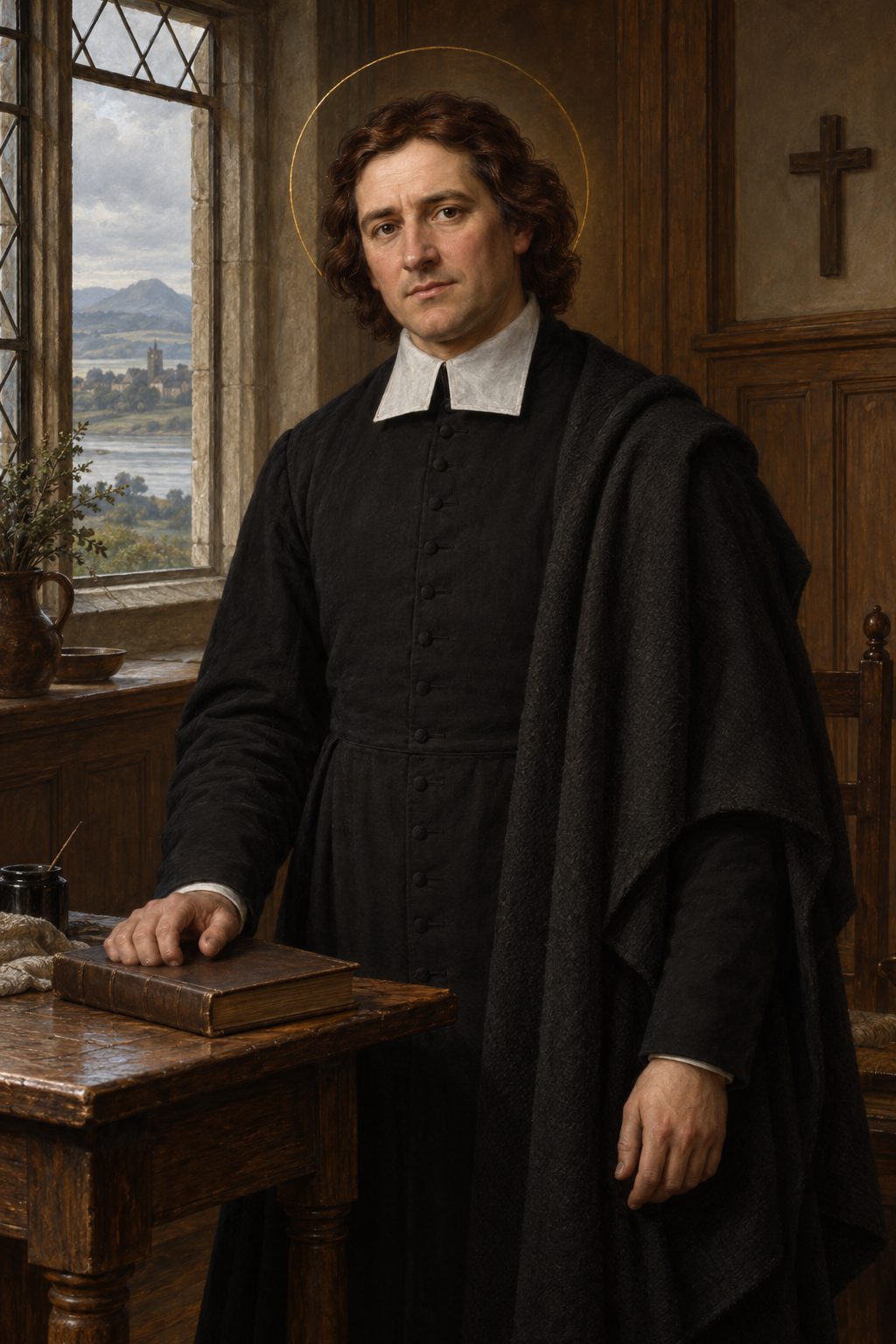
About John Plessington
John Plessington was born about 1637 at Dimples Hall in Lancashire into a Catholic and royalist household. His family maintained a chaplain, Thomas Whitaker, who was later executed. Fitzherbert’s New Catholic Encyclopedia account considers it probable that Whitaker taught the young John before his death. Plessington later attended a Jesuit school at Scarisbrick Hall and continued his education at Saint-Omer. These stages took him from the protected religious life of a family home toward the training of a priest who would return to serve Catholics in England.
The next part of his preparation led to the English seminary at Valladolid in Spain. Samuel Burke’s account places his arrival there in November 1660 under the name Scarisbrick. He was ordained at Segovia on March 25, 1662, but illness interrupted his further studies. He returned to England while his theological course was still incomplete. The interruption did not end his ministry: the same account places him subsequently at Holywell in North Wales, where the shrine of Saint Winefride remained a center of Catholic religious life.
His service at Holywell connected him with Catholics in Flintshire and nearby districts. By 1670 he was at Puddington Hall on the Wirral, the home of the Massey family. His public role there was tutor to the children, while he also served the family and neighboring Catholics as a priest. The Norwegian church biography preserves both aspects of that life. Teaching within a household gave him a settled responsibility, while his priestly work extended beyond the household to a wider community.
The upheaval surrounding the alleged Popish Plot brought that work to an end. Burke records a raid on Puddington on December 28, 1678, when Thomas Dutton found and arrested him. The subsequent trial rested on evidence that he was a priest. Plessington challenged the testimony, and Burke describes a disputed prosecution in which the sufficiency of the witnesses became a central issue. A reprieve following the verdict did not save him. He remained under sentence in Chester Castle before the execution was carried out.
His own printed final speech gives a direct account of the position he wished to defend. He said that priesthood was compatible with the law of God, monarchy and civil government, and denied that the charges established any participation in a murderous conspiracy. He rejected the claim that Catholics were bound to believe the pope could authorize the killing of rulers. The distinction mattered to him: he acknowledged his priesthood while refusing the implication that it made him an enemy of king or country.
The speech also turns from defense to repentance and forgiveness. Plessington professed his faith, expressed sorrow for sins against God and entrusted himself to Christ’s mercy. He forgave those responsible for his death and prayed for the king, the royal family and peace among the people. These statements preserve his chosen final emphasis, joining firm religious conviction to a refusal of personal revenge. He also challenged the claim that he had celebrated Mass for one of the witnesses, saying that they had scarcely known one another. He distinguished his acknowledgment of priesthood from acceptance of every statement made against him.
He was executed at Chester on July 19, 1679, after nine weeks under sentence. His remains were sent back to Puddington with an order that they be displayed on the house. The Masseys instead arranged burial in the churchyard at Burton. Later attempts to locate his remains did not settle their identification: Fitzherbert records that the traditional grave was opened in 1962 without finding remains certainly identifiable as his. The recorded burial and the later uncertainty about relics are therefore separate parts of his story.
His remembrance also took visual form. Claire FitzGerald’s study of Margaret Rope’s stained glass examines the martyrs’ window at the Church of the Holy Name in Birkenhead. Plessington appears holding a chalice beneath Christ, and a smaller scene shows him giving Communion to kneeling Catholics in a private house while a man keeps watch at the door. Other details recall Holywell, Chester and Burton. The images interpret the recorded ministry and death for a later worshipping community; they are memorial art, rather than contemporary pictures of his appearance. FitzGerald situates the image among figures chosen for their links to the area that became the Shrewsbury diocese. Names, heraldry and small narrative panels make each martyr identifiable. The design connects public commemoration with places and actions from Plessington’s life, particularly the celebration of the Eucharist.
Pius XI beatified Plessington in 1929, and Paul VI canonized him on October 25, 1970, among the Forty Martyrs of England and Wales. The Catholic college bearing his name on the Wirral explicitly honors him as its patron saint and marks July 19 as his feast. That local remembrance continues the association of his name with education, faith and service.
Wondering how to weigh the stories and sources? Learn how to read a saint biography.