Biography
John Stone
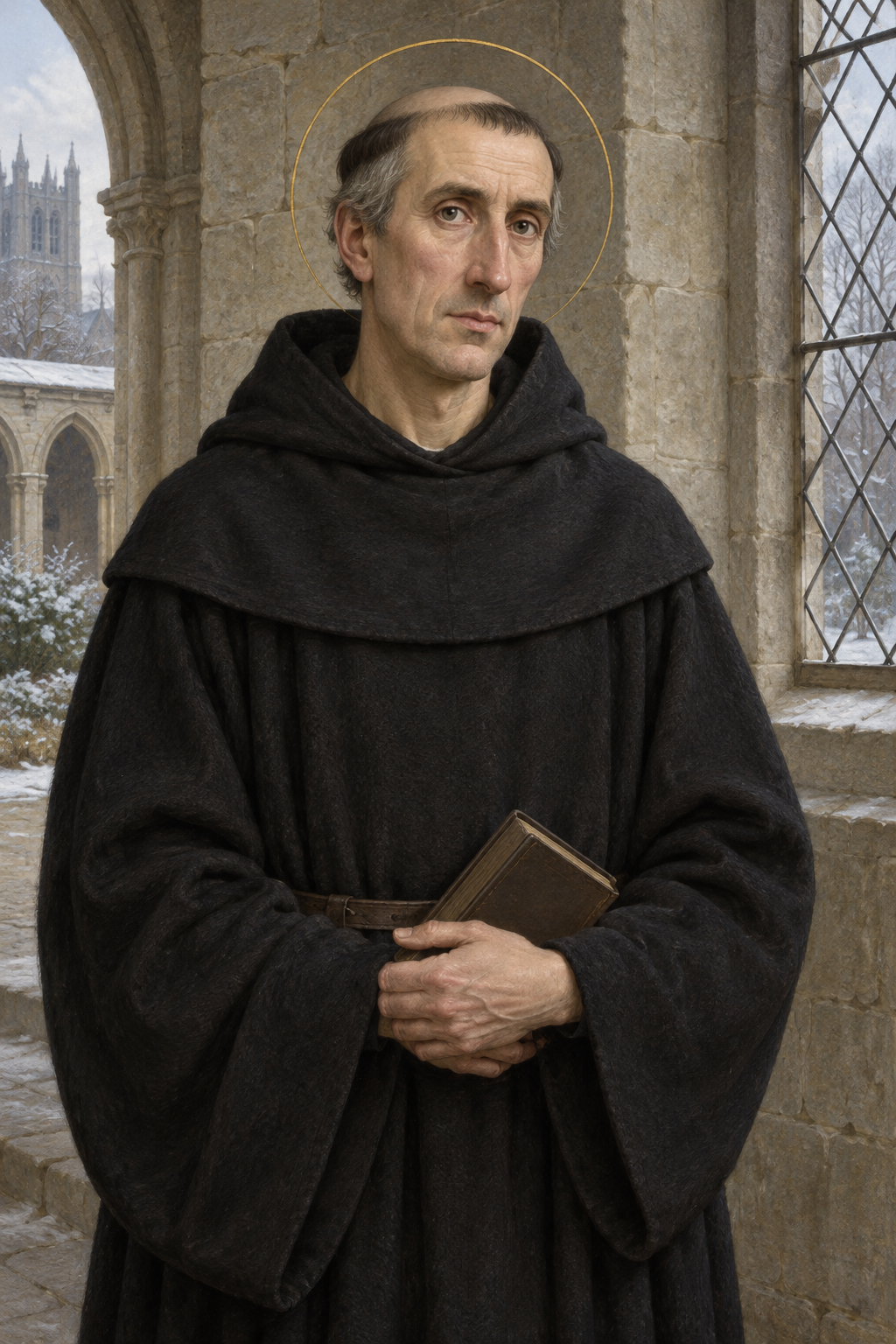
About John Stone
John Stone was an Augustinian friar and priest at Canterbury when the royal government closed his community in 1538. Little is known of his earlier life. The Catholic Church in Norway identifies him as a doctor of theology, but the record of his childhood and the course of his religious training remain unknown. His surviving story centers on his refusal to acknowledge Henry VIII as head of the Church in England, followed by imprisonment, trial and execution.
The Augustinian order’s account places the decisive confrontation on December 14, 1538. Richard Ingworth arrived at Austin Friars after closing the Franciscan and Dominican houses in Canterbury. The friars were required to acknowledge the king’s ecclesiastical supremacy. Stone refused and challenged the king’s assumption of authority over the Church. He was taken to London and brought before Thomas Cromwell, but would not withdraw his position. The order remembers the following period as a year of detention before his return to Canterbury.
Research into Canterbury’s civic records gives further detail. James Henry Stuart Palmer records two examinations by Ingworth, involving local officials, before Stone was sent to Cromwell. Back in Canterbury, the case proceeded in the guildhall. A judicial commission was issued to the mayor on October 27, 1539, and Stone was found guilty of treason on December 6. His refusal had become a public legal confrontation as well as a religious one. Palmer places the execution within the city government’s assertion of royal authority: the magistrates made a conspicuous example of a resident who had opposed the king.
The gallows stood on the Dane John mound, rather than the city’s customary execution ground. Stone was taken through Canterbury and executed by hanging, drawing and quartering. The surviving civic account records materials used for the execution, and his remains were displayed at the gates. These details show the public character of his death without preserving a fuller account of his earlier ministry.
The exact day is less certain than the year and place. The Norwegian notice gives December 27, 1539; the Augustinian order calls that date probable. The order also transmits a prison tradition in which prayer and fasting brought him encouragement before death. That religious memory belongs to the account of his final endurance, rather than to independently documented details of his early life.
Stone was beatified by Leo XIII in 1886 and canonized by Paul VI with the other thirty-nine martyrs of England and Wales on October 25, 1970. The Augustinians commemorate him on October 25. His province in England and Scotland names him its patron, preserving the memory of a friar whose recorded witness emerged chiefly in the final year of his life.
Wondering how to weigh the stories and sources? Learn how to read a saint biography.