Biography
John Wall
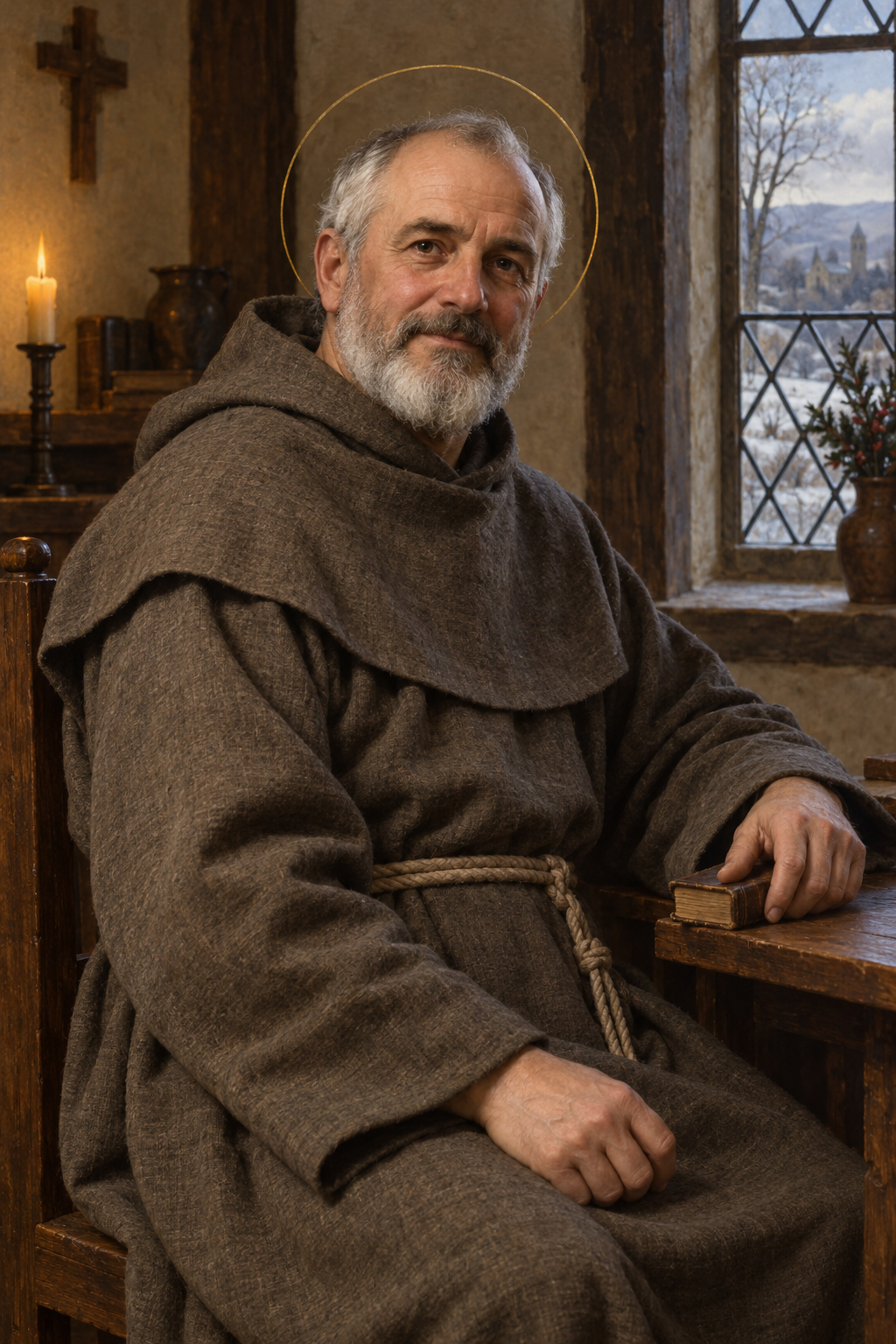
About John Wall
John Wall was born in Lancashire in 1620 into a Catholic family. His father, William, belonged to the community of recusants who declined Anglican worship. The young John studied at the English College at Douai during the 1630s and early 1640s, then continued his preparation for priesthood in Rome. He was ordained in 1645 and returned to England in 1648. His later vocation as a Franciscan grew from a priesthood already begun, rather than replacing an entirely separate career.
Fitzherbert’s New Catholic Encyclopedia account connects that change with a visit to Saint Bonaventure’s friary at Douai. Travelling toward England, Wall asked to join the Friars Minor. After a period on the English mission he returned to the friary, where he entered the novitiate on January 1, 1651. He took the name Joachim of Saint Anne. His brother William followed a different religious path, eventually becoming the Benedictine Dom Cuthbert. Their distinct choices placed both brothers within religious communities on the Continent.
Wall made his Franciscan profession a year after receiving the habit. Whitfield’s older Catholic Encyclopedia biography records that he served as vicar and novice master at Douai before returning to England in 1656. His work there extended over more than twenty years, particularly in Worcestershire. Different names accompanied these changes of place and circumstance: John Marsh during his education, Joachim in religion, and Francis Johnson, Webb or Dormore during the mission. These names recur in accounts of the same priest and help identify him in the records.
Harvington Hall is closely associated with his memory, although the details of that connection require care. The historian Michael Hodgetts examined the tradition that it had been his home for twelve years. His published notes show how small errors could change the story: one transcription omitted the word “not” from Wall’s statement that he had not intended to remain at the Worcestershire house where he was arrested. Another altered a question about his calling into a question about his college. The notes also reject a later imagined meeting as historical evidence.
Wall’s own prison narrative gives a direct account of his arrest. He says officers arrived at a friend’s house looking for a debtor and initially seized him by mistake. Once another man recognized him, they took him before the justices. He refused the required oaths on grounds of conscience, while declaring his loyalty to the king. In his explanation, obedience to civil commands and refusal to swear against his faith were compatible obligations. He wanted the reason for his refusal to be publicly understood. Before reading the oaths aloud, he asked that this should not be mistaken for taking them; he wanted a public explanation of his refusal.
The same narrative preserves his effort to defend himself in court. He asked the judge to allow an answer to each accusation and to assist him where he did not understand the law. He argued that his life, though that of a private man, mattered to him as much as a ruler’s life mattered to that ruler. The appeal joined a defense of his legal position to a claim for the equal worth of the life at stake.
Imprisonment also brought contact with other people in danger. Fitzherbert records that Wall received fellow prisoners into the Church at Worcester before he was taken to London for questioning about the alleged Oates plot. Examination did not establish his involvement in that conspiracy. He was nevertheless confined in Newgate and returned to Worcester to face death for his priesthood. His brother Cuthbert was also imprisoned in Newgate, but was not permitted to visit him. The restriction kept the brothers apart during their imprisonment.
Wall was executed at Worcester on August 22, 1679. Whitfield records that a fellow priest, Levison, was able to hear his confession and give him Communion before death, then offer absolution at the execution. His friends obtained his remains. His head was taken to the Franciscan community at Douai, where it was preserved until the disruption of the French Revolution. The history of those remains forms part of the later remembrance of his death, rather than evidence that every reported relic can now be identified.
At Harvington, remembrance of Wall continues within a wider account of Catholic recusant life. The hall, owned by the Archdiocese of Birmingham, names him and Nicholas Owen among the saints directly linked with its history. It describes itself as a place of pilgrimage, where an annual Mass commemorates the Martyrs of England and Wales. The house’s present work combines that religious memory with education about the people who sheltered priests and the pressures under which they lived.
Paul VI canonized Wall in 1970 among the Forty Martyrs of England and Wales. The Irish Franciscans remember him on July 12 with John Jones, whose death came in 1598. Their common observance joins two separate lives of Franciscan ministry and witness.
Wondering how to weigh the stories and sources? Learn how to read a saint biography.