Biography
José Gabriel Brochero
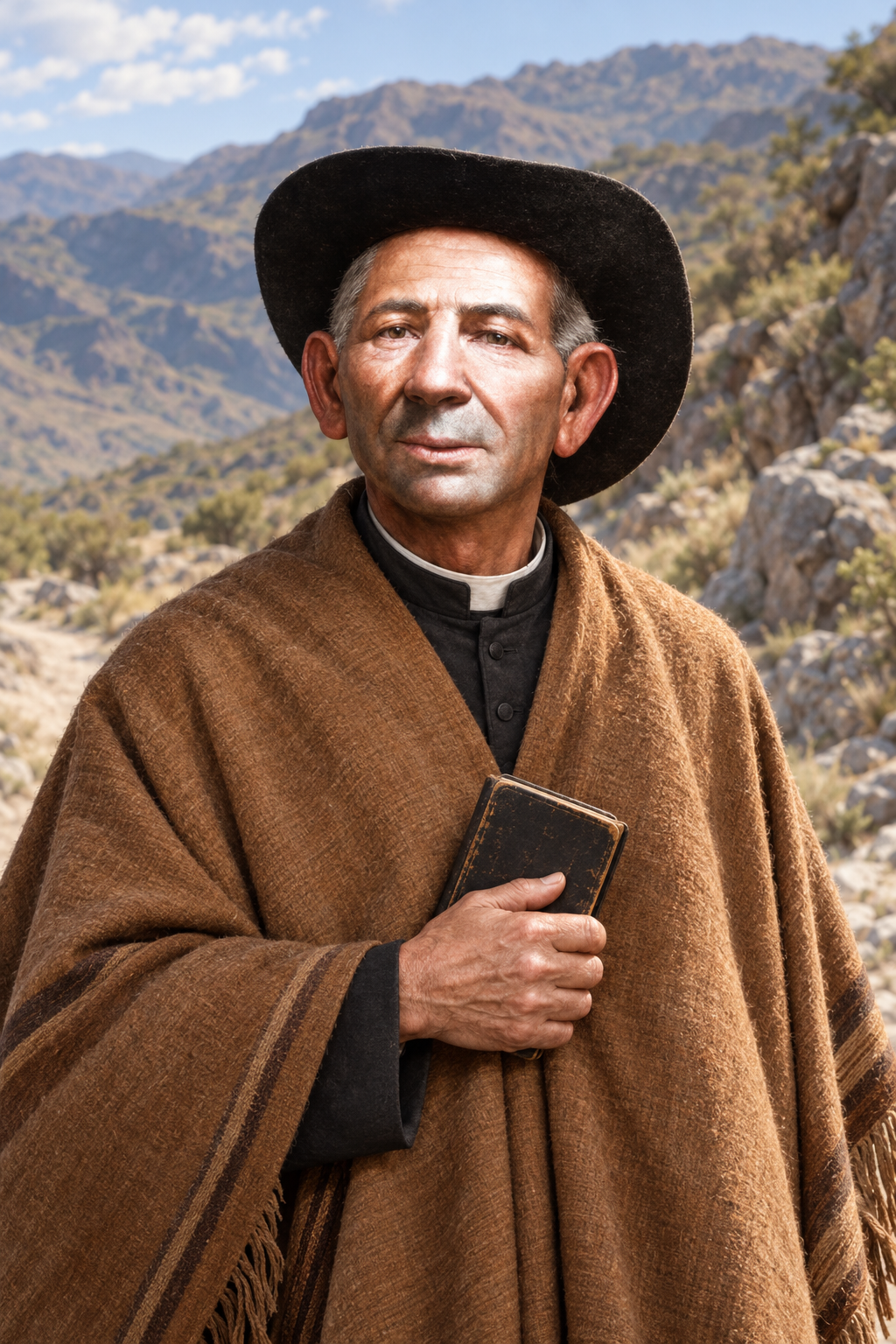
About José Gabriel Brochero
José Gabriel del Rosario Brochero served scattered communities in the mountains of Córdoba, Argentina. Known as the Cura Gaucho, he became closely identified with the people of Traslasierra. The Argentine bishops remember a priest whose ministry joined care for the sick with the ordinary work of a parish. His name remains attached to the town once called Villa del Tránsito.
He was born on March 16, 1840, at Carreta Quemada, near Santa Rosa de Río Primero. The fourth of ten children, he grew up in a farming family. He entered the seminary of Our Lady of Loreto in 1856 and was ordained a priest on November 4, 1866. His early assignments included work at Córdoba’s cathedral and service as prefect of studies at the seminary.
His preparation included university study as well as seminary responsibilities. The municipal chronology records a philosophy qualification from the University of Córdoba in November 1869, shortly before he left for San Alberto. It also identifies Martín Yañiz as a companion at his priestly ordination.
During the cholera epidemic of 1867, Brochero cared for people who were sick and dying in Córdoba. In 1869 he began his ministry in Traslasierra. Distance and difficult travel shaped the work: families were spread across a mountain region, and reaching them required sustained effort. The bishops’ account places his service to the sick near the beginning of the ministry for which he would later be remembered.
Brochero made retreats an important part of parish life. He led groups across the mountains to Córdoba for the Spiritual Exercises, then worked with local people to build a retreat house nearer their homes. Construction began in 1875 and the house opened in 1877. The municipal history describes contributions from neighbors and supporters in other provinces. The Sisters of the Sacred Heart were entrusted with its care.
Education belonged to the same effort. A school for girls opened in 1880 alongside the retreat house, staffed by the sisters. It began with limited space and expanded as further rooms were built. The surviving complex also recalls the practical difficulties of parish life: after a storm damaged the church in 1896, the school chapel served the parish while a replacement church was developed. Brochero helped with that work, though the larger building took decades to complete.
His practical projects extended beyond church buildings. The dicastery describes road construction undertaken with local residents and petitions that secured postal and telegraph facilities. He also sought a railway connection between Villa Dolores and Soto. The account identifies the railway as a project, rather than a completed achievement. These efforts addressed the isolation that affected travel, communication and the economic life of the valley.
Francis’s letter also recalls the ordinary setting of parish visits: conversation over mate, a Marian image, a prayer book and supplies for celebrating Mass. He links Brochero’s retreats with efforts to reconcile neighbors and strengthen family responsibilities. The pope’s account is a later pastoral remembrance, yet its attention to household encounters helps explain why the priest’s work is remembered through lasting personal relationships as well as buildings.
The municipality’s chronology records a change in 1898, when Brochero accepted a position as a canon at Córdoba’s cathedral and handed over the parish. He returned to the parish in 1902. By 1908 illness forced him to resign, and he went to live in Santa Rosa. In 1912 he returned to Villa del Tránsito. These moves complicate the familiar image of an unbroken lifetime on the mountain roads: his ministry also included transitions, declining health and dependence on others.
His own words make that dependence especially clear. In a letter of October 28, 1913, to his fellow priest and friend Bishop Martín Yañiz, Brochero described being nearly blind and losing sensation in his limbs. He needed help dressing, and kneeling and rising for Mass had become difficult. He had once expected to remain vigorous until death. Now he understood prayer for others as work still entrusted to him. The letter combines an unvarnished account of disability with gratitude and affection for his old companion.
Brochero had leprosy and died at Villa del Tránsito on January 26, 1914. The dicastery’s biography describes how his former parishioners had encouraged his return there. Later devotion gathered around his tomb. Pope Francis canonized him on October 16, 2016, in Saint Peter’s Square, together with six other saints.
At his beatification in 2013, Francis highlighted the closeness between Brochero and the people he served. The pope pictured his visits to homes, his familiar speech and his willingness to reach people far from church life. He presented Brochero’s prayer and missionary work as parts of one vocation. The Argentine bishops honor him as patron of the country’s priests. Villa Cura Brochero also named him its patron in 2014. His feast in Argentina is March 16.
Wondering how to weigh the stories and sources? Learn how to read a saint biography.