Biography
Josep Manyanet y Vives
About Josep Manyanet y Vives
Josep Manyanet y Vives was born on January 7, 1833, at Tremp in Lleida, Spain, within a large Christian family. The Dicastery for the Causes of Saints says he was baptized the same day and, at age five, was offered by his mother to Our Lady of Valldeflors, patroness of the city.
His education required work from an early age. To complete secondary studies at Barbastro and then philosophy and theology in the diocesan seminaries of Lleida and Urgell, Josep had to find employment while still a boy. This detail should anchor the profile in discipline and perseverance rather than privilege.
Josep was ordained priest on April 9, 1859. For twelve years he worked intensely in the Diocese of Urgell in service of the bishop, serving as household familiar, palace steward, seminary librarian, vice-secretary of the chancery, and secretary for pastoral visitation.
After those diocesan years, he felt called to religious life and to found two congregations. With episcopal approval, in 1864 he founded the Sons of the Holy Family, Jesus, Mary, and Joseph. In 1874 he founded the Missionary Daughters of the Holy Family of Nazareth.
The Dicastery profile says the mission of these congregations was to imitate, honor, and spread devotion to the Holy Family of Nazareth and to foster the Christian formation of families. Their ordinary instruments were Catholic education and instruction for children and young people, together with priestly ministry.
For nearly forty years Josep guided and expanded the two institutes. The source names colleges, vocational schools, seminaries, and other apostolic centers in various parts of Spain. Current international statistics are omitted here because the living institutes need a fresh source if those are used later.
His spirituality was not only institutional. He wrote works and pamphlets to present the example of the Holy Family, spread devotion to it, and encourage its imitation. The source identifies this family and Nazareth theme as the center of his message.
He also founded the magazine La Sagrada Familia. The Dicastery profile says he was inspired to propose an expiatory temple in Barcelona in honor of the Holy Family, a spiritual and universal home for families. From that inspiration came the Sagrada Familia temple, associated with Antoni Gaudi.
John Paul II's canonization homily calls Josep a true apostle of the family and says he took inspiration from the school of Nazareth for his personal holiness and apostolic mission. The same homily points to the Barcelona Sagrada Familia as a visible symbol of his apostolic desire.
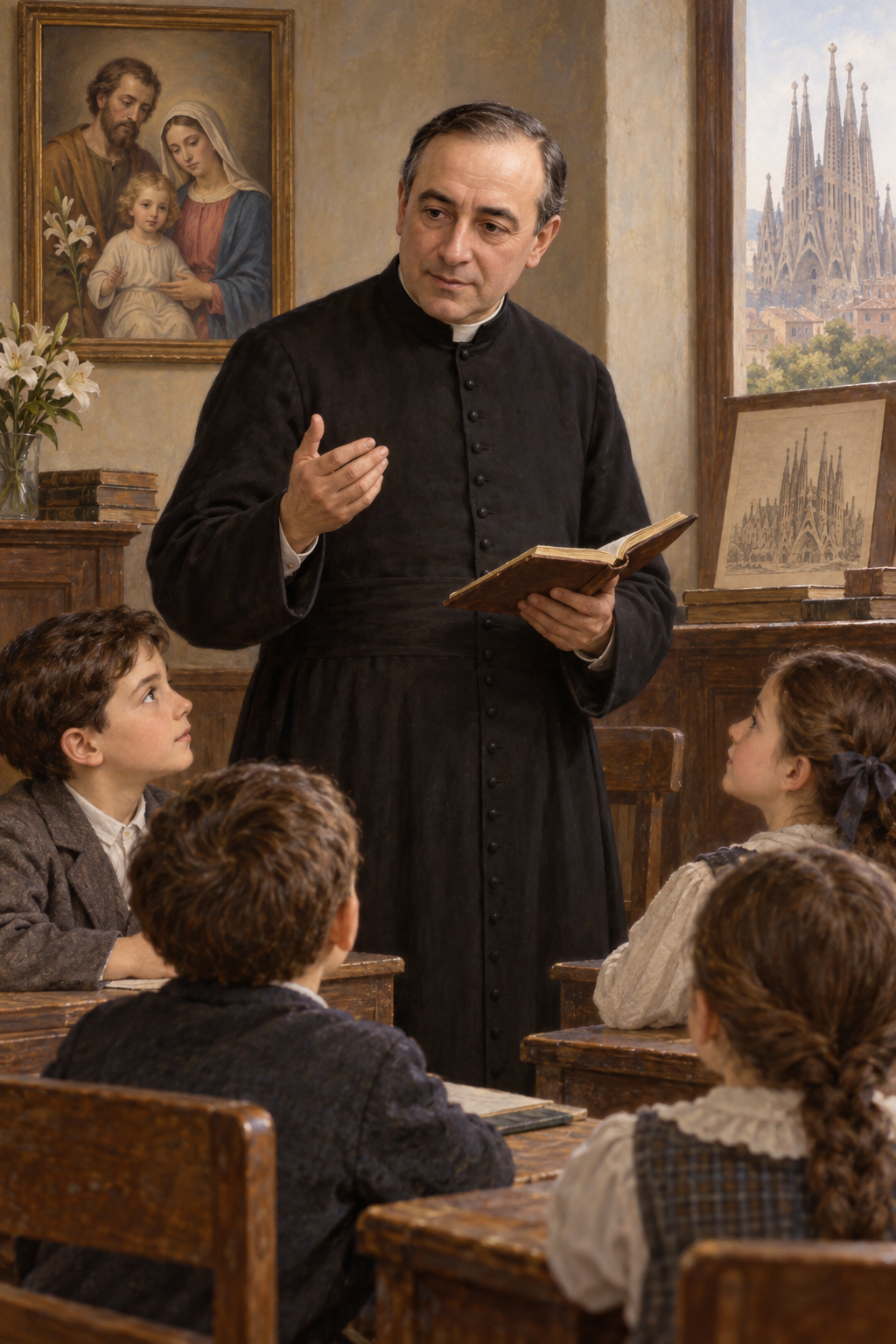
The page should state the Sagrada Familia connection carefully: Josep inspired or proposed the idea according to the official profile, while Gaudi was the architect. The artwork may include a restrained architectural cue but should not make the basilica the main subject.
Among Josep's writings, the Dicastery highlights La Escuela de Nazaret y Casa de la Sagrada Familia, published in 1895. It describes that book as a spiritual biography in which the soul, personified as Desideria, dialogues with Jesus, Mary, and Joseph.
He also wrote Preciosa joya de familia in 1899, a guide for spouses and families, reminding readers of the dignity of marriage as a vocation and the importance of Christian education for children. For religious formation, he wrote El espiritu de la Sagrada Familia.
The works grew amid many difficulties. The Dicastery profile says he endured painful bodily illnesses throughout life and that his constancy and strength were nourished by deep adherence and obedience to God's will.
The beatification homily presents his particular service as the honor of the Holy Family and the good of families and children. That source also places his work in a difficult historical moment when he saw threats to family life and answered with education shaped by Nazareth.
In his last sixteen years, he suffered open wounds in his side, which he called the mercies of the Lord. The public page should mention this soberly and avoid graphic medical description or turning suffering into spectacle.
Josep died on December 17, 1901, at the Barcelona motherhouse, the center of his work, surrounded by the affection and grief of many children and young people. The official profile says his remains rest in the chapel of the Jesus, Mary, and Joseph school in Barcelona.
The Dicastery records his beatification by John Paul II on November 25, 1984, and canonization by John Paul II in Saint Peter's Square on May 16, 2004. It also gives December 17 as his liturgical memorial. The page should present him as priest, founder, educator, and apostle of the family.
Later in the Dicastery text, the cause narrative says his message remained current because it urged families to love, imitate, and bless the Holy Family of Nazareth and to make each home a kind of Nazareth. This idea can be paraphrased in the final page without turning it into a long quoted motto.
Artwork should show a Catalan priest-founder in a black cassock in a school or study setting, with children, a Holy Family image, and a restrained Sagrada Familia architectural cue. Avoid making Gaudi or the basilica the protagonist, rendered words, modern objects, halos, and exact-likeness claims.
Wondering how to weigh the stories and sources? Learn how to read a saint biography.