Biography
Joseph Cafasso
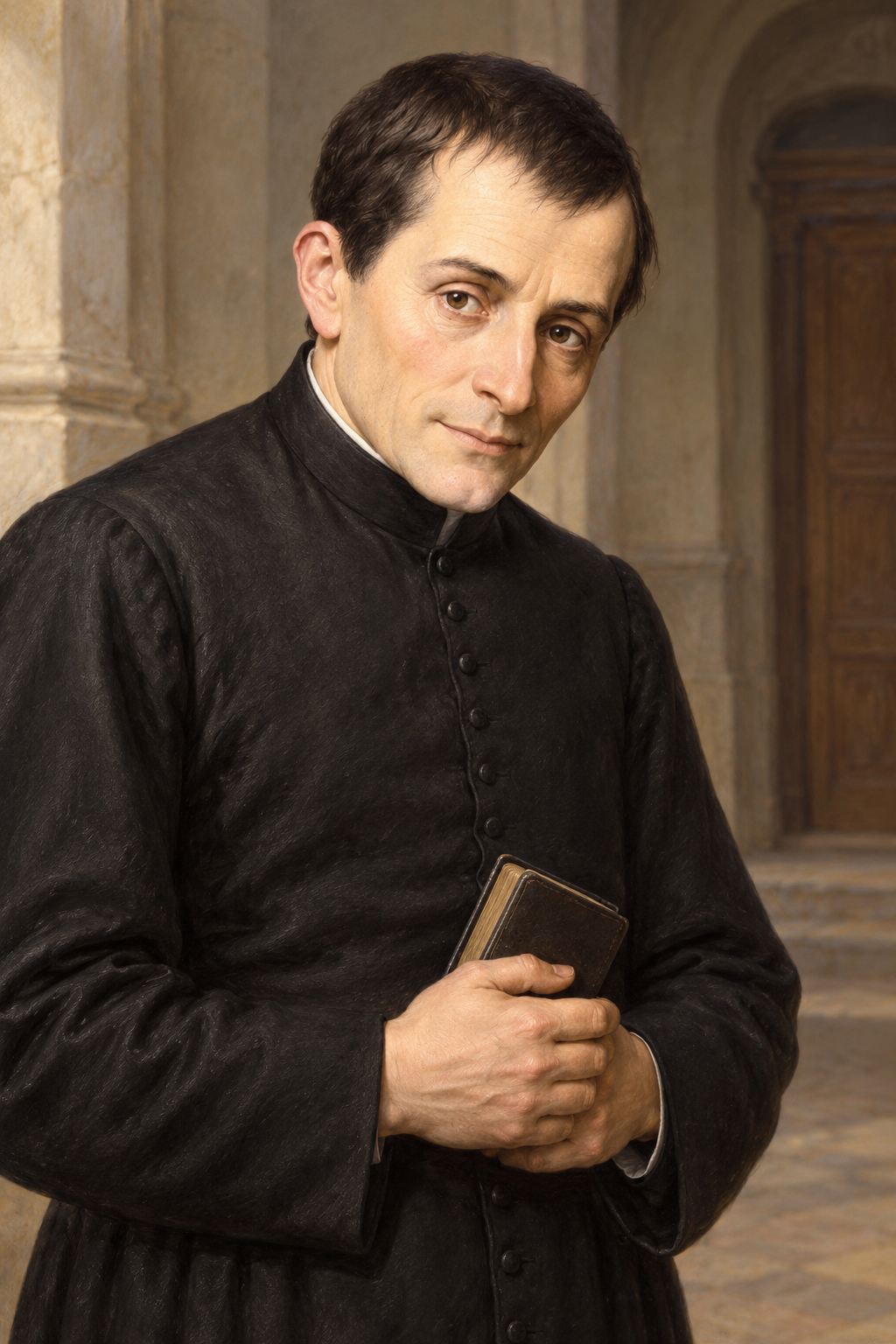
About Joseph Cafasso
Joseph Cafasso was a priest in nineteenth-century Turin whose work centered on preparing other priests for ministry. His influence reached beyond the classroom through preaching, confession and personal counsel. Born at Castelnuovo d’Asti in January 1811 to farming parents, he studied at Chieri and was ordained in 1833. In 1834 he entered Turin’s Convitto Ecclesiastico, a residence and school where priests continued their pastoral training. He remained there for the rest of his life, eventually becoming its rector.
His preparation had practical difficulties. The Salesian account describes his lodging with a tailor while attending school at Chieri and the mockery he initially faced from some fellow pupils. Study gradually brought him their respect. Later, successful examinations at the Convitto led Luigi Guala and the teaching staff to invite him to stay as a tutor. His work there developed from being a student into helping other students learn. The same account places his leadership of Lenten prison catechesis near the beginning of his years at the Convitto.
The historian Giuseppe Tuninetti describes Cafasso’s teaching as an effort to join moral principles with attention to the particular person seeking help. He resisted both excessive severity and an easy dismissal of moral responsibility. His advice grew out of sustained work as a confessor. People from different social backgrounds sought him, including prominent families and people with little wealth or influence. The spiritual welfare of the person before him mattered more than a display of learning.
The formation he offered drew on particular spiritual traditions. Benedict XVI identifies Ignatius of Loyola’s approach to prayer and discernment and Alphonsus Liguori’s moral and pastoral theology as central to the Convitto. Young priests, many from rural backgrounds, learned preaching and confession within a shared life of prayer and ministry. Cafasso hoped that those he trained would themselves guide priests, religious and laypeople, extending the school’s influence through their later work in other communities.
He preached in Piedmontese, the local language.
John Bosco’s funeral account gives a more personal view of that work. Bosco recalled Cafasso providing books and financial help so that priests with few resources could complete their studies. His assistance also reached young people who needed clothing, food or a way to learn a trade. Bosco remembered him helping them find work and paying for their training. Written in praise of a beloved teacher soon after his death, the account is a grateful witness to practical generosity rather than a detached assessment.
Bosco also described whole days spent in prisons, teaching, listening and hearing confessions. His account includes a troubling episode in which Cafasso held a reluctant prisoner by his beard and insisted that he confess. Bosco presented the incident as a triumph of charity and conversion. Read today, the story also shows the pressure that could accompany nineteenth-century pastoral care. It should not be turned into a model for overriding another person’s consent.
Cafasso’s relationship with Bosco combined spiritual guidance and material support. The Salesian account describes help with rent, loans and building costs as Bosco’s work for young people developed into the Oratory of Saint Francis de Sales. Cafasso also helped meet ordinary expenses, including food, and introduced Bosco to other supporters. In his will he left property beside the Oratory and a financial gift, and forgave Bosco’s outstanding debts to him. The relationship helped sustain an institution that was still taking shape.
Benedict XVI later emphasized another quality of that relationship: Cafasso helped Bosco discern his own vocation instead of trying to make him a copy of himself. The pope connected this patient guidance with Cafasso’s teaching and his prison visits. He described a ministry that gradually gave more room to individual conversation, alongside public preaching. Cafasso also stayed with men condemned to death, offering confession, Communion and companionship as they approached execution. Accounts differ about their number; an exact total is not necessary to understand the care he offered.
Cafasso died in Turin on June 23, 1860. His belongings and remains later became associated with the Consolata sanctuary, but he had not lived there. The sanctuary’s exhibition guide makes that distinction carefully: the Convitto moved from its earlier home beside San Francesco d’Assisi after his death. Furniture, books and other possessions moved with it. The surviving collection includes his prayer books, a writing desk and a small crucifix. These ordinary objects preserve something of the setting of his study and prayer.
Pius XII canonized Cafasso on June 22, 1947; his feast is June 23. In 1948 he was named patron of Italian prisons. The Consolata chronology also records patronage of the Apostolic Union of the Clergy in Italy and, in 1959, of the Convitto Ecclesiastico della Consolata. These specific patronages reflect the two settings most closely associated with his memory: the formation of priests and sustained care for people in prison.
Wondering how to weigh the stories and sources? Learn how to read a saint biography.