Biography
Joseph Freinademetz
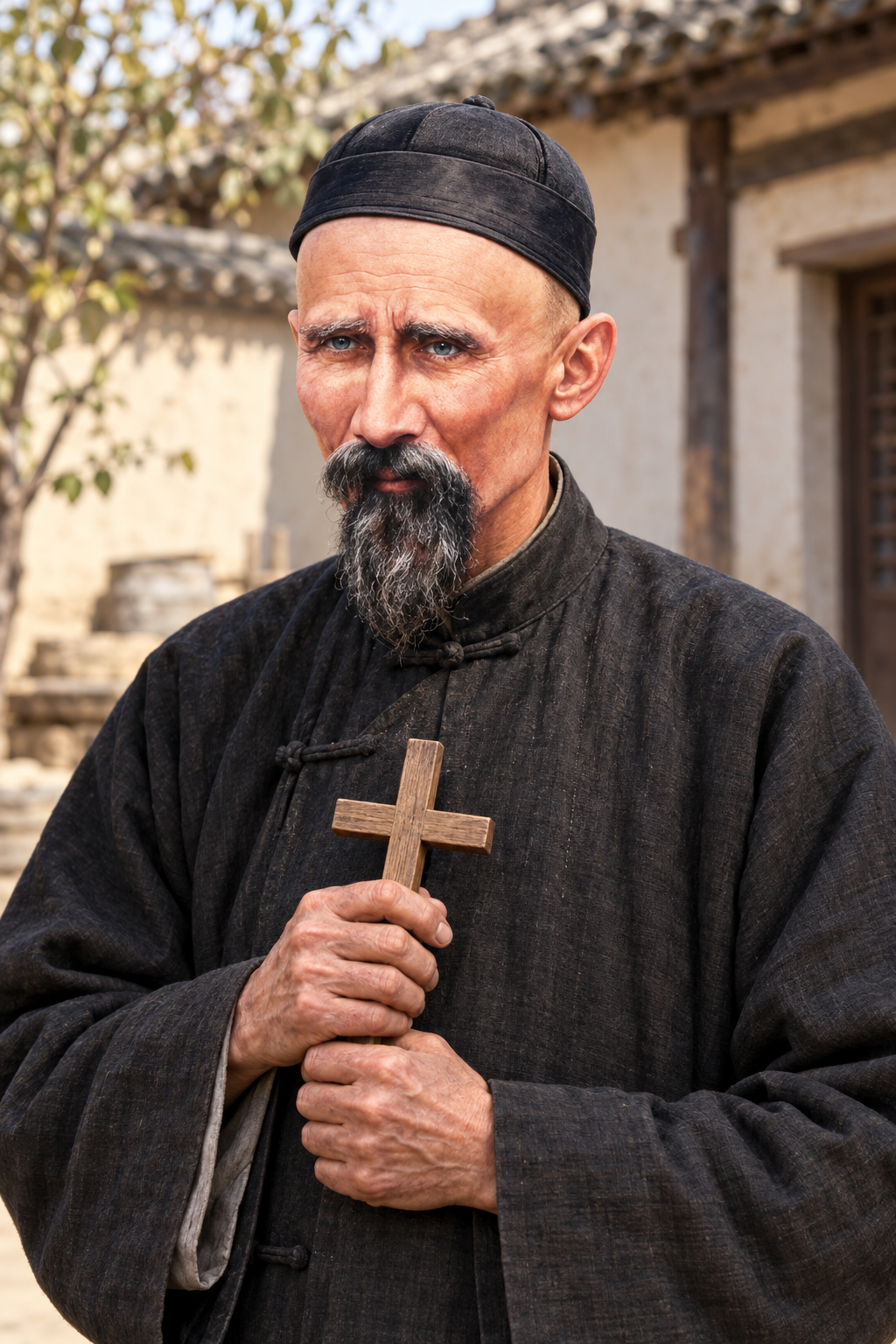
About Joseph Freinademetz
Joseph Freinademetz spent most of his priestly life in China as a member of the Society of the Divine Word. Born on April 15, 1852, in Oies in the Tyrol, he studied for the priesthood at Brixen and was ordained in 1875. After serving near his home, he entered Arnold Janssen’s mission house at Steyl in 1878. The following year he left for China with John Baptist Anzer, one of the new society’s first missionaries.
Learning across languages began before China. Sepp Hollweck’s account describes Freinademetz growing up speaking Ladin, then moving to Brixen for school with little German. Two years of elementary education there prepared him for secondary study. His later parish assignment in the Gader Valley included teaching. The move from a small linguistic community into German education preceded his much larger adjustment to Chinese society.
His early experience was difficult. He first worked in the Hong Kong region, learning the language and adjusting to unfamiliar surroundings. In 1881 he moved to Shandong, where he would spend the rest of his ministry. The Holy See’s biography describes repeated journeys to establish Christian communities. Once a community had begun to take shape, he could be asked to leave it and begin again elsewhere. This work required people who could sustain the community after the visiting missionary had moved on.
Training Chinese catechists therefore became a central concern. Karl Müller’s account describes Freinademetz preparing teaching materials in Chinese and promoting the formation of Chinese priests. His responsibilities also included the care of fellow missionaries. As provincial superior from 1900, he established a central house at Taikia where they could gather for spiritual renewal. Müller connects these administrative tasks with a life of prayer and with a willingness to remain beside local Christians during the violence of the Boxer uprising.
The catechists’ responsibilities were substantial. Hollweck explains that a Chinese catechist might visit an interested village before a foreign priest, or remain after the priest’s departure to continue instruction. Catechists led many small village communities. While directing their training in 1893 and 1894, Freinademetz prepared a rule in Chinese and Latin. He also required further periods of study and spiritual exercises. Their work depended on local knowledge and relationships, not simply on repeating a visiting missionary’s words. This organization gave Chinese lay Christians a continuing role in the mission’s pastoral life and the formation of new communities through their daily service.
His sympathy for Chinese people developed over time. The Oies shrine publishes translated excerpts from early letters in which he described Chinese customs with hostility and treated their religions as demonic. Later letters show admiration for Chinese learning and growing affection for the people among whom he lived. A document prepared for a 1892 synod argues that Chinese priests should not be treated as an inferior class. The change was more substantial than adopting local clothes: it required him to reconsider assumptions he had brought from Europe.
The mission also operated amid European imperial expansion. The shrine’s account describes the German occupation of Kiaochow after two missionaries were murdered in 1897. Freinademetz had reservations about the military occupation, yet as administrator he participated in negotiations for compensation. His service cannot be separated from that unequal political setting. These tensions belong beside the accounts of personal kindness and religious dedication.
The older Neue Deutsche Biographie places his work within nearly three decades of leadership in southern Shandong. He repeatedly served as administrator, provicar and provincial superior. Its account especially emphasizes his efforts to prepare a local clergy. This was work intended to outlast the presence of individual European missionaries. The same entry records the continuing reputation for holiness that led to a formal cause after his death.
Illness eventually curtailed his strength. In 1898 he went to Japan to recover from serious throat and lung problems, then returned to China. In 1907 he again took responsibility for the mission’s administration. While caring for people during an epidemic, he contracted the illness that caused his death at Taikia on January 28, 1908. His burial place became a focus of devotion.
John Paul II canonized Freinademetz on October 5, 2003, together with Arnold Janssen and Daniel Comboni. In the homily, the pope emphasized his sharing in the lives of the people he served and presented love as essential to missionary work. That later interpretation remembers the mature commitment of a man whose own writings also reveal the prejudices he had needed to confront.
His memory is also attached to a particular community in Beijing. John B. Zhang’s study of pastoral care for migrants identifies him as patron of the German-speaking Catholic community and records its 2011 pilgrimage to Daijiazhuang. His Roman Martyrology commemoration is January 28, while the Diocese of Bozen-Brixen and the Society of the Divine Word celebrate him on January 29.
Wondering how to weigh the stories and sources? Learn how to read a saint biography.