Biography
Joseph Gérard
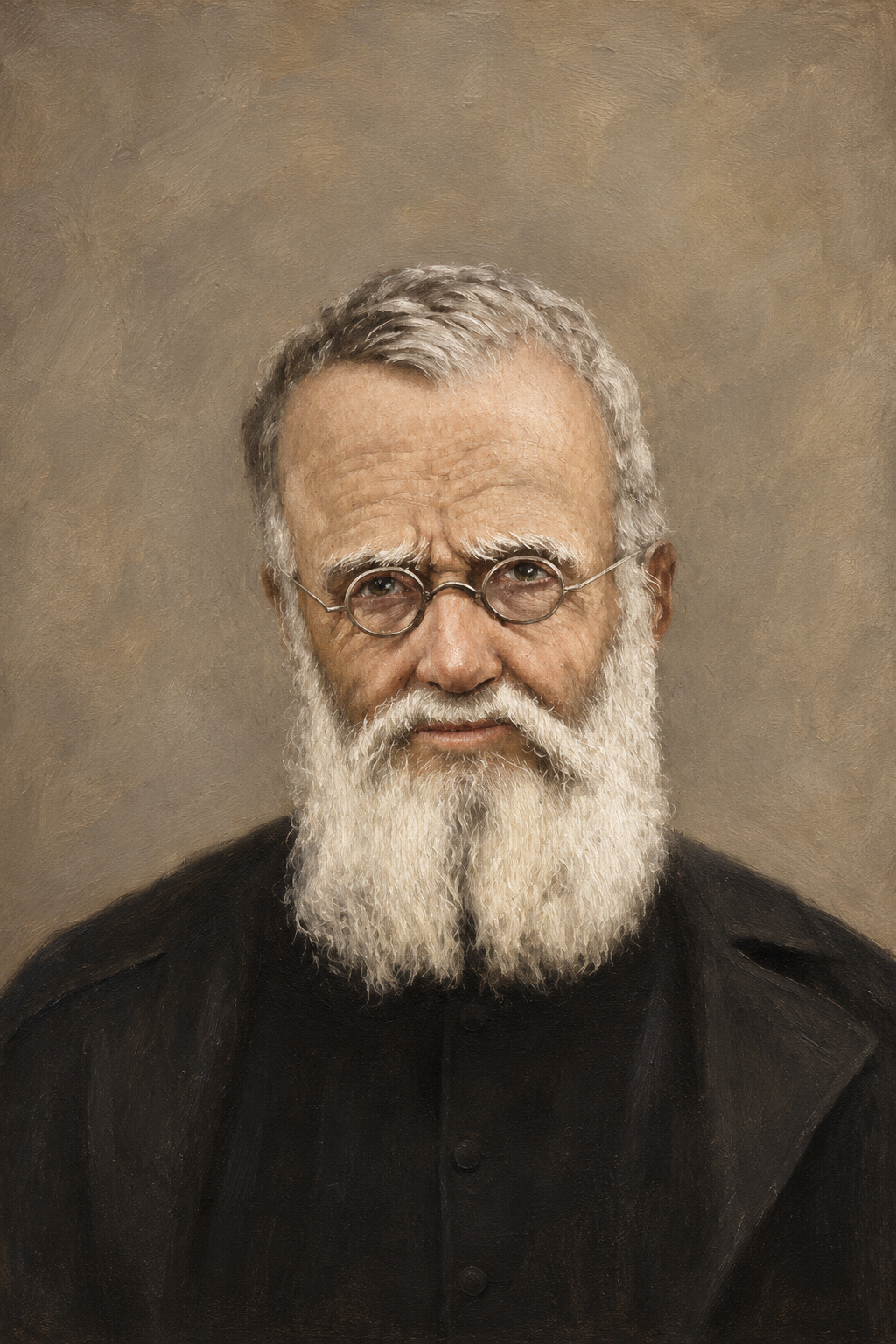
About Joseph Gérard
Joseph Gérard was born on 12 March 1831 at Bouxières-aux-Chênes, near Nancy in France. He grew up in a modest farming family. His parish priest encouraged his wish to become a priest, and he studied first at the minor seminary in Pont-à-Mousson and then at Nancy. Visiting Missionary Oblates of Mary Immaculate spoke about their work in Canada. Their accounts helped draw him toward missionary life, and he entered the Oblate novitiate at Notre-Dame de l’Osier in 1851.
The Oblate founder, Eugene de Mazenod, ordained him a deacon and sent him to Natal in southern Africa. He left France in 1853 and never returned. On 19 February 1854 he was ordained a priest at Pietermaritzburg. His first years of ministry among Zulu people were difficult. The results he hoped for did not quickly appear, and the official biography describes his disappointment. He continued working within the congregation, but his long missionary life would develop chiefly in another region.
His correspondence also preserves the discouragement of those early years. In a June 1860 letter, he described the obstacles at Saint Michael’s while saying that he remained willing to continue. Mazenod answered with encouragement. These exchanged letters show the missionary seeking counsel within his congregation as he faced results that differed from his hopes.
During the journey to Africa he spent time in Mauritius, where he met Jacques-Désiré Laval. O’Hara identifies Laval’s catechetical methods as an influence on his later work. Gérard’s own ministry eventually included writing as well as preaching and visiting. In 1876 he supervised the printing of two works in Sesotho: his translation of Luke’s Gospel and a short history of the Church. These publications show his concern to communicate Christian teaching in the language used by the people among whom he lived.
In 1862 he travelled to Basutoland, now Lesotho, and helped establish a Catholic mission at the place that became known as Roma. King Moshoeshoe permitted the settlement. Gérard’s work there developed slowly, and the first baptisms came only after several years. The mission also became associated with a school and a convent. He later went north to establish Saint Monica’s mission, remaining there for years before returning to Roma toward the end of the nineteenth century. His work thus extended beyond a single station or its immediate neighbourhood.
John Paul II’s beatification homily describes Gérard learning the language and customs of the Basotho after arriving with Bishop Allard and Brother Bernard. He sought to understand people’s concerns and ways of thinking as part of his religious work. The homily also recalls the growth of mission stations beyond Roma, including Korokoro and Saint Michael’s. At Saint Monica’s, education and the establishment of a religious community accompanied parish ministry. The developing Church depended upon several forms of service, rather than preaching alone.
Care for sick and elderly people remained a defining part of Gérard’s life. He travelled on foot or horseback through mountainous country, taking the sacraments to people who could not reach him. Distance, weather and inconvenience did not usually deter him. The practical demands of those journeys remained part of his routine even in old age. The Oblate biography records that he was still riding to visit people in need up to a month before his death. This persistent attention to individuals is central to the affection with which he was remembered.
He died at Roma on 29 May 1914, after more than half a century of work in southern Africa. His memory remained closely tied to the Basotho people and to the institutions with which he had lived and worked. The Catholic Church later examined his life and reputation for holiness. On 15 September 1988, John Paul II proclaimed him Blessed at Maseru, bringing the recognition to the country in which the greater part of his adult life had been spent.
At the beatification, the pope connected Gérard’s care for others with his habits of prayer. He recalled the Liturgy of the Hours, visits to the Blessed Sacrament and devotion to Mary. He presented these practices as the source of sustained service through difficult journeys and long periods of work. The homily also placed his memory within a call to reconciliation and peace. In that Catholic interpretation, spiritual life gave direction to the patient care of neighbours and to the effort to build a lasting community.
Later that day, John Paul II met priests, religious and seminarians in Maseru. He began with a Sesotho greeting that he said Gérard had taught his first converts, now part of the country’s Catholic tradition. He also emphasized that local men and women were increasingly assuming responsibilities once carried by foreign missionaries. The beatification was therefore remembered alongside the continuing work of Basotho Christians. Gérard’s legacy belonged within a Church whose future depended upon their own leadership, vocations and service to the wider society.
Wondering how to weigh the stories and sources? Learn how to read a saint biography.