Biography
Joseph of Anchieta
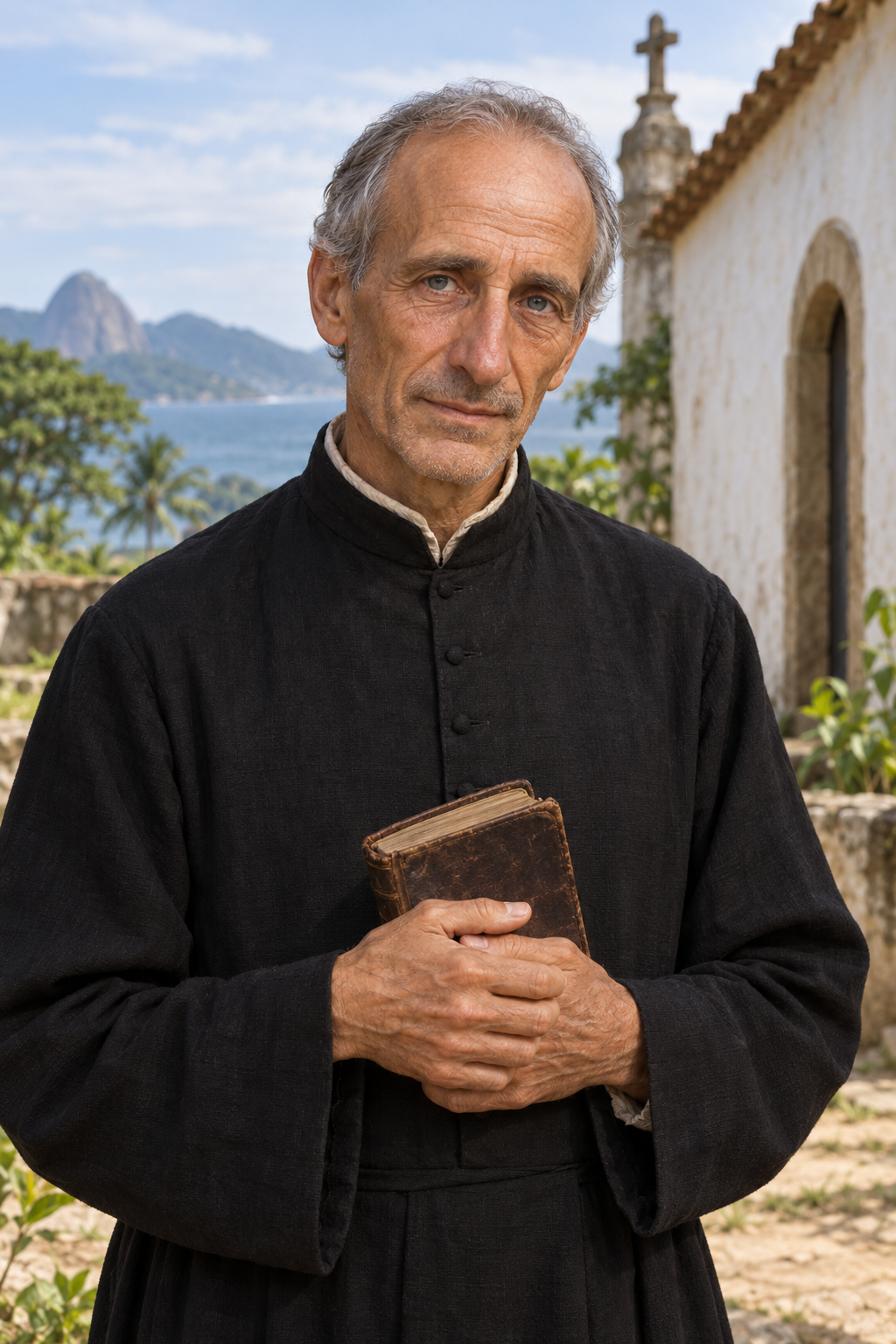
About Joseph of Anchieta
José de Anchieta was a Jesuit priest whose teaching, writing and missionary journeys helped shape the early Catholic Church in Brazil. Born on March 19, 1534, in San Cristóbal de La Laguna on Tenerife, he eventually made his home among communities far across the Atlantic. He is remembered in Brazil both for his religious work and for his part in the beginnings of São Paulo.
As a young man he studied in Coimbra and entered the Society of Jesus in 1551. A serious illness left him with a curved back. His superiors sent him to Brazil in 1553, hoping that the climate might help his health. Physical frailty remained part of his life, but it did not prevent decades of demanding travel, teaching and leadership.
In the region of São Vicente and Piratininga, Anchieta taught Latin and studied Tupi. He sought to make Christian instruction understandable through the language people already spoke. His work included catechetical dialogues, devotional writing and religious drama. He became provincial of the Jesuits in Brazil in 1577 and continued visiting communities and carrying responsibilities until his final years. The Jesuit superior Adolfo Nicolás later emphasized the combination of illness and persistent missionary activity in his life.
His grammar of Tupi gives a particularly concrete picture of that work. Cristina Antunes, writing for the University of São Paulo’s Brasiliana library, notes that a manuscript version was already in use at the college in Bahia in 1556. The book was printed in Coimbra in 1595. It helped missionaries learn a language used along the coast, but its purpose was conversion. Antunes stresses that the effort to understand Indigenous cultures was also an effort to change them. The grammar therefore belongs both to the history of language study and to the history of colonial evangelization.
The grammar also involved choices about how diverse speech would be represented. Antunes describes a missionary effort to bring different coastal groups within a common language for instruction. The printed book therefore records more than vocabulary and rules: it preserves a particular approach to organizing religious teaching across communities whose cultures missionaries sought to transform.
Anchieta’s concern for Indigenous people must be understood within that difficult setting. José González Luis describes his practical defense of them while also examining his poem about the governor Mem de Sá. In that poem, Portuguese military power appears as an instrument of a Christian mission. González Luis observes that Anchieta justified armed force against Indigenous opponents and the suppression of practices he rejected. His closeness to communities did not free him from the assumptions of European colonial rule. A responsible account of his service must preserve that tension.
González Luis places the grammar within the European teaching traditions Anchieta knew. He used familiar grammatical models to describe and organize a language new to European missionaries. The resulting guide was intended for practical learning and communication. The scholar also surveys his writing across several literary forms: an epic about Mem de Sá, lyric poetry in Portuguese, Spanish and Tupi, and drama. This range helps explain why his work is studied beyond Church history. Its literary and ethnographic value does not remove the missionary purposes that shaped it.
The national shrine also remembers his role in peace negotiations with the Tamoios alongside Manuel da Nóbrega. He was ordained a priest in Salvador in 1566 and served as a superior in several missions and colleges. His later years were spent at Reritiba, where he died on June 9, 1597. His body was taken to Vitória for burial. These places preserve the memory of a ministry carried out through schools, religious communities, travel and personal encounters.
His responsibilities also involved building institutions. The national shrine records that he arranged new colleges and missions and sought permission to establish a university in Brazil. It does not say that this university project was realized. He supervised the Santiago college in Vitória directly. The shrine also recalls his concern for the harsh treatment of enslaved people. These activities place teaching, administration and social concerns alongside the better-known journeys and negotiations, without suggesting that they stood outside the colonial system.
At Reritiba he also began a history of the Jesuits in Brazil. Nicolás reports that only fragments of the history he began in his final years now survive.
John Paul II beatified Anchieta in 1980, and Francis canonized him on April 3, 2014. His feast is June 9.
At the thanksgiving Mass later that April, Francis reflected on the joy of sharing an encounter with Christ. That is the spiritual invitation the Church continues to draw from Anchieta’s life.
The Brazilian bishops’ conference identifies him as patron of catechists and pharmacists in Brazil and as a secondary patron of the country. Those honors connect his memory with the work of teaching faith and caring for others today.
Wondering how to weigh the stories and sources? Learn how to read a saint biography.