Biography
Józef Bilczewski
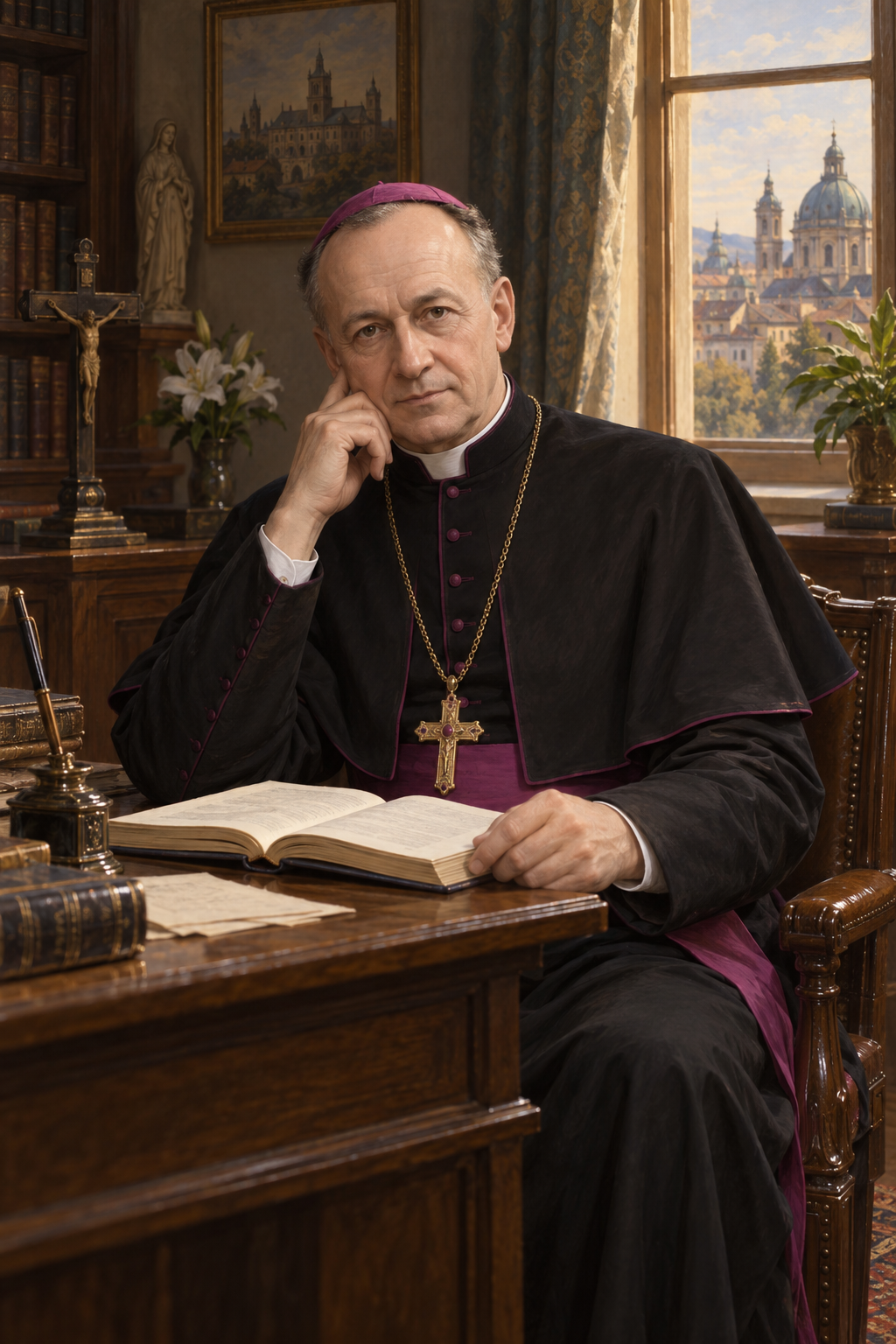
About Józef Bilczewski
Józef Bilczewski was born on 26 April 1860 in Wilamowice, near Kęty, then in the Diocese of Kraków. A Lviv historical profile gives his birth name as Józef Biba and describes him as the eldest of nine children in a family supported by farming and carpentry. Those details place his childhood far from the university and episcopal offices he later held. The profile also situates his adult life in a region whose religious institutions and national movements were closely entwined.
After schooling in Wilamowice, Kęty and Wadowice, he entered theological formation in Kraków. Cardinal Albino Dunajewski ordained him a priest there on 6 July 1884. It records study at Vienna, Rome and Paris. Its precise doctorate year differs from that in a Lviv historical account, so the sequence is more secure here than a single year for the degree. Study and parish work gave him a path into teaching without ending his obligations as a priest.
Benedict XVI's canonization decree records Bilczewski's work at the Jagiellonian University and his appointment to teach theology in Lviv. It singles out his use of early Christian images and inscriptions in theological study, particularly his writing on the Eucharist. This was scholarly work within a Catholic tradition, not simply a prelude to his later episcopate. He became dean of the theology faculty and rector of the university. The record shows a priest whose public authority grew first through teaching and administration.
Leo XIII appointed the forty-year-old scholar Latin-rite archbishop of Lviv on 17 December 1900. The Holy See biography describes a large archdiocese with complex social, economic, ethnic and religious circumstances. His appointment gave him responsibility for clergy, parish life and education across communities with different languages and traditions. The same biography describes pastoral letters, encouragement of Eucharistic devotion, schools and care for poorer parishes. Those are ecclesial accounts of his priorities; they do not settle how every community experienced his policies.
His episcopal consecration took place on 20 January 1901, according to the papal decree. The decree emphasizes his preparation of priests, catechesis for children and youth, and the building of churches, chapels, schools and places of care. It also places his social teaching alongside Leo XIII's *Rerum novarum*. These undertakings depended on clergy, teachers and lay supporters as well as an archbishop's direction. The scale of a diocese makes a single-person account inadequate even when a later official text praises its leader.
The Polish Catholic Information Agency describes practical support for schools, students and workers' associations. It reports that Bilczewski organized courses to prepare priests for social work and helped provide a Catholic house for associations in Lviv. That program joined religious formation to material concerns. It responded to the growth of organized labor, but it was a Catholic proposal in a crowded political field, not the only way workers in Galicia understood their needs. His social initiatives depended on teachers and local organizers as well as episcopal encouragement.
The Polish diocese that includes his birthplace remembers him as both a religious leader and a Polish patriot. Its account stresses social organizations and his solicitude for working people. Such local commemoration explains why he remains prominent in Polish Catholic memory. It also gives the biography a reason to name national identity directly. The archbishop's commitments were formed in a setting where church buildings, schooling and public speech could carry national meanings as well as pastoral ones.
Ukrainian historical writing presents a more contested public figure. The *Encyclopedia of Modern Ukraine* records his opposition to a proposed electoral compromise in 1913–14 that would have expanded Ukrainian representation in the Galician Diet. A dispute over representation was consequential to people beyond his own Latin-rite flock. The encyclopedia has errors in some personal dates, so its political account is read alongside the Center for Urban History rather than used for vital statistics. The opposition remains an important part of the public record.
Historian Maciej Janowski identifies Bilczewski among five Polish bishops who signed an April 1913 public letter opposing electoral reform. Janowski explains that the proposal sought a Polish-Ukrainian compromise through separate constituencies, and that the bishops' objection favored the stronger Polish position. This contemporary public act gives substance to the dispute over representation. It also prevents a biography from treating the archbishop's entire tenure as free of national tension, as one short devotional life does. Church institutions could serve pastoral needs while also taking positions with political consequences.
During the First World War and the Polish-Ukrainian struggle over Lviv, his public role included relief. A Catholic reference in Norway describes support for students, schools, workers' groups and people in poverty; during the 1918 fighting, it says, he led a committee that provided food. It records that Bilczewski and Greek Catholic Metropolitan Andrey Sheptytskyi made a joint appeal against bloodshed in November. Their appeal did not undo the conflict. It is still evidence of an effort by leaders from different churches to restrain violence amid a war affecting their communities.
At Bilczewski's beatification in Lviv in 2001, John Paul II recalled his aid during the First World War and his wish to be buried at Janów cemetery among poorer residents. The pope also acknowledged wounds in Polish-Ukrainian Christian history and urged forgiveness and cooperation. A beatification homily is an interpretation of sanctity, not a complete political history. Its call for reconciliation is especially meaningful when read alongside evidence of the divisions in which Bilczewski had participated and tried at times to ease.
Bilczewski died in Lviv on 20 March 1923 and was buried at Janów cemetery, as he had requested. A bilingual history published by the Wilamowice Museum recalls the burial among the poor and the later recognition of him in his hometown. It notes that Wilamowice named him its patron in 2013 and that the local church became a shrine in 2016. The continuing public memory joins scholarly and pastoral work to care for people in need. His place in national politics remains a subject of historical interpretation alongside those forms of service.
John Paul II beatified him in Lviv on 26 June 2001. Benedict XVI canonized him on 23 October 2005. The Dicastery lists 20 March as his memorial, while his home diocese in Poland observes him on 23 October. the careful account of his life also records the social and national setting in which he taught, governed and served. His work for people in poverty and his contested political positions both belong to that history.
Wondering how to weigh the stories and sources? Learn how to read a saint biography.