Biography
Juan Alonso Fernández
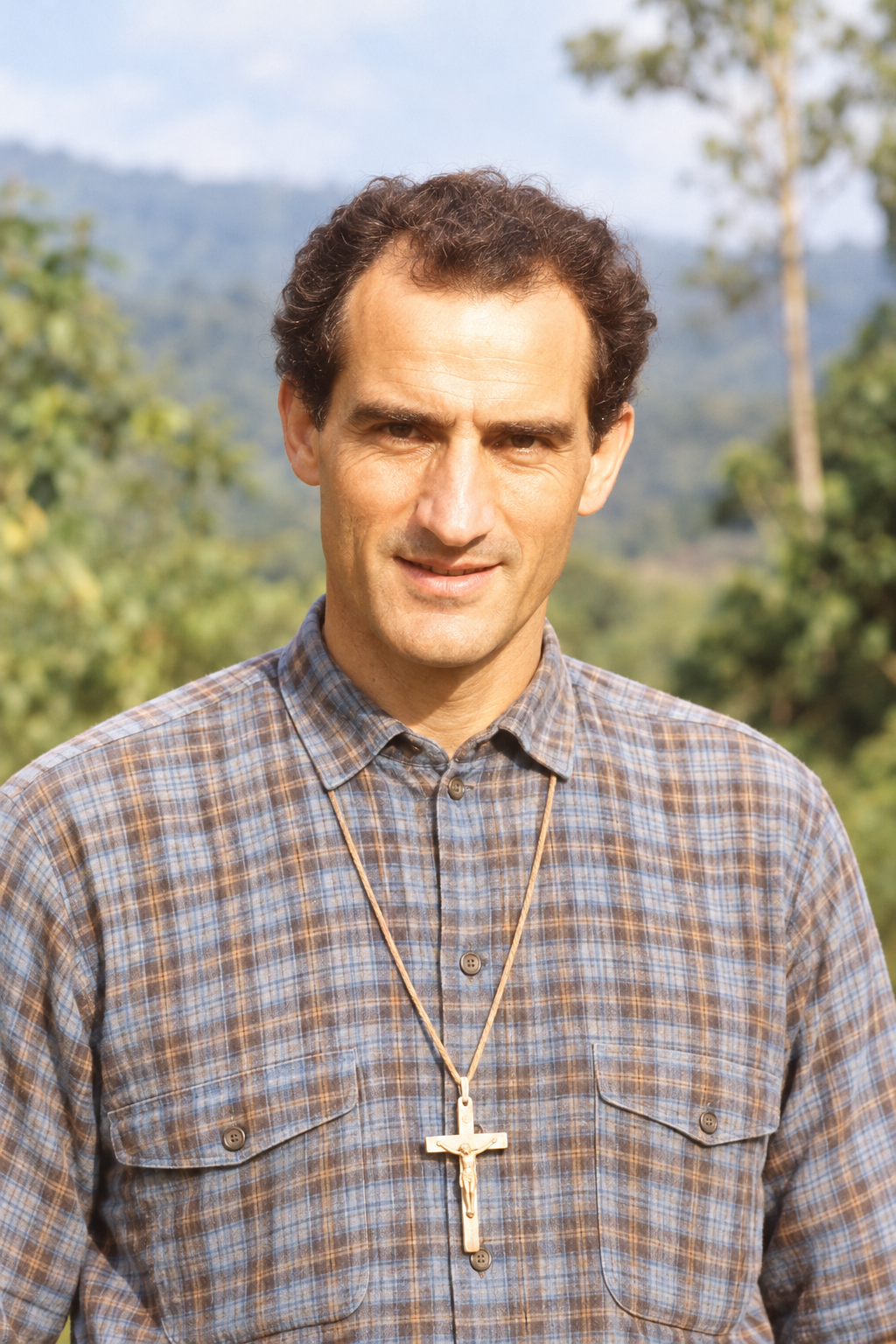
About Juan Alonso Fernández
Juan Alonso Fernández was a Missionary of the Sacred Heart from Cuérigo in Asturias. His brother Arcadio recalls that he attended the village school before entering the congregation’s college in 1947. He was ordained in 1960 and began missionary work in Guatemala.
Arcadio’s family account places their childhood in a working household. Their parents had emigrated to Cuba, married in Havana and returned to Asturias before the brothers were born. Their father worked in mining, building and carpentry; their mother supported the household through varied work, including cooking and midwifery.
His years in Indonesia left memories outside his family’s account. In an interview published in 2021, Johanis Mangkey, later a Missionary of the Sacred Heart, recalled seeing Alonso while he was in primary school in Tataaran. The priest arrived at the rectory on a large motorcycle, with a child riding behind him. Mangkey remembered a bearded visitor in a white cassock who spoke quickly, while his Indonesian was still developing. The children found him difficult to understand. The recollection gives a glimpse of a missionary adapting to a new language, rather than someone immediately at home in every setting.
Mangkey also described Alonso’s journeys beyond his assignment at Kokoleh. He reported that the baptismal register at Langowan recorded Alonso’s ministry, linking his travel with visits to Catholic communities. Mangkey’s own encounter and his later account of the registers are different kinds of evidence: the interview preserves both, but the registers themselves have not been inspected for this biography.
After serving in Indonesia, he returned to Guatemala and worked in Lancetillo. Jesús López Sáez’s account, drawing on family testimony, describes a missionary who worked as a carpenter, builder and plumber while preparing a church, school and other community facilities. Letters to his family recorded both his commitment to the people and his awareness of the danger.
A local health worker’s recollection adds another perspective on the parish. Eleuterio Pérez Pastor, a K’iche’ man from Nebaj, recalled receiving training through the Ministry of Health before moving with his family to Lancetillo. In testimony published in El efecto Guatemala, he said that he learned more at the parish with Alonso. His account places the priest within a wider network of community knowledge and public health training. Pérez also remembered the killing of Alonso and seven health promoters in 1981. He considered abandoning his work, but continued because people asked for his help. This is Pérez’s account of his own experience; it does not establish that Alonso founded the health service or directed all the workers he mentions.
His work belonged to a wider network of priests, religious sisters and lay catechists. In a later diocesan interview, Marcelino Montoto described how catechists met monthly with priests to review their communities’ needs and prepare celebrations. When violence forced the clergy to leave, he recalled, those lay workers sustained the communities’ religious life. This is testimony about the mission’s setting, rather than a claim that Alonso personally organized every activity.
The same interview records José María Orviz’s recollection of accusations that the missionaries supported guerrillas. Orviz rejected that accusation and described attacks on the residence at Uspantán before the diocesan priests withdrew. José Antonio Álvarez remembered Alonso’s determination to remain available to the people despite the risk.
Bernardo Gosse’s history of the Quiché mission describes Alonso’s return during the crisis. He had been working in Petén when a small group of priests planned to resume ministry in Quiché. Gosse records a meeting with the diocesan administrator, Víctor Hugo Martínez, and Alonso’s intention to return after attending to his remaining commitments. By February he was again travelling among the communities. On February 13, the military commander at Uspantán summoned him for questioning.
Two days later, Alonso failed to arrive for dinner with Martínez and another priest in Sacapulas. In Gosse’s account, news reached them that armed men had stopped him on the road to Cunén. The following day the two men searched for him and found his motorcycle. Later they learned that volunteer firefighters had taken his body to Santa Cruz del Quiché.
Alonso was killed at La Barranca on February 15, 1981.
The Catholic Church beatified him with nine other Quiché martyrs on April 23, 2021. A thanksgiving Mass followed in Oviedo Cathedral on May 28, attended by the provincial of his congregation and three priests who had served in the diocesan mission. The archdiocese’s report preserves Archbishop Jesús Sanz’s emphasis on their service to the people as an expression of faith.
His memory remains attached to places where he worked and died. In a 2024 visit report, the Missionary of the Sacred Heart Michael Miller described an outdoor chapel at La Barranca. Parishioners showed the visitors the steep embankment where they said Alonso’s body had been left. Miller also visited the parish church in Lancetillo and reported that Alonso’s remains rested beneath a side altar. The report records later commemoration and the visitors’ encounter with local memory; Miller was not a witness to the killing.
Wondering how to weigh the stories and sources? Learn how to read a saint biography.