Biography
John Baptist of the Conception
About John Baptist of the Conception
Juan García Rico, known in religion as John Baptist of the Conception, was a Spanish priest, writer and reformer of the Trinitarian Order. He was born at Almodóvar del Campo on July 10, 1561, one of eight children of Marcos García Gijón and Isabel López Rico. His studies took him from the Carmelites of his hometown to Baeza, Toledo and Alcalá de Henares. He made his religious profession in 1581.
His schooling included grammar with the Carmelites and philosophy at Toledo. The diocesan account records four further years of theology at Alcalá before his move to Seville. The preacher and reformer therefore emerged from a sustained course of study within several religious and university settings.
As a priest, he became known for his preaching. He joined a community at Valdepeñas where Trinitarians were attempting a more demanding religious life. Dissatisfied with its progress, he went to Rome to seek papal authorization for a lasting reform. On August 20, 1599, he obtained the document that allowed the reformed communities to develop.
This undertaking grew out of earlier efforts rather than beginning in isolation. In a scholarly review of Juan Pujana’s history, Eduardo Javier Alonso Romo describes decades of reform involving religious superiors, the Spanish crown and Rome. He identifies the 1594 assembly of Spanish Trinitarians and the experiment at Valdepeñas as important steps toward the later foundation. The competing authorities did not always agree about how reform should proceed.
The order’s history explains the new communities’ purpose as a return to the strict observance of John of Matha’s rule. Prayer, poverty and penance were joined to concern for prisoners and poor people. The Trinity was central to Juan’s understanding of this work: devotion was meant to find expression in practical charity. The same institutional history credits him with establishing eighteen houses for men and one for contemplative women.
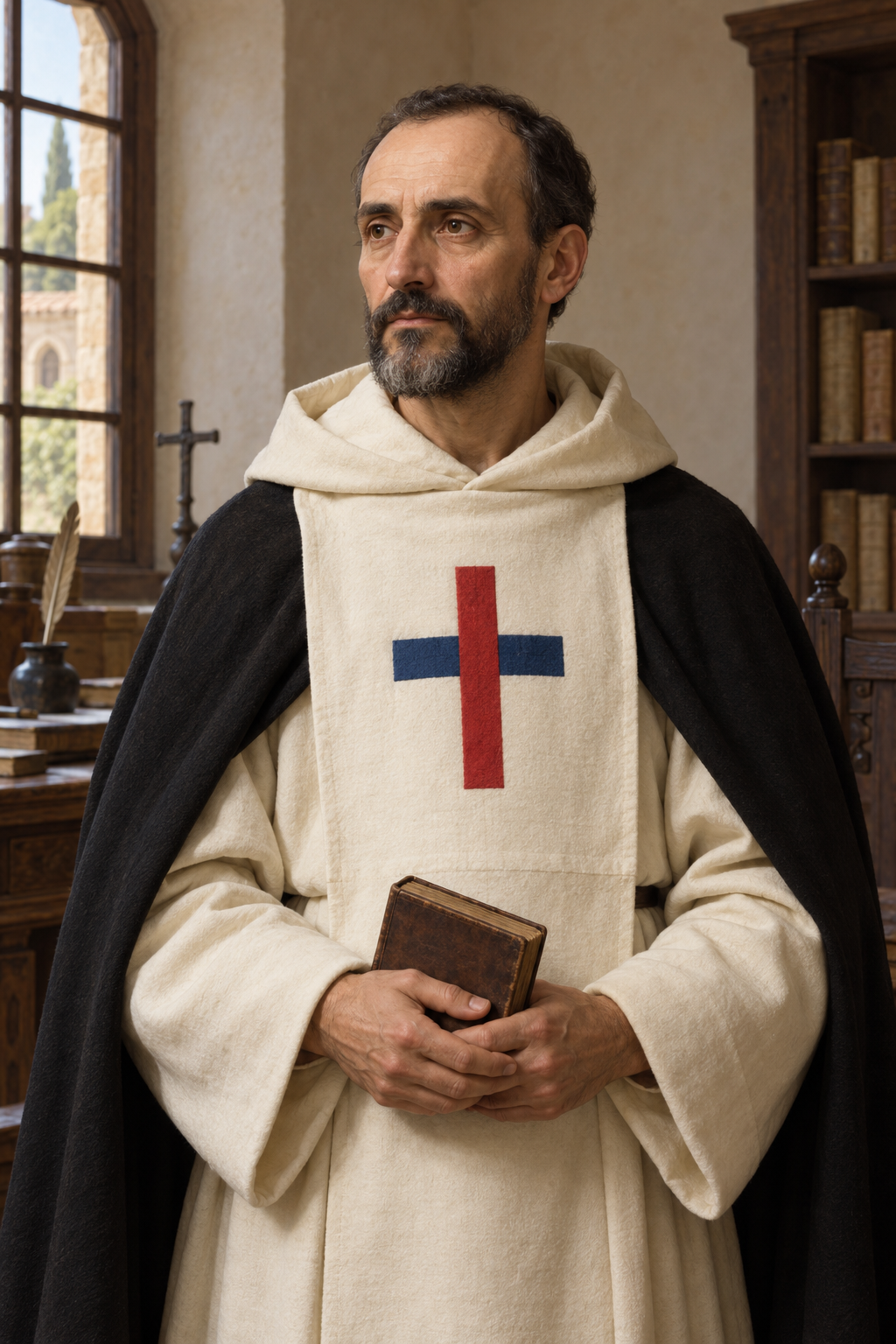
The province’s account names foundations in Alcalá de Henares, Madrid, Salamanca, Córdoba, Toledo, Baeza, Granada, Seville and Pamplona. The developing houses formed the Province of the Holy Spirit, with Juan as its first provincial superior. Their identity was also visible in the habit: he chose a red and blue cross with straight arms, understood within the order as an expression of austerity and simplicity. These outward arrangements accompanied the more demanding shared life he sought.
His reform also faced serious criticism. The editors of his collected works describe an apostolic visitation in 1608 that raised objections to excessive austerity, rapid recruitment, demands for alms that burdened farmers and continuing internal disputes. Juan answered these objections in a substantial defense of the reform. The editors note that his confidence in divine support did not fully address practical concerns about inadequate numbers of experienced teachers and priests. They also distinguish his account of constructive spiritual disagreements from less admirable conflicts within the communities.
These tensions are part of the record of his leadership. The editors explain that the visitation threatened the reformed communities’ autonomy and that the duke of Lerma’s support helped preserve it. Their discussion allows Juan’s own explanation of events to be read alongside the institutional pressures and criticisms he faced.
The critical editors also acknowledge a limit in the evidence: the original visitation record has not been located. The objections are known through the material preserved in Juan’s response. This makes his defense valuable without treating it as the visitor’s own complete report.
Writing was another enduring part of his work. His surviving texts include spiritual instruction, autobiography and reflections on the reform. Alonso Romo notes that a modern critical edition brought this substantial literary legacy together in four volumes. Its publication made an important body of Spanish religious writing more accessible for study. His correspondence also formed part of that legacy.
Alonso Romo places the movement beside other reforms of the period, including the Discalced Carmelites and Augustinian Recollects. The comparison situates Juan’s work within a wider search for renewed religious discipline. The collected writings likewise range across spiritual instruction, the history and spirit of reform, and exhortations to communities. That range preserves both institutional concerns and teaching intended for the ordinary religious life of his followers.
Juan died in Córdoba on February 14, 1613.
Paul VI canonized him on May 25, 1975. In the ceremony’s homily, the pope presented his life as an example of renewal rooted in personal conversion, prayer and fidelity. He also referred to the two newly canonized saints as patrons of their respective religious families.
The Trinitarians celebrate his feast on February 14 and venerate his remains in Córdoba.
Almodóvar del Campo honors him as one of its patrons. A municipal account of the 2026 celebration describes a procession carrying his relics from the chapel at his birthplace, followed by Mass. Local remembrance thus joins the wider Trinitarian devotion to the place where his life began.
Wondering how to weigh the stories and sources? Learn how to read a saint biography.