Biography
Juliana of Norwich
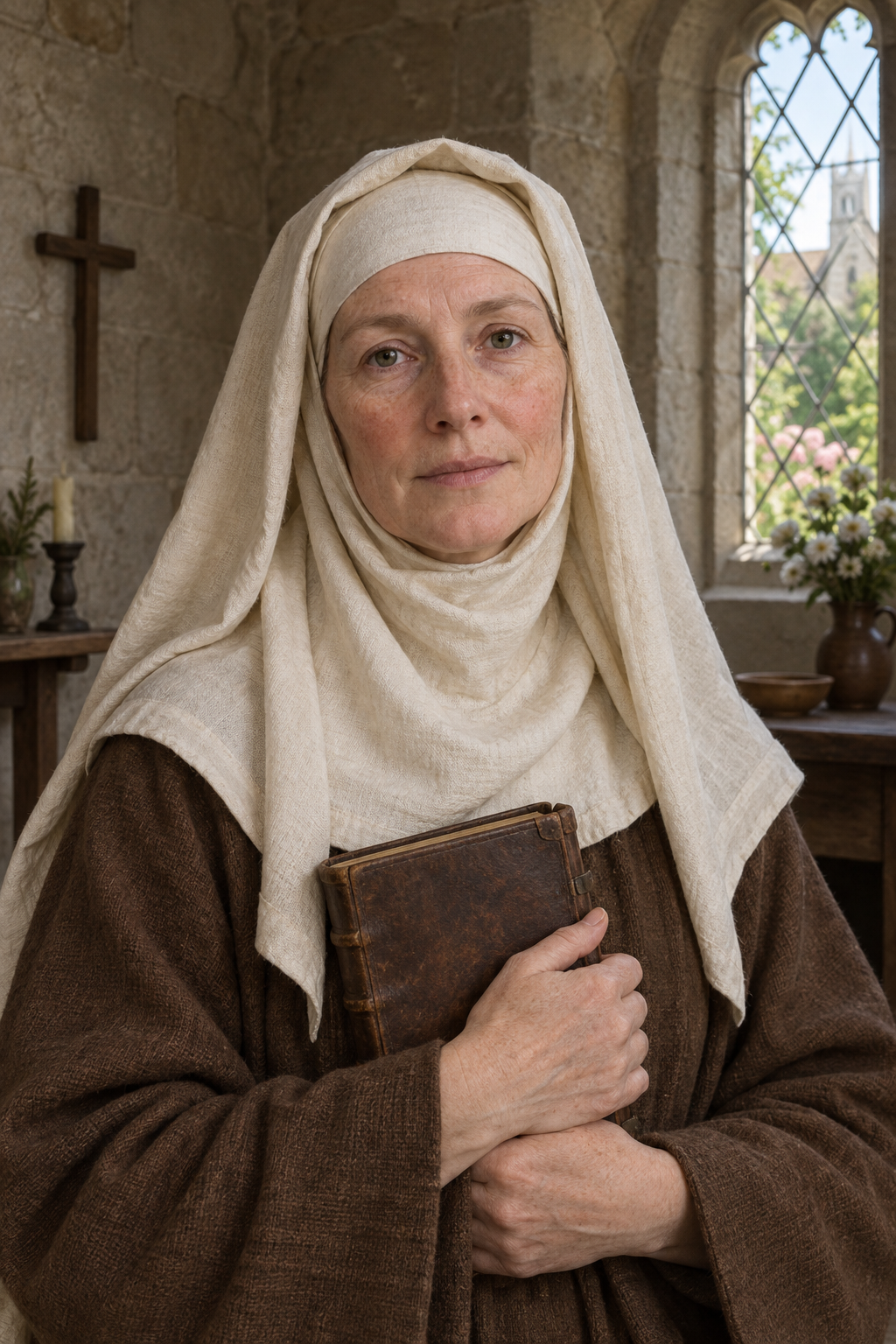
About Juliana of Norwich
Julian of Norwich lived as an anchoress, a woman dedicated to prayer in a dwelling attached to a church. She was born around 1342, but her family and childhood remain largely unknown. Even the name by which she is remembered may have come from the church beside her cell rather than from her birth. The surviving evidence does not securely establish that she had previously been a Benedictine nun. Her life is connected most firmly with Norwich, where she became known as a spiritual counsellor and the author of Revelations of Divine Love.
In her own account, a grave illness in May 1373 brought her close to death when she was thirty and a half. She described a sequence of visions and later reflection on their meaning. Her writing presents divine love as the centre of what she believed she had received.
Her Norwich was a busy religious and commercial city, not an empty retreat from the world. Georgia Ronan Crampton's scholarly introduction describes its cathedral, grammar schools, and communities of friars. Public preaching offered opportunities to hear religious teaching beyond the schools themselves. The city also endured recurrent plague and the upheaval of the rising of 1381. These events belong to the setting of Julian's life, though they cannot establish particular experiences within her family. The four mendicant orders maintained houses that prepared their candidates for further study at Cambridge or Oxford. Her own education remains uncertain, and the surviving records do not identify a particular school or teacher who instructed her.
Wills provide glimpses of the practical support surrounding her enclosure. Philip Sheldrake discusses a bequest from Roger Reed in 1393 or 1394, and a will of 1404 that names Julian beside St Julian's Church. The latter also mentions Sarah, who lived with her, without securely identifying Sarah's role. Another named bequest was proved in 1416. Such gifts placed an anchoress within a network of benefactors who valued her prayers, despite the separation of her dwelling from ordinary household life.
A more personal encounter survives in the Book of Margery Kempe. Margery sought Julian's counsel about her religious experiences, wanting to know whether they involved deception. The account presents Julian as an experienced listener who tested spiritual claims by their consequences: they should honour God and benefit other Christians. She encouraged perseverance and patience rather than surrender to the contempt of others. Margery remembered their religious conversation continuing over several days. The meeting reveals an enclosure that could still make room for sustained attention to another person's questions.
The history of Julian's book extends well beyond that meeting. The British Library distinguishes the shorter account from the substantially expanded Long Text, developed in or after 1393. Only an abridged medieval witness to the Long Text survives; its complete witnesses come from a later period. English Catholic women living in religious communities in northern France played a crucial part in copying it. The surviving manuscripts include a seventeenth-century Paris copy and two Sloane manuscripts, one from around 1650 and another from the first half of the eighteenth century. The distance between Julian's writing and these surviving copies makes their preservation particularly important: the book reached later readers through the work of people living centuries after its author.
Her exact death date is not established. The Church of England's calendar uses approximately 1417, while the New Catholic Encyclopedia proposes a probable range between 1416 and 1423. Those estimates should not be mistaken for an anniversary known to the day.
A printed edition appeared in 1670 through the work of the Benedictine Serenus Cressy. This brought the text into print long after its author's lifetime. The physical place associated with Julian also underwent loss and restoration: her cell was rebuilt after damage during the Second World War. The present devotional setting therefore belongs to the history of remembrance, not to an untouched medieval interior. Prayer and welcome continued there through the care of the sisters of All Hallows, connecting a reconstructed place with the older tradition of contemplation.
Interest in her writing has crossed denominational boundaries. Barbara Bishop records an ecumenical celebration in Norwich in 1973, marking six centuries since the experiences described in the book. Scholarly editions and translations have also widened access to the writing and encouraged close attention to its language. The publication of a critical text by Edmund Colledge and James Walsh in 1978 was an important part of that renewed study. Julian's place among medieval English religious writers rests on a surviving work that readers have continued to examine, translate, and discuss.
In 2010 Benedict XVI spoke of her veneration among Catholics and Anglicans and highlighted the counsel offered from her cell. That recognition should not be confused with a claim that he canonized her. The enduring image is of a woman whose settled life of prayer did not prevent generous engagement with visitors seeking help.
Wondering how to weigh the stories and sources? Learn how to read a saint biography.
Explore similar vocations
Prayers for Juliana of Norwich
Juliana of Norwich: sourced prayer excerpt
God, of Thy Goodness, give me Thyself