Biography
Kuriakose Elias Chavara
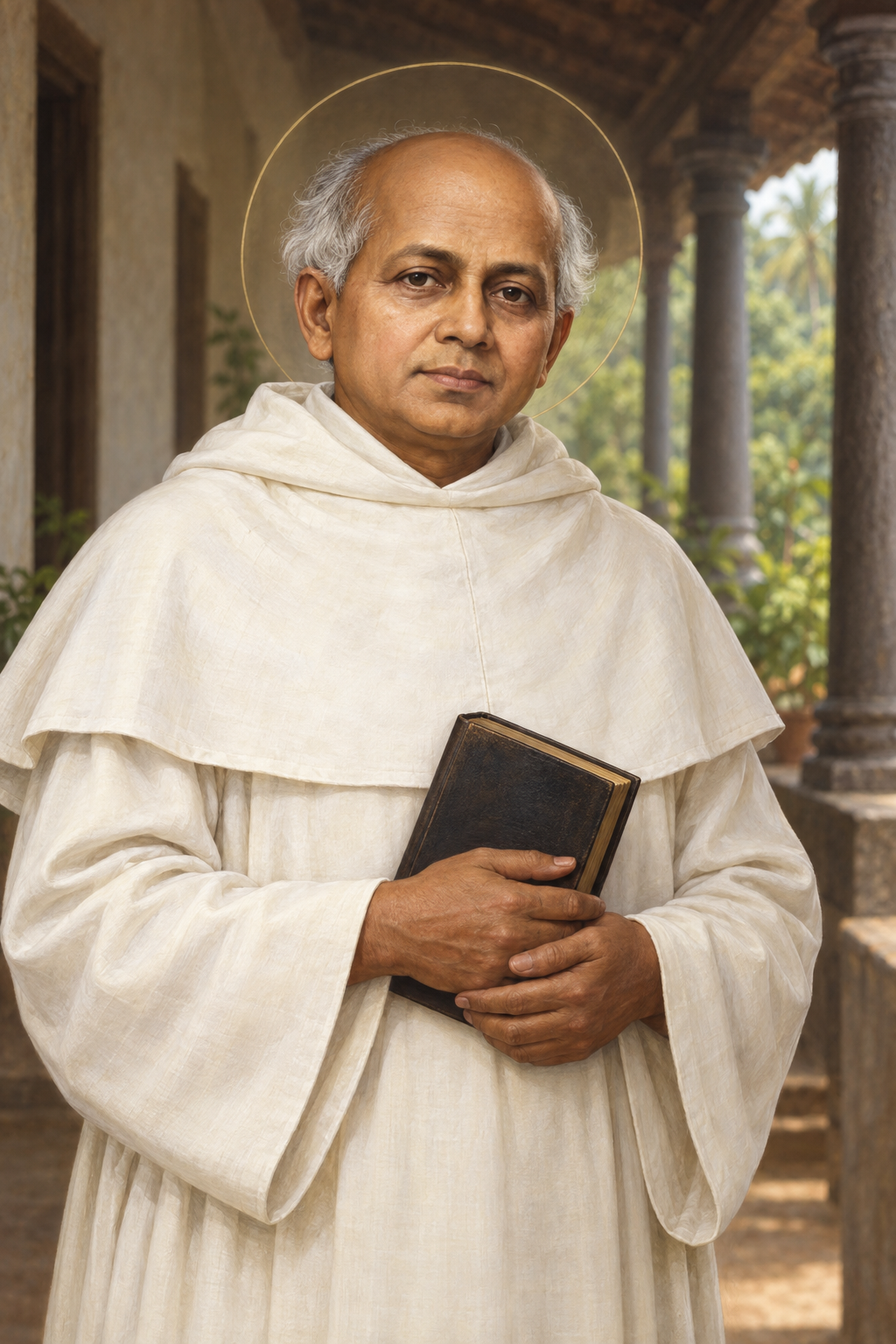
About Kuriakose Elias Chavara
Kuriakose Elias Chavara was a priest of the Syro-Malabar Catholic Church whose work in Kerala joined religious community life with education, publishing and care for people in need. Born at Kainakary in 1805, he began learning in a village school under a Hindu teacher. He later studied with his parish priest and entered the seminary at Pallipuram. After his ordination in 1829, he served in pastoral ministry and returned to the seminary as a teacher.
His vocation developed through collaboration. Thomas Palackal and Thomas Porukara were already planning a religious community when he joined them. Chavara went to Mannanam to oversee construction, and the foundation stone of their house was laid in 1831. Following the deaths of his two senior collaborators, he assumed leadership. The community became the Carmelites of Mary Immaculate.
He made his religious profession in December 1855, taking the name Kuriakose Elias of the Holy Family. His work also extended to women’s religious life. In 1866, he worked with the Italian Carmelite Leopold Beccaro to establish a convent at Koonammavu for women’s education and spiritual formation. The foundation subsequently developed into separate Latin and Syro-Malabar congregations.
Education was a central concern, but later descriptions sometimes simplify how the schools began. Historian A. Mathias Mundadan distinguishes the Sanskrit school at Mannanam from the English school established there after Chavara’s death. He also examines the parish-school decree: the surviving manuscript is in Chavara’s handwriting, but the decree formally came from the archbishop. Mundadan considers Chavara’s initiative and recommendation the likely explanation. The distinction preserves his contribution without making him the sole author of every institutional development. Mundadan also records a proposed chapel and school for Pulaya converts, supported by monastery resources. He cautions that the precise opening date of the Sanskrit school is not securely established by the source often cited for it.
Publishing supported this wider pastoral work. He prepared a liturgical calendar in 1862 and supervised the printing of prayer books in Malayalam at Mannanam.
His public responsibilities brought conflict as well as institution building. In 1861, as vicar general, he opposed Bishop Thomas Roccos’s intervention in the Kerala Church. Catholic accounts remember this as a defense of communion with Rome.
Mundadan places the dispute within a longer struggle by the Saint Thomas Christians for autonomy and bishops of their own rite. Chavara recognized their dissatisfaction with rulers who used a different language and rite, but his proposed remedy was a European missionary bishop who would learn Syriac and adopt their rite. His position therefore combined concern for local religious life with loyalty to the missionary authorities.
Chavara’s own writing makes his understanding of family life more concrete. His 1868 Chavarul, or Testament of a Loving Father, was addressed to his people at Kainakari. He asked them to preserve it and read it together regularly. Its advice ranged from forgiveness within the household to restrained spending, timely payment of workers and the education of children. Parents were to follow their children’s school progress and teach by their own conduct.
The household timetable he prescribed joined morning prayer, meals and evening reading. He expected families to keep their prayer routine even when visitors arrived, and to revisit his instructions together.
The text also carries the severity of its period. It warns against books considered heretical and accepts corporal punishment and rationing children’s food, even while warning that excessive anger damages trust. Alongside these restrictions, it insists that children’s consent be obtained before arranging marriages and that their choice of vocation should not belong to their parents. These contrasting instructions are part of the historical document, rather than a modern parenting guide.
Chavara became seriously ill late in 1870 and was blind during his final months. He died at Koonammavu on January 3, 1871. His remains were later transferred to the congregation’s motherhouse at Mannanam.
John Paul II beatified him at Kottayam on February 8, 1986, alongside Alphonsa of the Immaculate Conception. In his homily, the pope emphasized the way Chavara’s work continued through the religious communities he helped establish. He recalled seminaries, retreats, Catholic publishing, schooling, instruction for people preparing for baptism and a home for the destitute and dying. The address also linked his practical work with devotion to the Eucharist and Holy Family, and with his concern for unity within the Church.
Pope Francis canonized Chavara on November 23, 2014. The canonization booklet identifies him as a patron of families in connection with his Testament.
His institutional legacy also has a particular local expression in Kerala. The Chavara Cultural Centre in Kochi identifies him as its patron and describes its continuing mission through education, culture and social harmony. Chavara Public School identifies him as patron of CMI institutions. These communities preserve his memory through work in learning and public life, as well as through religious devotion.
Wondering how to weigh the stories and sources? Learn how to read a saint biography.