Biography
Laurence Imbert
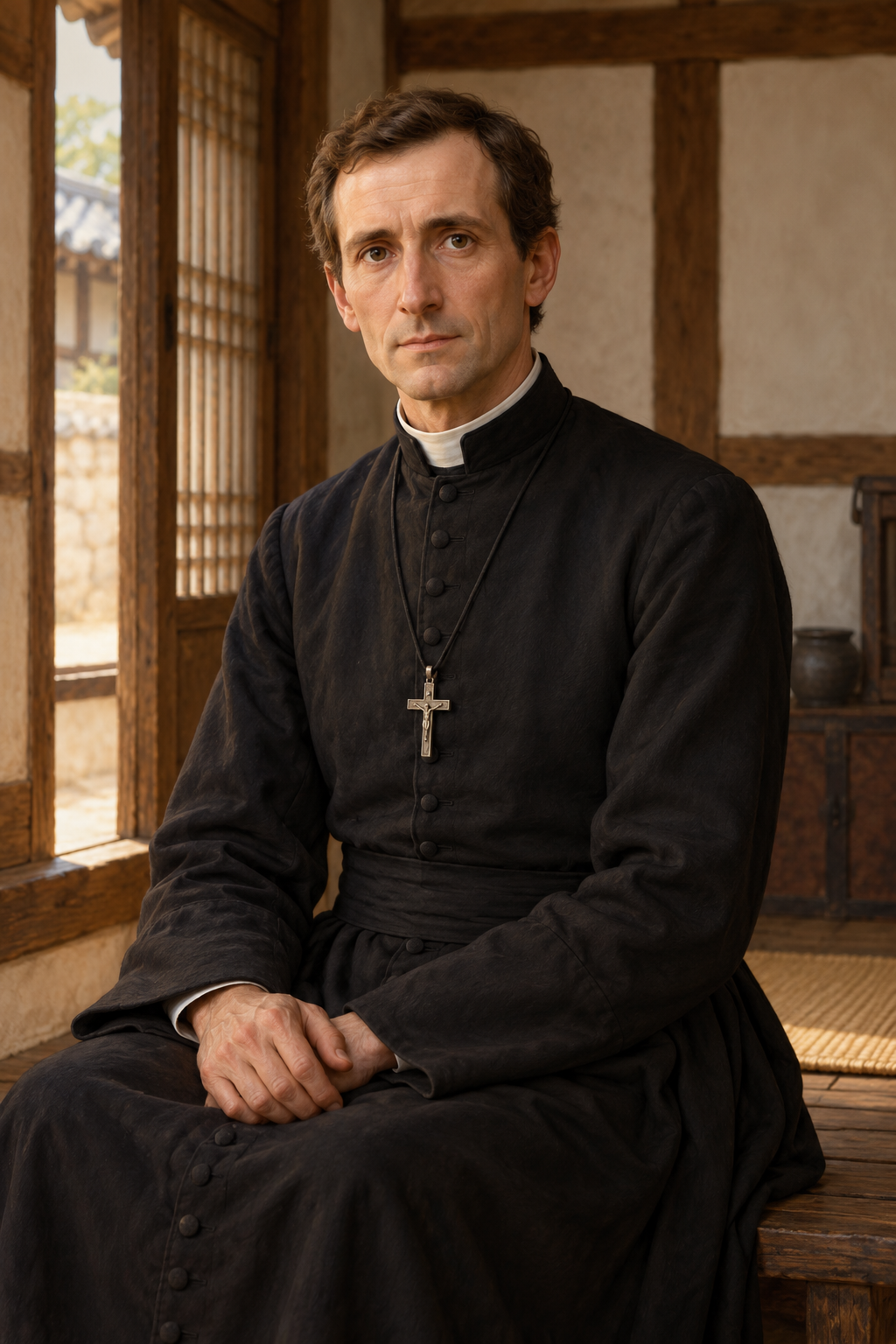
About Laurence Imbert
Born at Marignane in France on March 23, 1796, he came from a family whose home was in the nearby hamlet of Callas. Laurence Imbert studied in Aix before entering the Paris Foreign Missions seminary in October 1818. He was ordained a priest the following year and left France for an assignment in Sichuan in 1820. The journey took several years: he taught at the college in Penang, ministered in Tonkin and finally reached Sichuan in 1825. There he directed the seminary at Moupin. He offered to serve in Korea when the society considered taking responsibility for its Catholic communities. After Bishop Barthélemy Bruguière died before entering the country, Imbert was chosen to succeed him. He was consecrated a bishop in May 1837 and left Sichuan later that year.
Writing from Mukden in December 1837, Imbert described the precautions taken on his journey toward Korea. Snow made a route through the desert seem too dangerous, so he chose the imperial road instead. He and his companions traveled on horseback, wearing caps like those of Tartar officers to avoid questioning at customs posts. At another checkpoint, where travelers were required to dismount, he hired a guide who led him past a damaged section of the wall at night. His horses and belongings followed separately. A Christian household gave him shelter, and another received him outside Mukden. He stayed outside the city rather than visiting its monuments, explaining that caution prevented sightseeing. From there he hoped to reach the frontier during the annual market and find the Korean Catholics expected to escort him.
A shorter letter to Legrégeois, the mission procurator at Macao, reported that the rendezvous had succeeded. Five Korean Catholics had arrived: two would accompany the embassy to Beijing, while three would guide him into Korea. Imbert described their meeting warmly and planned to leave the following night. His letter also recorded lengthy delays along the route and the journey still ahead before reaching the capital.
In November 1838, Imbert gave the mission’s directors an account of his arrival and first year. He recalled crossing the frozen Yalu River after dark, close enough to a guard post that the travelers feared being heard. They reached an inn where Catholics were waiting to help conceal him. During the onward journey he kept his hair covered and his face screened so that strangers would not recognize a European. He reached Seoul at the end of December and spent New Year’s Day with a Catholic family. Peter Maubant joined him that evening; Jacques Chastan was traveling farther south and did not meet him until May. Imbert reported visiting communities with his colleagues before returning to Seoul late that month. He then heard confessions despite his still-limited Korean. The letter describes this work alongside the responsibilities of administering the mission, which left the three priests little time for other preaching.
In a separate letter to Henri Bolot, Imbert described the hardship of families driven from their homes because of their religion. He reported that some had settled in remote mountain areas with little land suitable for cultivation. Their hunger weakened them further, and he said that some survived on acorns and wild roots. He included news from Chastan about money distributed to families in need and deaths that the assistance had not prevented. Both priests had stayed with him in the capital during the summer, while many rural Catholics were occupied with farming. In October they resumed visits outside Seoul; Imbert intended to follow after sending the couriers away. His plans also extended beyond Korea. He asked Chastan to send a catechist to make contact with Japanese people in the south and inquire whether Christian communities still survived in Japan. The letter records an intended inquiry, rather than proof that those hoped-for contacts were established.
Maubant’s letter to the procurators in Macao, written two days later, adds details of Imbert’s work within the Korean church. He reported that the bishop had revised religious books and arranged daily and Sunday prayers. Imbert had also taken responsibility for a share of the Catholic communities, joining the pastoral work already carried out by the two priests. Maubant recorded several local persecutions during the year and acknowledged that some believers had renounced their religion. The work on books and prayers therefore took place while communities were facing repeated disruption.
During the wider persecution of 1839, Imbert took refuge near Suwon. The Korean bishops’ conference account says that he surrendered to protect the Catholics sheltering him. After his arrest he asked Maubant and Chastan to give themselves up as well, hoping that the authorities would spare other believers. The priests followed his request. Interrogation and torture did not persuade the three missionaries to renounce their faith. They were condemned to death and executed at Saenamteo on September 21, 1839.
Wondering how to weigh the stories and sources? Learn how to read a saint biography.