Biography
Adalbert of Prague
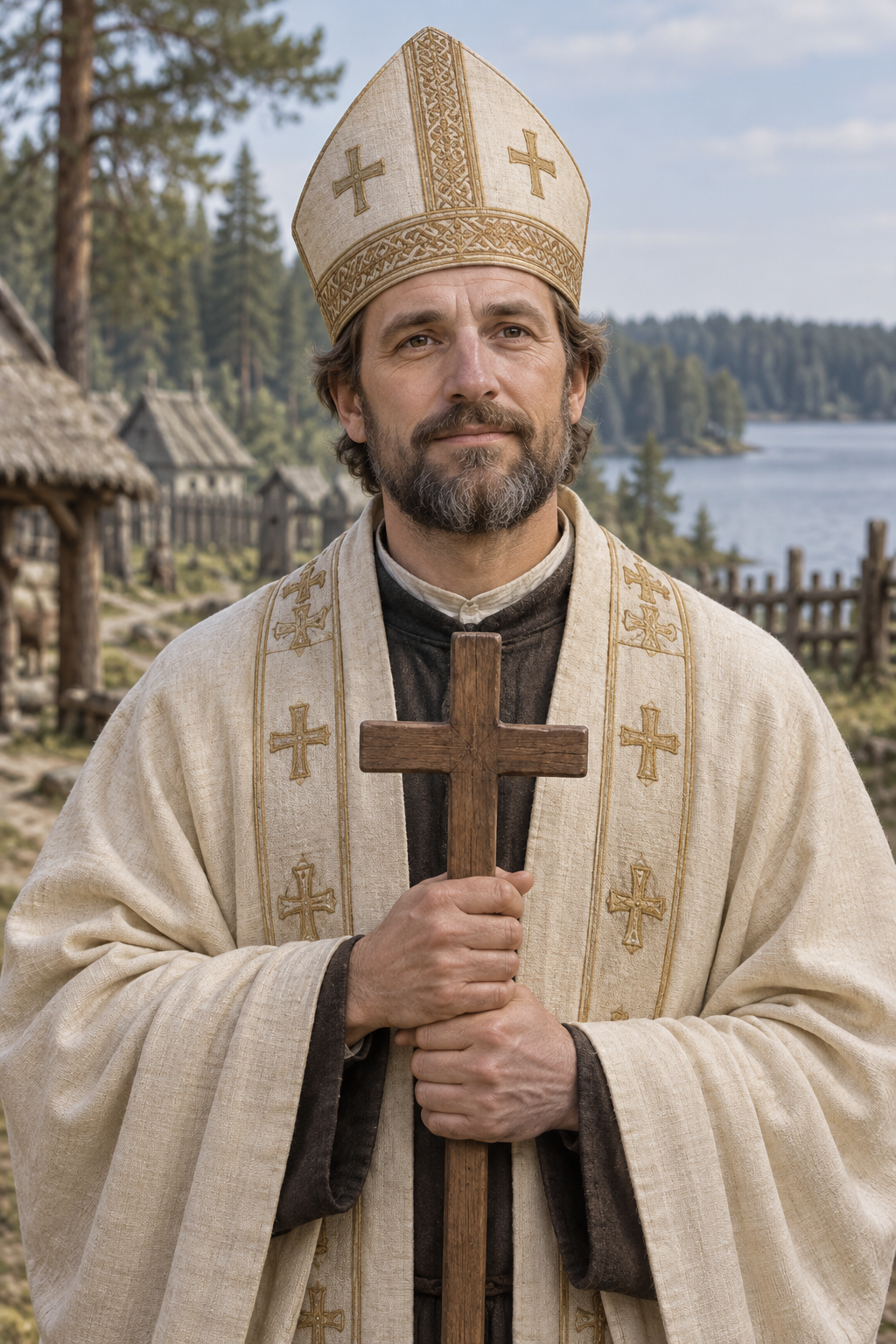
About Adalbert of Prague
Adalbert of Prague was a Bohemian bishop whose ministry led him repeatedly beyond his homeland. He was born around 956, although his exact birthday is not established. The religious account preserved by Vatican News describes his education under Archbishop Adalbert at Magdeburg and his adoption of that name at confirmation. It also remembers his demands for chastity among clergy, justice from rulers and a Christian way of life among the people he served. These demands brought him into conflict with the society around him.
His family belonged to the house of Slavník, and his earlier name is remembered in Czech as Vojtěch. He became Bishop of Prague in 983. His encounters with Benedictine life began during his education and later offered him a different setting for religious service. After disputes with the Bohemian aristocracy, he left for Rome at the end of 988. There he entered the community of Saints Boniface and Alexius on the Aventine. His departure interrupted his work as bishop, but did not end his connection with Prague.
The return to Prague was difficult as well. John Paul II's account describes a bishop who came back when circumstances seemed more favourable, only to face renewed opposition. Adalbert again left his homeland and continued his work as a missionary. The account places him in Pannonia, associated with present-day Hungary, and then at the court of Boleslaw the Brave in Gniezno. These changes of setting are part of his story: episcopal office, monastic life and missionary travel did not unfold as an uninterrupted ascent in public influence.
One lasting result of his return was the foundation of Břevnov with Duke Boleslav II. He brought monks from the Aventine community, giving the new house a connection with the religious life he had known in Rome. The monastery's history identifies a papal document dated May 31, 993, as early evidence for the foundation. It names Anastasius as the first abbot. Břevnov became a continuing institution even though Adalbert's renewed residence in Prague was brief.
The monastery also preserves a different kind of account of its beginning. According to its foundation legend, the duke and bishop received matching dreams directing them to a spring. They met there and saw a stag unable to drink because a log obstructed the water. Adalbert removed the log, allowing the animal to drink. The community's visitor guide explicitly presents this as legend and connects the log with its coat of arms. The story belongs to the monastery's remembrance of its founders; it does not establish the circumstances of a historical meeting.
Renewed hostility also affected Adalbert's family. Vatican News relates that, while he was away, members of his family were killed and their property seized. Learning that his return was unwelcome, he found refuge with Boleslaw in Poland. The same account describes his later preaching in Prussian territory and dates his killing to April 23, 997. Its reported speeches and detailed scenes of captivity belong to the religious narrative of his martyrdom; they are not treated here as a surviving transcript of his words.
His mission also entered the memory of Gdansk. In a homily there in 1999, John Paul II recalled Adalbert's arrival in 997 and his preaching and baptismal ministry. The celebration marked a thousand years since the Church's recognition of him as a saint. That commemoration linked the missionary's brief presence with a religious inheritance sustained by later generations. The pope's account witnesses to the place Adalbert holds in the local Church's memory, rather than supplying a precise modern site for his death.
Boleslaw had Adalbert's body brought to Gniezno after paying a ransom. The shrine became the setting for a meeting between Boleslaw and Emperor Otto III in the presence of a papal representative. At Gniezno the announcement of a Polish metropolitan see connected remembrance of the martyr with the developing organization of the Church. Krakow, Wrocław and Kolobrzeg were joined to that metropolitan see. The political and ecclesiastical consequences extended beyond the short mission that had ended in Adalbert's death.
His memory also remained rooted in Bohemia. Prague Castle's historical account identifies Adalbert among the country's patron saints whose relics were kept in the principal castle church. The castle was both a seat of political authority and a centre of episcopal life. Remembering Adalbert there placed his religious legacy alongside the institutions that shaped the country's public history. This surviving connection should be distinguished from a claim that any modern building or devotional portrait reproduces the surroundings of his own lifetime.
The millennium of his death brought that legacy into public discussion again in 1997. In Prague, John Paul II recalled the decade of spiritual renewal proposed by Cardinal František Tomášek to prepare for the anniversary. The celebrations considered both religious and civic history, presenting Adalbert as a Czech figure whose influence crossed national boundaries. The pope announced a visit to Břevnov, the monastery associated with his work. A life marked by departures and resistance had become a point of remembrance shared by neighbouring peoples.
Speaking to heads of state at Gniezno, John Paul II linked Adalbert's influence with service to poor people and defence of human dignity. He also emphasized the different cultures the bishop encountered through education, pilgrimage and mission. Adalbert's enduring significance lies in these connected histories of Bohemia, monastic Rome and the Baltic mission, and in the communities that continued to remember him after his death.
Wondering how to weigh the stories and sources? Learn how to read a saint biography.
Explore similar vocations
Prayers for Adalbert of Prague
Adalbert of Prague: sourced prayer excerpt
Salvum fac populum tuum, Domine, et benedic haereditati tuae.