Biography
Lawrence
About Lawrence
Lawrence served the Christian community at Rome as a deacon and died during Emperor Valerian's persecution in 258. Those facts stand on firmer ground than most of the colorful stories attached to his name. Cyprian of Carthage reported that Valerian ordered bishops, priests, and deacons to be executed immediately. Cyprian also recorded that Pope Sixtus II and four deacons were killed in a Roman cemetery on August 6. An early Roman calendar places Lawrence's commemoration four days later, on August 10, at the Via Tiburtina. These near-contemporary and early liturgical witnesses locate Lawrence within a violent imperial policy and Rome's ordained ministry, although they say almost nothing about his childhood or formation.
No reliable source establishes Lawrence's birth date. Later tradition calls him Spanish and often names Huesca as his birthplace, but the evidence is late and internally varied. Stories that he studied at Zaragoza, met the future Sixtus there, and traveled with him to Rome are devotional reconstruction rather than documented biography. Even the title archdeacon or proto-deacon, while longstanding, is not supplied by Cyprian's report. What can be said more securely is that Roman memory identified Lawrence as a deacon and distinguished his burial and feast very early. Removing the database's exact 225 birth date is therefore not a loss of useful history; it prevents a traditional estimate from appearing as a civil record.
A Roman deacon's work in the third century involved service within the church, and later accounts especially connected Lawrence with care of communal goods and people in need. The best-known version appears in Ambrose of Milan's late-fourth-century work on clerical duties, written more than a century after Lawrence's death. Ambrose says that persecutors demanded the Church's treasures. Lawrence gathered poor people and presented them as the Church's true treasures. He preferred, Ambrose explains, to use gold for poor people instead of preserving it for persecutors. This is early and influential tradition, not an eyewitness account. It nevertheless gave concrete form to the remembered meaning of Lawrence's diaconal service: resources entrusted to the church existed for people, not merely for safekeeping.
The same Ambrosian tradition ties Lawrence closely to Sixtus II. In Ambrose's telling, Lawrence sees the bishop being led to death and asks why the father is leaving his deacon behind. Sixtus answers that Lawrence will follow after three days and face a greater trial. The scene expresses the bond between bishop and deacon and explains the four-day interval between their commemorations. Cyprian confirms Sixtus's execution with four deacons, but he does not name Lawrence among those killed on August 6 or preserve this farewell. The dialogue must therefore remain attributed to Ambrose. Its value lies in fourth-century reflection on ministry and companionship, not in providing a verbatim exchange from the cemetery.
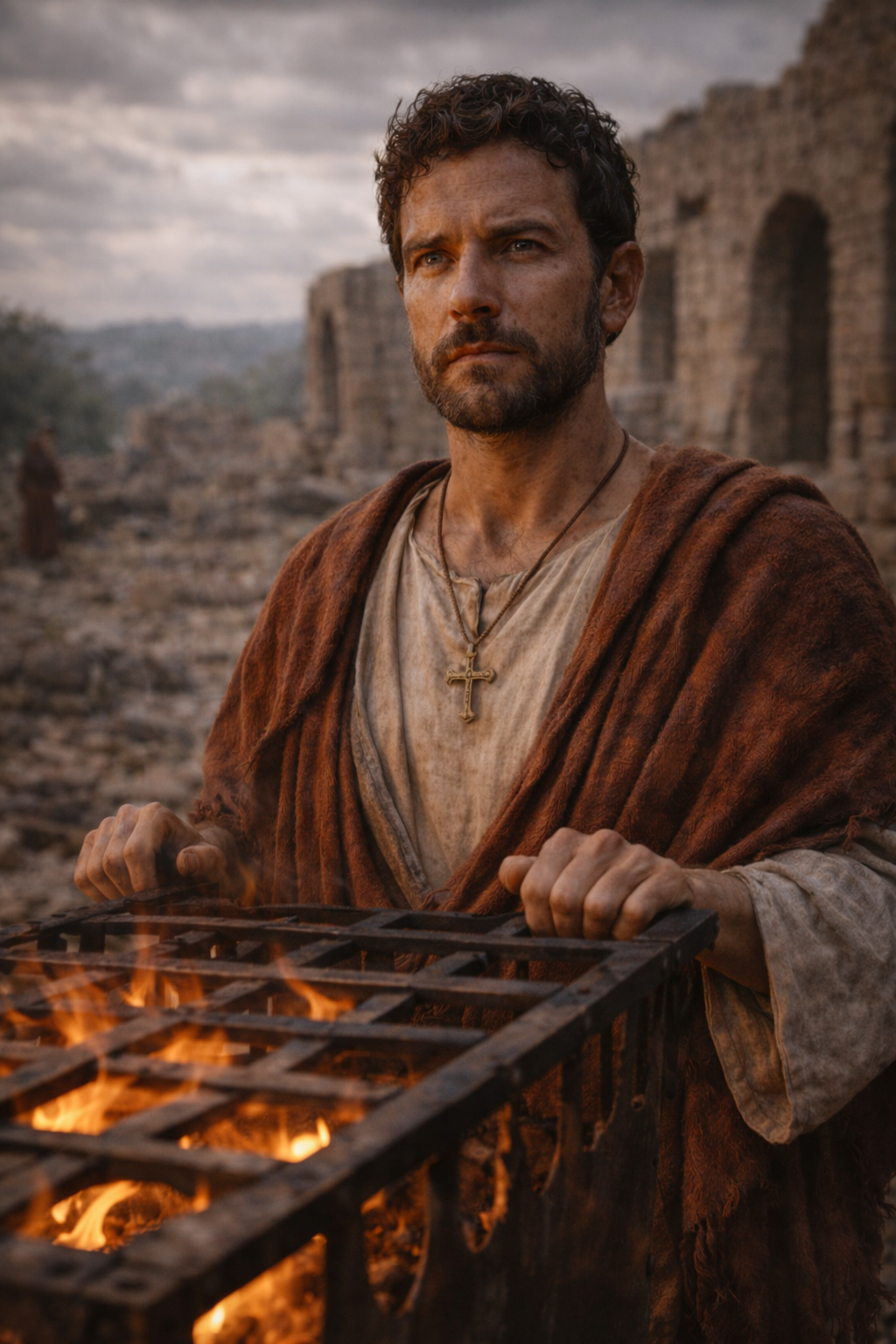
Lawrence's manner of death is similarly layered. Roman commemoration firmly places his martyrdom under Valerian in 258 and his burial on the Via Tiburtina. By the fourth century, Ambrose and other Christian writers described death by fire, and later devotion fixed on a metal gridiron. The often repeated joke asking persecutors to turn him over appears in later narrative and should not be quoted as certain speech. Some modern historians have questioned whether a Roman official would have used this method when Valerian's decree called for immediate execution. The evidence supports execution and burial; death by fire is an early tradition; the elaborate torture scene and exact dialogue belong to hagiographic development.
After Lawrence's death, Roman Christians buried him on the Via Tiburtina. His grave became one of Rome's most important martyr shrines, eventually associated with the basilica of San Lorenzo fuori le Mura. The fourth-century Depositio martyrum already records his August 10 observance, showing that devotion was established well before the fullest written Passion narratives. His name entered the Roman Canon, and churches across different traditions continued to keep his feast. These developments document reception rather than fill the silence around his early years. They also support map entries for Rome and the Via Tiburtina burial area while offering no warrant for an exact execution site or a plotted route from Sixtus's cemetery to Lawrence's death.
Lawrence's memory became a sustained interpretation of the diaconate. The Vatican Congregation for the Clergy presents his service of charity and martyrdom together, while acknowledging that the personal narrative comes through traditions already widespread by the fourth century. The Orthodox Church in America honors him as archdeacon and martyr and preserves the accounts of distributing goods and enduring the gridiron. These communities do not provide independent contemporary confirmation of each episode; they show how ancient traditions remain active in worship. Recording Roman Catholic and Eastern Orthodox observances separately respects their jurisdictions even when both use August 10. Recording deacon and martyr separately also prevents a broad legacy category from obscuring his office and witness.
The strongest portrait of Lawrence therefore combines a small documented core with an influential traditional interpretation. He was a Roman deacon caught in Valerian's targeted violence against church leaders. He died in 258, was buried on the Via Tiburtina, and was commemorated on August 10 from an early period. Ambrose's later account remembers him turning church wealth toward poor people and calling those people the Church's treasure. Whether or not every detail occurred as written, that narrative has shaped Christian expectations of responsible stewardship for centuries. Lawrence remains significant as a martyr whose ancient Roman cult is historically secure and as a deacon whose received story insists that institutional resources be measured by their service to vulnerable people.
Wondering how to weigh the stories and sources? Learn how to read a saint biography.