Biography
Leonard van Veghel
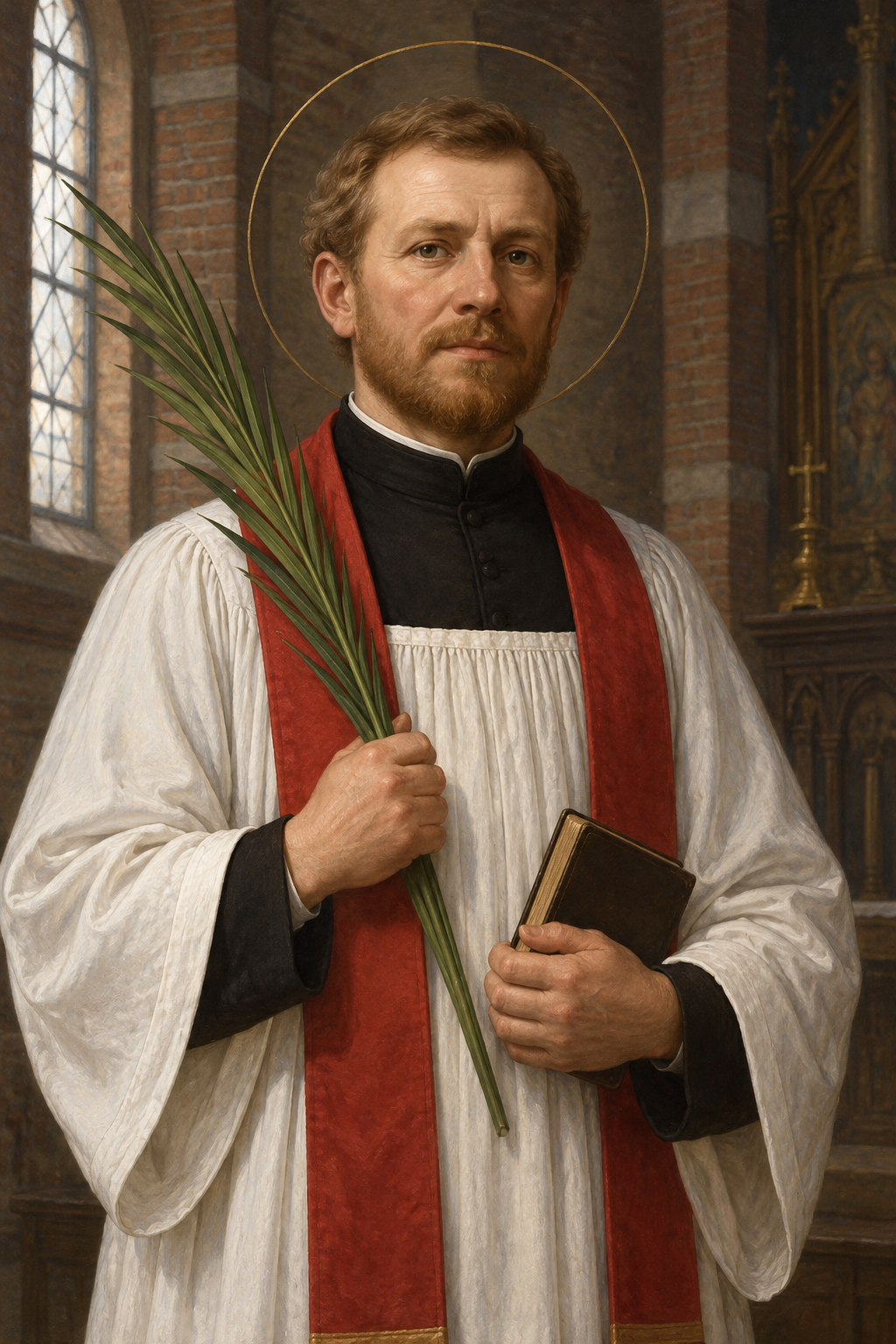
About Leonard van Veghel
Leonard van Veghel was a diocesan priest in Gorinchem, also known as Gorcum, and one of the nineteen Catholic clergy remembered as the Martyrs of Gorcum. Born around 1527 in ’s-Hertogenbosch, he was the son of a candlemaker. His family name also appears as Vechel, and documents preserve several forms of his personal name.
His education took him to Leuven. The scholarly register Noordbrabantse studenten records his enrollment in February 1545 and his arts degree in March 1547, when he ranked third among 185 candidates. He then studied theology at the Pope’s College. The register distinguishes this training from a later planned theological promotion, dated to July 1572. Modern accounts disagree over the degree chronology, so it is safer not to describe him as having completed that later qualification.
He became a parish priest at Gorcum in 1556. A diocesan account remembers him as learned, eloquent and sincere. It also describes his relationship with Nicholas Poppel, whom he called to serve as a chaplain in 1558. When Poppel considered entering the Jesuits, Leonard was among those who persuaded him that his work remained in Gorcum. Their ministry joined the parish clergy with the wider religious life of the town.
The same diocesan leaflet says that he declined a parish appointment at Gouda in the year before his death, while tensions were increasing in Gorcum.
The Catholic Church in Norway’s biography preserves a particularly practical account of his charity. It describes his concern for sick people in poverty and his provision of peat, cheese and flour during summer so that households would have help in winter. It also recalls a preacher who rebuked wrongdoing without regard to social rank. These details come through the devotional biography and show how his pastoral care was remembered.
The same account places him firmly within the religious and political divisions of his time. He opposed Calvinist teaching and urged loyalty to both the Catholic Church and the king. His ministry unfolded during resistance to Spanish rule, when religious allegiance and political suspicion were closely entangled. Remembering his death does not require treating every Protestant or every opponent of Spain as responsible for the violence that followed.
In June 1572, the Sea Beggars captured Gorcum. Leonard and other clergy had taken refuge in the Blauwe Toren castle, where they were arrested and mistreated. He briefly obtained an opportunity to leave toward his home city, but was seized again at Woudrichem and returned to captivity. In early July, the prisoners were taken through Dordrecht to Brielle.
William of Orange ordered that the clergy be released. The commander Lumey refused to comply. The regional Canon van Nederland account emphasizes this division between the rebel leader’s order and the conduct of the men holding the prisoners. The killings were therefore not simply the execution of a common policy shared by all opponents of Spanish government.
Leonard and eighteen companions were hanged at Brielle on July 9, 1572. Their group included diocesan priests and members of several religious communities. The shrine’s account presents their martyrdom as fidelity to Christ expressed through love and forgiveness, rather than a model of violence against others.
The story reached later generations through accounts shaped by both testimony and religious interpretation. Maria-Theresia Leuker identifies Willem Estius’s 1603 history as the central source. Estius drew on research and witness conversations gathered by his brother, and one of the executed men was his uncle. His narrative interpreted the prisoners’ suffering through the Passion of Christ. Nineteenth-century authors went further, adding fictional dialogue and developing Leonard as an exemplary central figure. Such retellings should be distinguished from a record of his exact words.
Leuker also places the renewed nineteenth-century interest in the martyrs within Dutch Catholic emancipation. After the restoration of the episcopal hierarchy in 1853, accounts of national Catholic saints helped a community assert its place in the country’s history. The stories served both religious devotion and public identity.
Pius IX canonized the nineteen martyrs on June 29, 1867.
In Leonard’s home city, a statue by Jos Graven was installed in Saint John’s Cathedral in 1872. A confraternity established in 1874 placed itself under the martyrs’ protection, especially Leonard’s, and promoted annual pilgrimage to the place of their death. The Meertens Institute nevertheless distinguishes this devotion from an established pilgrimage cult centered on his cathedral statue. His local feast is celebrated on July 9.
His devotional image reflects his ministry and death. Artists show a priest in cassock, white surplice and stole, carrying a palm, crucifix or chalice. These are traditional identifying attributes, rather than evidence for his precise appearance.
The cathedral also commemorated the martyrdom’s 450th anniversary in 2022.
In 2023, descendants of Leonard’s brother established the Gast-Vechel foundation and lent family religious objects to Saint John’s parish, including a reliquary, chalice and signed confession certificate.
Wondering how to weigh the stories and sources? Learn how to read a saint biography.