Biography
Leonardo Murialdo
About Leonardo Murialdo
Murialdo was born in Turin on 26 October 1828 and studied with the Piarists in Savona. Paul VI later described his family as well-to-do.
His congregation says his father was a wealthy currency broker who died in 1833. Murialdo studied in Savona from 1836 to 1843, returned to Turin and pursued theology. The account is a later institutional biography, useful for the outward sequence but less direct for his private struggles. His training gave him a path into priestly work at a time when Turin was changing through urban growth and new forms of labor. That setting would later bring him into contact with young people seeking food, education and employment.
Benedict XVI recounts Murialdo's adolescent religious crisis as Murialdo himself later understood it. That testimony should be identified as an account of his own spiritual experience, rather than treated as a diagnosis of the young man's inner life. He chose the priesthood and was ordained on 20 September 1851. The pope describes work at the Oratory of the Guardian Angel and later the San Luigi oratory. These settings brought teaching, religious formation and recreation together for young people in Turin's poorer neighborhoods.
Benedict XVI records that Don Bosco entrusted Murialdo with the San Luigi oratory, which he directed until 1865. There, catechesis, schooling and recreation were linked in an educational method for young people facing poverty. The oratory offered sustained contact with families and local conditions, which the pope says deepened Murialdo's social concern. It was a communal undertaking involving other clergy, teachers and young people, not a school made by one priest alone. His later initiatives built on the relationships and practical experience gained in these Turin neighborhoods.
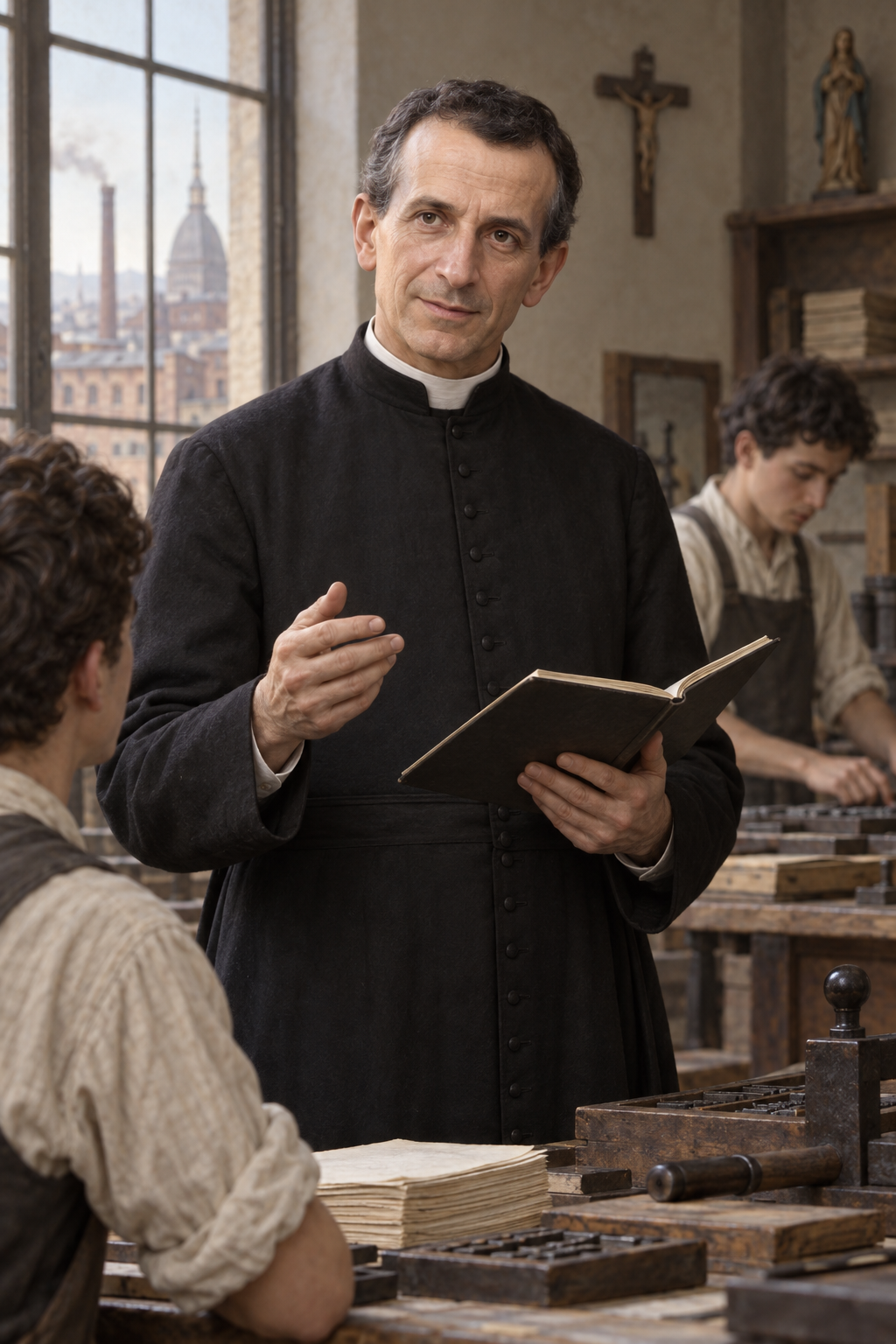
The Artigianelli college already existed when Murialdo arrived as rector in 1866. MuseoTorino's separate history of the institution says its internal workshops expanded under his direction and a print shop was installed in 1876. Practical training was part of a broader program that included schooling, residence and religious education. The workshop setting did not make every young person a secure adult worker, but it offered skills to those facing limited choices. Remembering the college's earlier founders and teachers keeps the story from becoming a one-man foundation.
The city profile says roughly 150 boys were at the Artigianelli when he took charge, with older apprentices in workshops and younger pupils taught by instructors. It also records debt, interest payments and a weak flow of donations. The task was therefore not only pastoral: it required funding, staffing, instruction and a place where residents could live. Some of the older pupils became teachers or assistants for younger ones. Such details show how the college functioned through an interdependent community, and why expansion meant continuing financial pressure.
Paul VI's canonization homily identifies a petition Murialdo sent to the Italian government in December 1869 seeking rules for factory work by women and children. A papal homily gives the act as a remembered example of social concern; the original petition is not reproduced there, so its full wording and legislative effect should not be inferred. The request connects his educational work to conditions outside the school: young people needed protection in workplaces as well as training. The same homily describes his well-to-do origins.
On 19 March 1873 Murialdo founded the Congregation of Saint Joseph at the Artigianelli. Its own institutional account says the community was intended to educate and prepare poorer, orphaned and abandoned young people for work. The choice of Saint Joseph connected religious identity with the image of a worker and educator. The stated purpose should be read in its nineteenth-century context: technical instruction and Christian teaching were combined, not separated into unrelated programs. The community provided people willing to make that service a continuing commitment.
The Dicastery identifies Eugenio Reffo as a cofounder who served at the Artigianelli and later wrote Murialdo's biography. His contribution belongs in the history of the congregation.
Murialdo also worked through Catholic labor associations and print. A historical account from his congregation describes his participation in the Catholic Workers' Union and the paper that became *La Voce dell'Operaio*. Such organizations offered a Catholic response to industrial change and drew on lay involvement, not only clerical direction. The same account records educational difficulties and strained relations with government funding at a reform institution connected to this network. These limits help explain why Murialdo's projects required adaptation and cooperation rather than uninterrupted growth.
The congregation's short life says he later helped establish a family home, an agricultural colony and other oratories. These offered different environments for young people, rather than one school duplicated under new names. Its account also places him in Piedmontese Catholic associations and publishing. The description is institutional memory and naturally emphasizes continuity of the congregation's mission; it does not measure the outcomes for every child who entered. Murialdo died in Turin on 30 March 1900, after more than three decades at the Artigianelli.
Paul VI beatified Murialdo on 3 November 1963. In that homily the pope emphasized the social shape of his work, especially education and the dignity of people doing manual labor. The homily is an official Catholic interpretation, not a complete economic history of Turin. It nevertheless identifies why the priest's attention to young workers remained important to the Church: he linked personal care to instruction and the conditions of employment. His collaborators and the young people themselves remain part of that historical picture.
Paul VI canonized Murialdo on 3 May 1970. The Dicastery lists 30 March as a memorial, while the congregation celebrates 18 May.
Wondering how to weigh the stories and sources? Learn how to read a saint biography.