Biography
Lodovico Pavoni
About Lodovico Pavoni
Lodovico Pavoni was born in Brescia on 11 September 1784 to a local noble family. His childhood gave him resources later used in education.
Pavoni was ordained a priest on 21 February 1807. A historical timeline published by his congregation places the ceremony at San Pietro in Oliveto. The precise setting matters because the Brescia episcopal seat had been disrupted in the Napoleonic period. After ordination Pavoni continued teaching in city oratories. His attention turned especially to boys who were poor, lacked steady support or were already exposed to work. Priestly ministry and practical education developed together, rather than as separate careers.
The congregation he founded remembers an oratory opened in 1812 for boys who felt unable to join other city groups. Such a later account conveys the purpose of the work, although it cannot identify the feelings of every child who attended. Pavoni also served Bishop Gabrio Maria Nava as secretary. That office connected him with diocesan administration while he kept working with young people. The two commitments explain how a modest oratory could later grow into a more stable institution with church support.
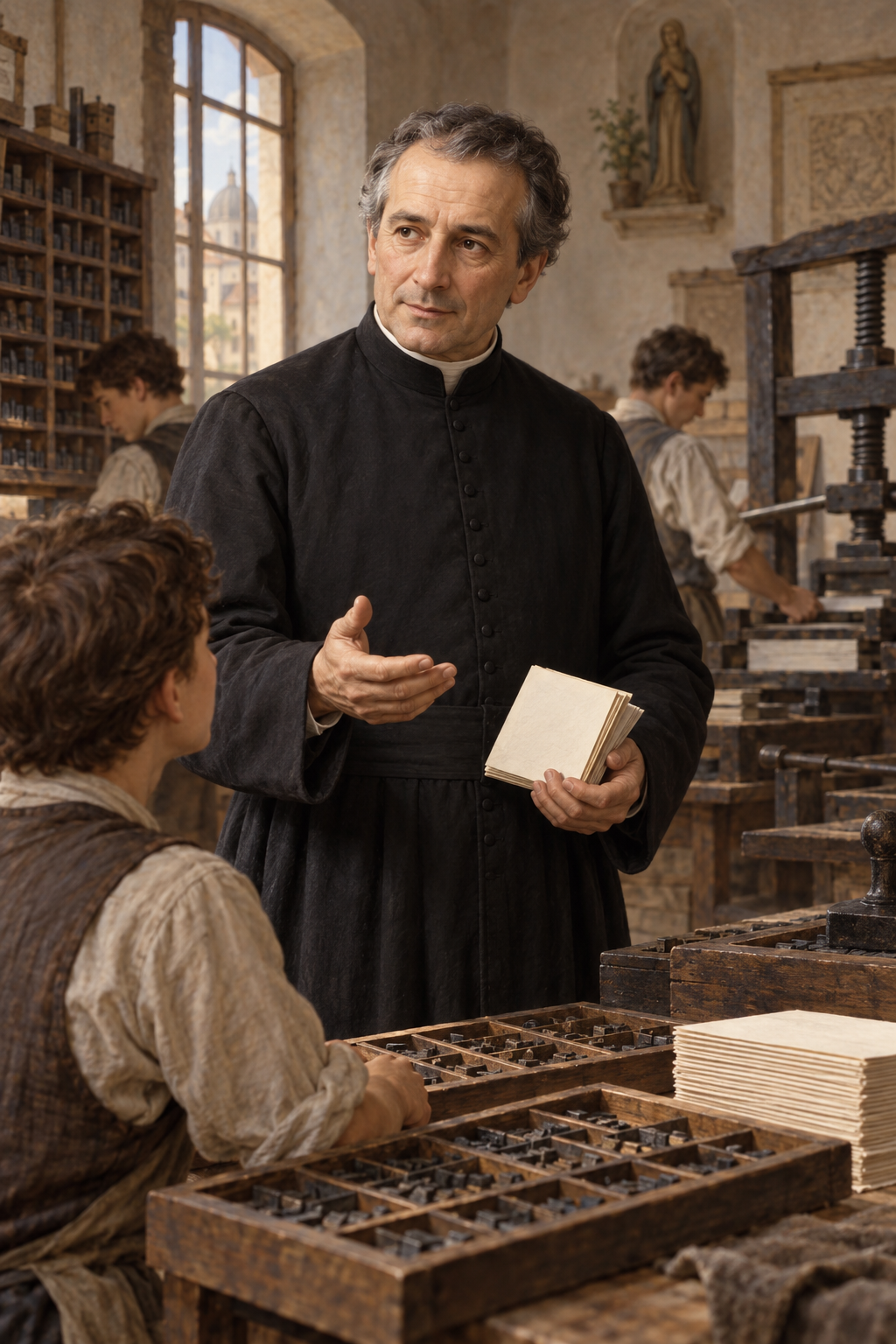
By 1818 Pavoni had drafted rules for the oratory and become rector of the church of Saint Barnabas. The congregation's 2021 review of documents says the institute formally began in June 1821; Pavoni sought a printing license a month later. It offered residence and Christian education while preparing boys for trades. The surviving petition joins the need for shelter to the hope of useful work. Calling it a college of arts captures the combination better than treating its workshops as ordinary factory labor. It also required teachers, space and supplies, which made the project a continuing institutional undertaking.
At the 2002 beatification, John Paul II described the reach of Pavoni's work from education to publishing and care for deaf young people. A homily is an interpretation of a life, not an institutional ledger, but it shows why the Church remembered these linked forms of service. The pupils' experience should not be reduced to the products they made: the stated aim included formation, shelter and a dependable community. That combination allowed a printing workshop to serve an educational purpose, even while its finances and daily outcomes still depended on people and resources.
The institute's response to the 1836 cholera epidemic shows how its educational mission met an immediate social need. BeWeB says Pavoni admitted boys left orphaned by the disease, increasing the number living there. The account does not provide a register of their individual lives, so the claim belongs to institutional history rather than a measured outcome for each pupil. The work required food, rooms and instruction as well as compassion. It also made the question of funding more pressing at a moment when more children needed care.
BeWeB, the Italian Church's cultural heritage portal, describes one response to that pressure: Pavoni offered a book subscription in return for small multiyear contributions. Books printed by the pupils would go to subscribers. This arrangement tied a workshop's output to support for the community and invited people outside the institute to share its costs. The portal also places his work amid Brescia's early industrial change, when some young people faced harsh conditions in new workshops. Those conditions help explain the institute's practical emphasis without claiming it solved the city's wider poverty.
A historical study by Roberto Cantù, excerpted in the congregation's 2021 magazine, explains how Saint Barnabas sought to combine assistance with schooling and vocational formation. That purpose went beyond giving children a bed or placing them at work; it aimed to let young people take part in shaping their futures. This was an aspiration described in institutional records, not proof that every lesson or workshop fulfilled it. Education, labor and religious formation sat within a larger argument about how to care for young people and who would govern such care.
The sources disagree on the first year in which deaf pupils joined the institute. They agree that Pavoni included them, expanding a community originally formed for poorer and orphaned boys. John Paul II remembered this care at the 2002 beatification alongside education and publishing. These were different forms of attention to young people, not one uniform program. The homily supports the inclusion of deaf pupils without settling its disputed chronology or recording what each child experienced. That limit matters when a commemorative source is used to reconstruct a school.
To carry the schools beyond his lifetime, Pavoni sought a religious community of priests and lay brothers. The congregation's timeline describes papal praise in 1843, imperial permission in 1846 and first professions in 1847. In that design priests and brothers shared one mission, while brothers also directed workshops and taught crafts. The congregation's establishment was a sequence of approvals and commitments, not a single spontaneous act. Other members undertook the daily instruction and labor that sustained the houses. Their contribution is part of the foundation's history even when the surviving biography chiefly names Pavoni.
In late March 1849, fighting reached Brescia during the Ten Days uprising. Pavoni led boys from the Saint Barnabas institute toward its house at Saiano. The Holy See describes a departure on 24 March; Treccani dates the rescue to 25 March. Rather than force those statements into one exact moment, the secure point is that he accompanied the young people away from danger. Later church accounts connect the journey in rain with the illness that followed. He died at Saiano on 1 April 1849, with the city's conflict still fresh.
John Paul II beatified Pavoni on 14 April 2002, and Francis canonized him on 16 October 2016. The Dicastery lists 1 April as his memorial; a permitted local observance falls on 28 May.
Wondering how to weigh the stories and sources? Learn how to read a saint biography.