Biography
Louis de Montfort
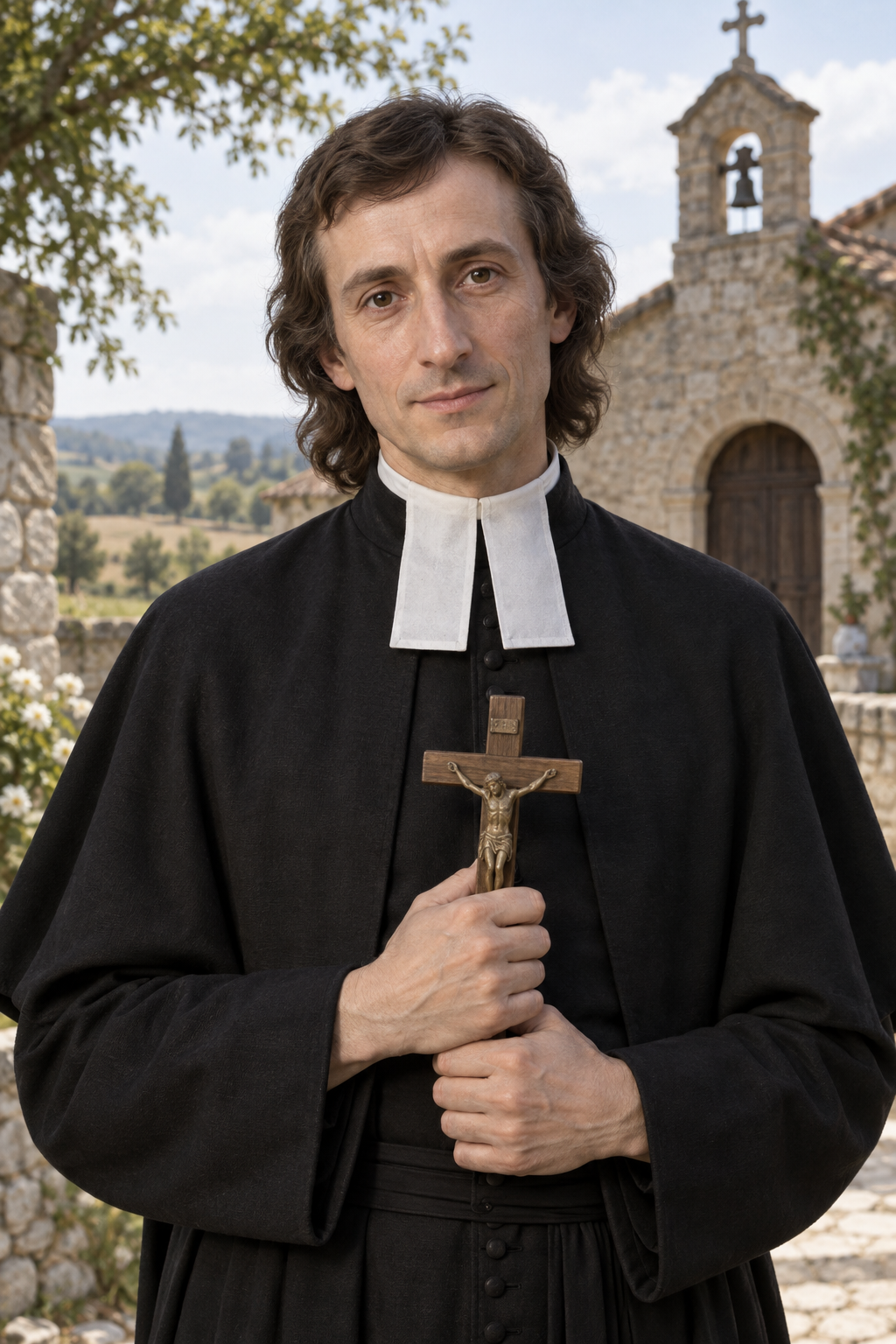
About Louis de Montfort
Louis de Montfort wanted to teach people whom other preachers seldom reached. In a letter written shortly after his ordination, he described the pull between a quiet, hidden life and the desire to teach the faith among poor country people. He did not pretend that his direction was already settled. Writing to his former seminary superior, he asked for guidance and imagined a small company of priests sharing that work. His hopes took shape through requests, disappointments and the needs of the people he met.
Born at Montfort on 31 January 1673, Louis attended the Jesuit college at Rennes. Poulain's account remembers him joining other young men who visited people in hospitals and read to them during meals. As a young adult he travelled to Paris for theological study. The same account tells how he gave away his money and exchanged clothes with poor people on the journey. These remembered acts of generosity anticipate the close identification with poverty that marked his later ministry.
Louis was ordained priest on 5 June 1700. After work at Nantes, he served at the General Hospital in Poitiers. In 1706 he went to Rome seeking direction from Clement XI, who appointed him an apostolic missionary. He returned to preach in western France. At Pontchâteau, a large Calvary project became a bitter disappointment when its blessing was prohibited. He continued his missions in the dioceses of Luçon, Saintes and La Rochelle, rather than abandoning the work.
His own account of arriving at Poitiers has a surprising reversal. He went to the poorhouse hoping to serve its residents, but they mistook him for someone needing help and collected money for him. He thanked them for their kindness. When they asked for him as their priest, he told his adviser that he was willing to give his time and health to them, although he had not intended to settle in a hospital.
At Poitiers he worked with Marie-Louise Trichet, whose vocation would be essential to the Daughters of Wisdom. The congregation dates its beginning, according to its tradition, to 2 February 1703. The partnership developed slowly, amid the practical demands of living among poor people. In 1715 Marie-Louise and Catherine Brunet moved to La Rochelle, and Marie-Louise encouraged Louis to put their rule into writing. After his death she continued the foundation, establishing communities, schools and places of care. Their shared undertaking was not simply the achievement of a preacher working alone.
Louis's rule for his missionary priests makes care for others unusually concrete. Poor people were to receive material help whenever possible, and were to be welcomed at the missionaries' table. He directed his companions to bear with one another's faults and to pray for people who had injured them. For preachers, he warned against seeking compliments, envying another speaker's audience or singling out an individual for public criticism. Time away from missions was to include rest and further study of preaching and confession. The rule joins demanding service to disciplines meant to keep zeal from becoming vanity or anger.
Prayer was also part of his effort to find companions. In the Prayer for Missionaries he asks for people ready to travel and serve, without being ruled by their own interests. His language is urgent, sometimes combative, and filled with the hope of a renewed Church. The missionaries he imagines must combine devotion with consistency, sound judgment and sincerity. For him, finding workers meant asking not merely for more people but for people formed for a particular way of life.
His writing about divine Wisdom begins with a very different tone: an admission of inadequacy. Addressing God, Louis asks that his imperfect words be accepted and that his readers grow in love. He presents writing itself as a search, offered with gratitude for the kindness he believes he has received. The teacher begins by acknowledging that he still needs to learn.
The best-known expression of his Marian teaching is True Devotion to Mary. John Paul II explained that this work remained unknown for more than a century before its discovery in 1842 and publication the following year. The pope recalled its importance in his own spiritual formation. He understood Montfort's devotion to Mary as directed toward Christ, not as a substitute for him. That reading helps explain why a missionary whose work began in particular French communities continued to reach readers far beyond them.
Louis died at Saint-Laurent-sur-Sèvre on 28 April 1716. Two priests had joined his company in the previous year, and his followers would carry the missions forward.
He was canonized in Rome on 20 July 1947. Marking that anniversary fifty years later, John Paul II remembered a saint whose prayer and preaching belonged together. He also noted that Montfort's language could surprise modern readers, shaped as it was by the religious culture of his own time. The lasting invitation lies in the connection between a life turned toward God and the desire to reach other people with faith and charity.
Wondering how to weigh the stories and sources? Learn how to read a saint biography.
Explore similar vocations
Prayers for Louis de Montfort
Louis de Montfort: sourced prayer excerpt
Accept, then, my loving Lord, these humble words of mine as though they were a masterly discourse.