Biography
Louis IX of France
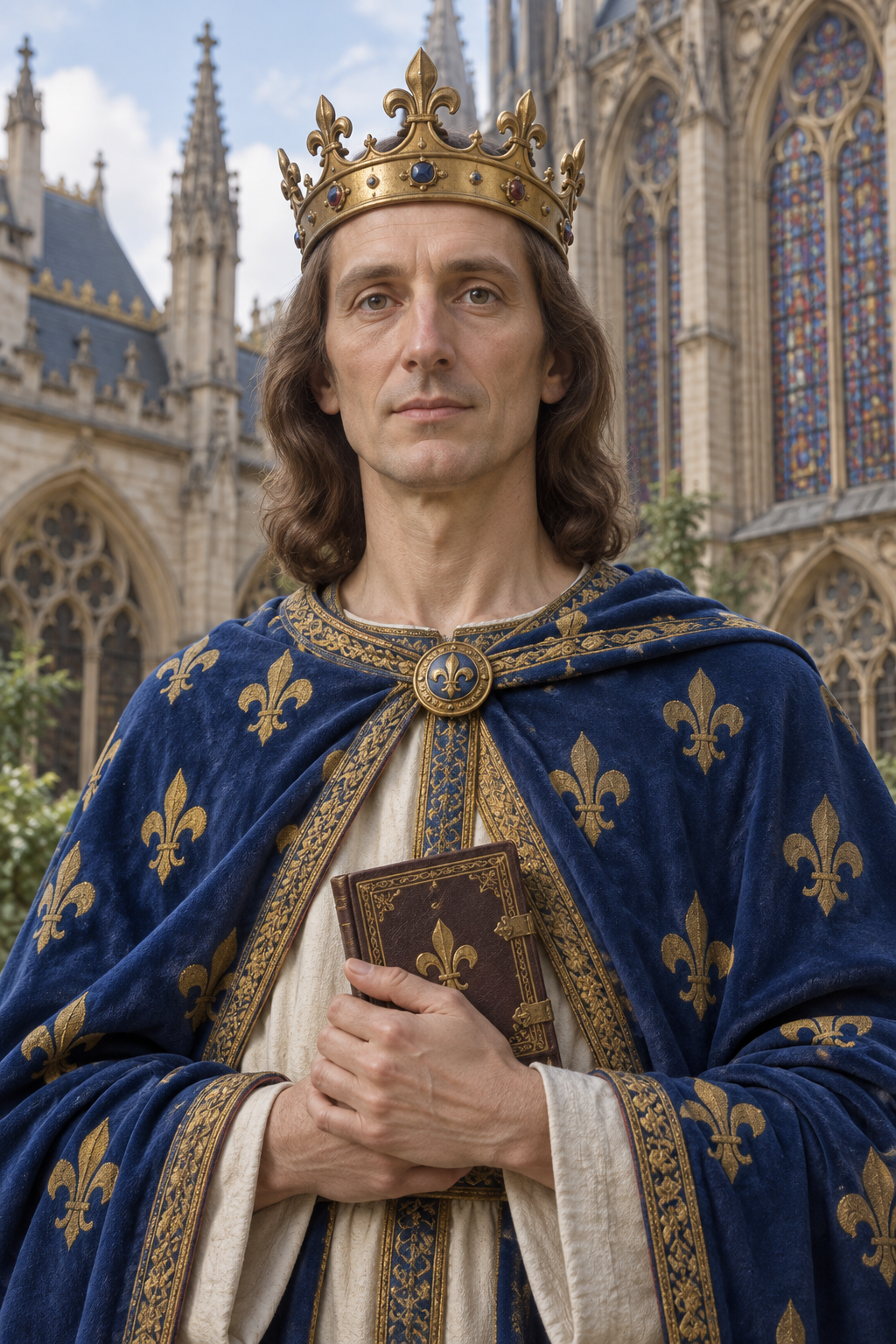
About Louis IX of France
Louis IX became king of France while still a child, and grew into a ruler who connected government with religious duty. He was born on 25 April 1214. His mother, Blanche of Castile, governed as regent and gave him a demanding religious education. His coronation took place at Reims in November 1226, when he was twelve. Kingship brought him authority before he was old enough to exercise it independently, and his mother's direction shaped the beginning of his reign.
Vincennes offered a setting where family life and government met. Louis went there with his wife, Marguerite of Provence, and their children, and held meetings of his council there. The residence was a place for administrative and legal business as well as visits by the royal household.
As an adult, Louis worked to make royal government more effective. Local officials were answerable to the king, and investigators collected complaints about their conduct. Written grievances could reach Paris, where the royal court was developing specialized branches for political affairs, appeals and accounts. These changes strengthened the monarchy while giving subjects ways to challenge abuses. His government was not simply a matter of a ruler hearing individual petitions; it also depended on officials, records and institutions.
The demands he placed on officials became particularly clear after his return from captivity in Egypt. His ordinance of 1254 required them to administer justice without favoritism, refuse gifts for themselves and their families, and avoid imposing fines without judgment. Yet his religious policies could also be coercive. He required Jews to wear a distinguishing badge. That discrimination belongs in the history of his reign alongside the efforts to restrain corruption, rather than being hidden behind his later reputation for justice.
Louis also gave his religious commitments a highly visible place in Paris. He acquired the relic venerated as the Crown of Thorns in 1239 and obtained other Passion relics two years later. He commissioned the Sainte-Chapelle to house this collection within the royal palace. The building served both devotion and royal prestige: possession of such revered objects enhanced the standing of the king and his capital. Its upper chapel was reserved for the king and distinguished visitors, while a lower chapel served the palace staff.
His building projects were not confined to churches. At Aigues-Mortes he developed a Mediterranean port that could serve commerce as well as departures for the Holy Land. The undertaking began in 1240 on land obtained from the abbey of Psalmodi. Louis completed the fortified tower and planned walls to protect the town, but the great enclosure was built after his death. The distinction matters to the story of his work: he established the project without seeing the city reach its completed form.
His first crusade brought a very different experience of power. The expedition left France in 1248, with his wife accompanying him and Blanche again responsible for the kingdom. After initial success at Damietta, the campaign in Egypt ended in defeat and captivity. Release required negotiation and ransom. Louis then remained in the eastern Mediterranean to strengthen Christian towns before returning to France in 1254. The years abroad interrupted his government at home without securing the victory he had sought.
Care for people in need also took an institutional form. The Quinze-Vingts foundation in Paris provided a home for a community of three hundred people, most of them blind, together with sighted people who assisted them. The institution's own history emphasizes that its original purpose was residential rather than that of a hospital ward. Residents could live with their families, raise children and practice their trades. This was support for daily life, not simply treatment during an illness. Louis confirmed the community's statutes in 1270, leaving documentary evidence of his continuing connection with the foundation.
The spiritual testament addressed to his son shows how Louis wanted religious devotion to guide the use of authority. He urged his heir to help poor and afflicted people, to thank God in prosperity, and to bear difficulties without abandoning faith. He also warned against allowing wealth to sway judgment before the truth of a dispute was known. The instructions joined prayer with practical decisions about the treatment of subjects. They ended with a father's blessing, asking that his son be protected from evil and enabled to serve God.
Louis supported religious communities beyond his own palace. Vatican News recalls his gift of land at Longchamp to his sister Isabelle for a community of Poor Clares. The same account places his concern for reconciliation between France and England alongside his continued desire to return to the Holy Land. His last expedition took him to North Africa instead, where illness ended his life on 25 August 1270. Boniface VIII canonized him in 1297. His foundations and religious commitments remain important to his memory, though his example cannot be separated from the powers of kingship.
Wondering how to weigh the stories and sources? Learn how to read a saint biography.
Explore similar vocations
Prayers for Louis IX of France
Louis IX of France: sourced prayer excerpt
May the three Persons of the Holy Trinity and all the saints protect you from every evil.