Biography
Luca Antonio Falcone
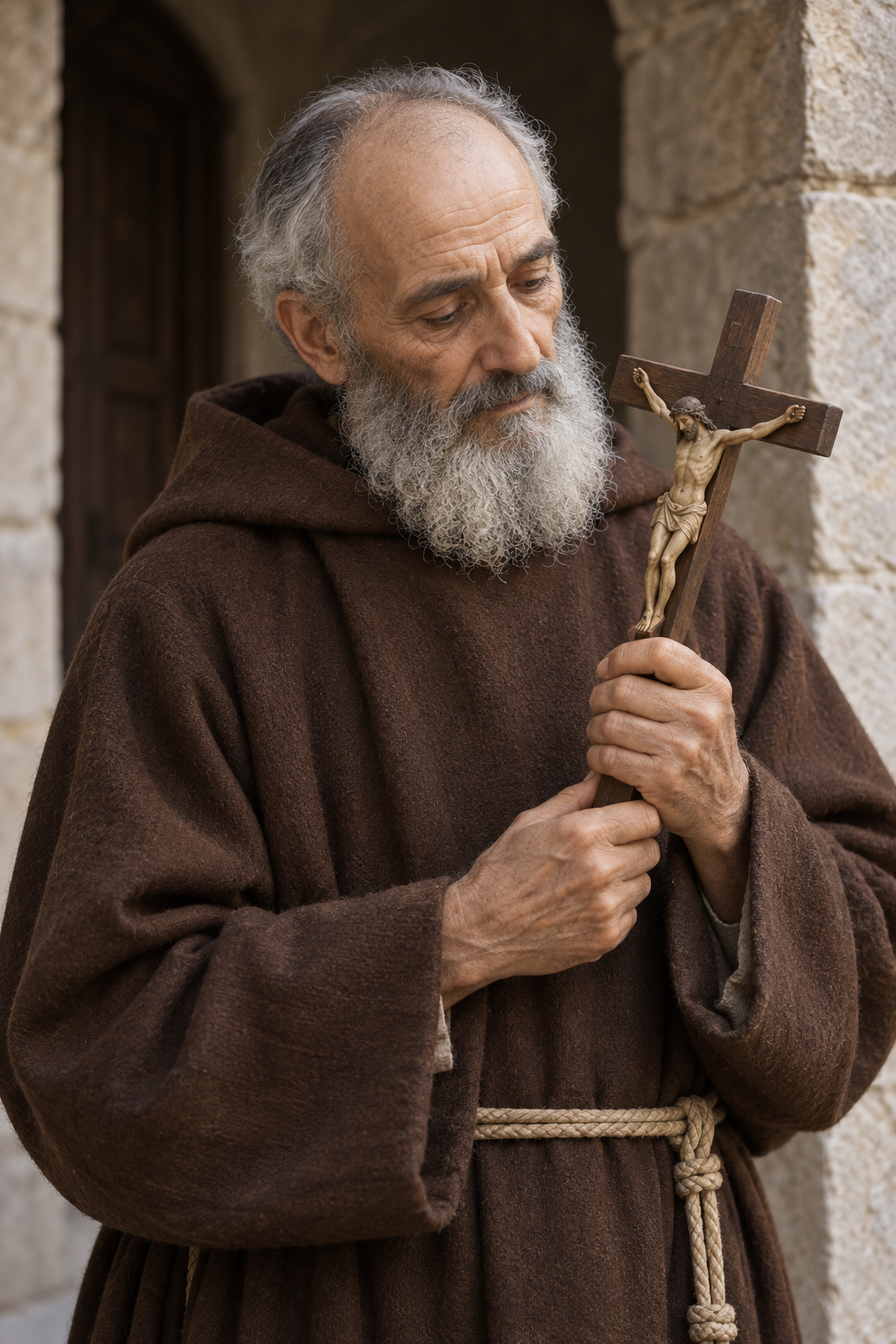
About Luca Antonio Falcone
Luca Antonio Falcone, known in religious life as Angelo of Acri, was a Capuchin priest and preacher from Calabria. He was born in Acri on October 19, 1669, into a family supported by his father’s farming and his mother’s work as a baker. A neighbor taught him to read and write. His priest uncle encouraged further study, hoping he would be able to support his widowed mother. Religious life drew him in a different direction.
His first attempts to become a friar ended in departure from the novitiate. He returned for a third attempt in November 1690 and professed his vows on November 12, 1691. The example of Bernard of Corleone helped him persevere. After further studies, he was ordained in 1700. These unsettled beginnings are part of his recorded life, rather than a reason to imagine that his later vocation had always been certain.
His early preaching was also difficult. Fredegando d’Anversa’s account describes a failure at San Giorgio Albanese: Angelo lost his prepared words and trembled in the pulpit. He continued studying Scripture and developed a simpler way of speaking that ordinary listeners could follow. The change concerned the language of his preaching, not the abandonment of preparation or religious teaching.
That directness could be severe. The same account describes forceful denunciations of vice, warnings to sinners and vehement reminders to clergy about their duties. Angelo’s popular style should not be mistaken for an invariably gentle manner. He traveled through Calabria, preaching in cities such as Cosenza, Reggio and Catanzaro as well as mountain villages. His ministry combined the ability to reach listeners with a demanding call to change their lives.
Not everyone welcomed him. Fernando de Riese’s biography, drawing on testimony from the beatification proceedings, recounts complaints about his language and gestures. At Amantea, a student challenged his criticism of Descartes. The account also recalls resistance from the Capuchin women at Acri when he urged greater austerity. These episodes preserve disagreement alongside the favorable memories collected for his cause; they do not justify assuming that every listener accepted his judgments.
He supported Maria Teresa Sanseverino’s wish to become a Capuchin nun and helped establish the women’s monastery at Acri. Construction began in 1724, and she entered in 1726. His relationship with the Sanseverino family also involved criticism: the biography describes appeals on behalf of poor people against abuses of wealth and authority. His concern extended to visiting prisoners, encouraging repentance and acceptance of punishment while seeking help for people judged innocent. Charity, in this setting, operated within the religious and social expectations of his age.
Some of his written work survived: letters, prayers and devotional verse. Riese describes his adaptation of meditations on Christ’s Passion into a shorter composition published after his death. These texts accompanied a ministry remembered chiefly through preaching and personal encounters.
Angelo died at Acri on October 30, 1739.
The process that led to his public recognition lasted long beyond his lifetime. In his apostolic letter of December 9, 1825, Pope Leo XII authorized the title of Blessed and specified forms of public devotion. The letter allowed veneration of his body and relics, images bearing rays of glory, and liturgical observance on October 30 within the Diocese of Bisignano and the Capuchin order. It also placed a restriction on processions carrying the relics. These detailed permissions show that recognition involved regulated public worship, not simply admiration for a remembered preacher. The letter designated December 18 for the beatification ceremony in the Vatican basilica.
The permission also extended to visiting priests celebrating Mass in the specified churches on his feast. Leo’s letter thus distinguished the saint’s growing reputation from the particular liturgical observances it formally authorized.
The site itself had an older Capuchin history: the cultural heritage record dates the beginning of the convent to 1590 and its small church to 1595. The basilica’s titular dedication is to the Immaculate Conception. Its association with Angelo therefore developed within an existing Franciscan place of worship, rather than beginning with him.
A later sanctuary gave this devotion a larger home. The Italian cultural heritage catalogue describes the new church erected in the 1890s and consecrated on July 17, 1898. Residents of Acri and emigrants in the Americas contributed to the undertaking. Paintings, statues and scenes of the Way of the Cross formed part of its decoration. The sanctuary became a minor basilica in 1980, long after Angelo’s death; its imposing setting belongs to the history of his remembrance, rather than to the world in which he preached.
Pope Francis canonized him on October 15, 2017. The heritage account describes pilgrims coming to his tomb throughout the year, including people whose families carried the devotion overseas. The shrine also hosts retreats and other gatherings, continuing the association between his memory and prayer.
He is honored as patron of Acri, with his feast on October 30.
Wondering how to weigh the stories and sources? Learn how to read a saint biography.