Biography
Ludovico of Casoria
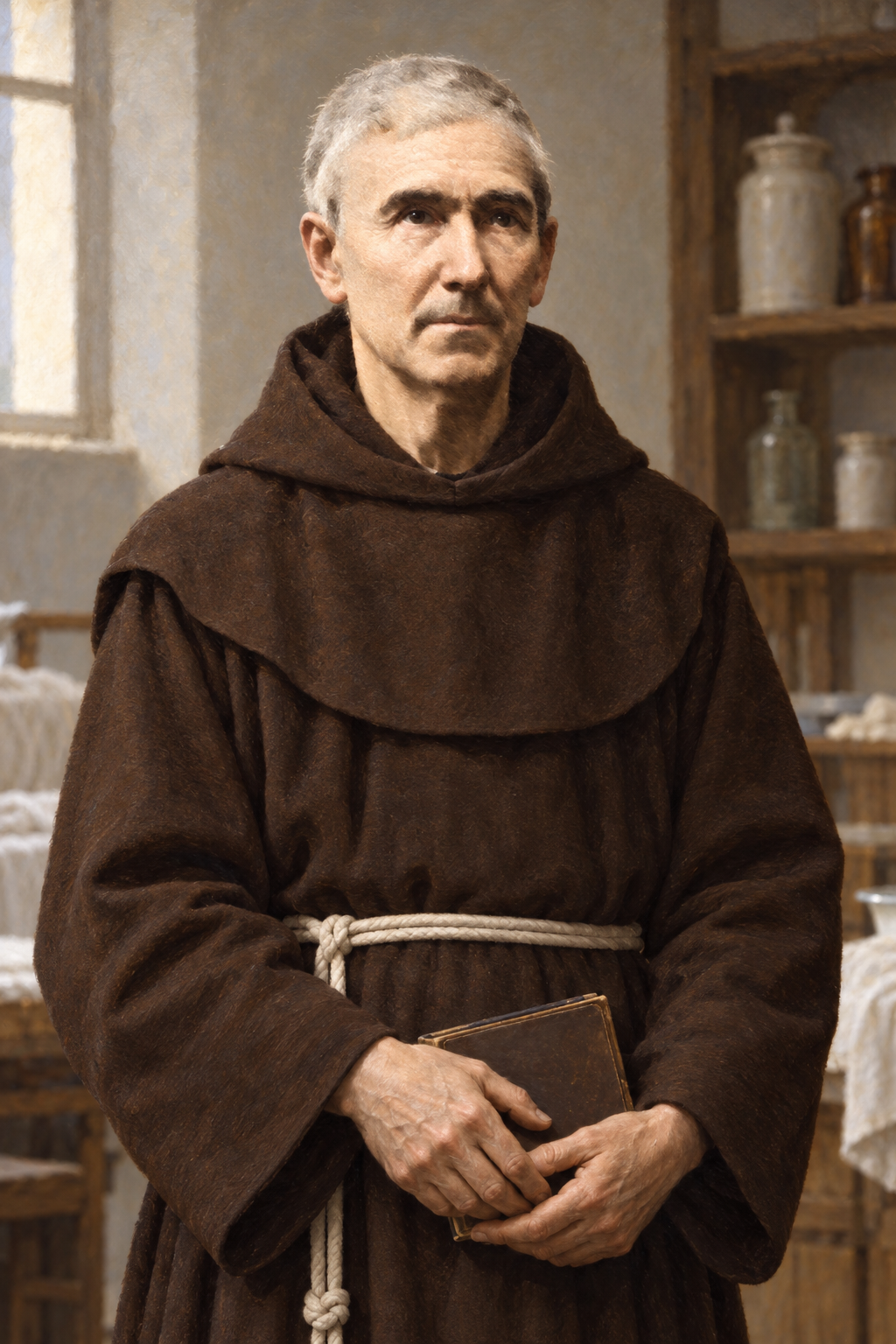
About Ludovico of Casoria
Ludovico of Casoria was a Franciscan priest who built a network of schools, infirmaries and homes for people in need. Born Arcangelo Palmentieri at Casoria, near Naples, on March 11, 1814, he learned carpentry before entering religious life. He received the Franciscan habit in 1832 and was ordained in 1837. Study and teaching occupied his early priesthood, with chemistry, mathematics and philosophy among his subjects.
In 1847 he underwent a religious experience while praying in the church of San Giuseppe dei Ruffi. He later understood it as a call to devote himself to poor and sick people. His first work was close at hand: he made a small pharmacy in his room for ill friars. A larger infirmary followed at La Palma, a property in the Capodimonte area of Naples.
His African project began in 1854 with two boys who had been purchased out of slavery. Ludovico hoped that education in Naples would prepare African children to return as Christian missionaries. A related institution for girls followed with Anna Lapini’s assistance. This joined relief from enslavement to an explicit program of religious conversion. The children’s later lives did not all follow the same course.
Giacomo Ghedini’s historical research records both educational achievements and profound losses. Some former pupils became priests, teachers or doctors; others worked in religious houses or returned to Africa. Yet the program also displaced their original cultural identities, and African children brought to Europe faced high mortality. These outcomes complicate a simple story of rescue and success.
During the 1866 cholera epidemic, the girls’ institution suffered many deaths, including European as well as African children. Ludovico was imprisoned after investigators learned of earlier burials on its grounds, then released when those burials were found unrelated to the outbreak. Meanwhile the mission at Shellal in Egypt lacked dependable financial support. Its personnel endured hunger, illness and deaths, and the enterprise closed. Ghedini identifies inadequate preparation and resources among the failures of this ambitious undertaking.
His Italian institutions likewise depended on people who could sustain their daily work. In 1859 he founded the Brothers of Charity, known as the Bigi, or Gray Friars, from their clothing.
The Sisters of Saint Elizabeth, called the Bigie, trace their foundation to 1862, when five women were entrusted with orphaned girls and children brought from slavery in Africa. Their own account preserves his instruction that love for one another, Christ and their neighbors should guide the community.
Education and practical training stood alongside shelter. Ludovico developed printing shops and other workshops for young people, agricultural schooling and homes for elderly people. He also attempted a Catholic academy of religion and science and supported periodicals. These cultural ventures were intended to defend Catholic teaching in a changing intellectual world, but organizational difficulties shortened the academy’s life. His relations with public authorities extended across the political changes that transformed southern Italy.
He helped negotiate the return of Cardinal Sisto Riario Sforza to Naples in 1860 after the archbishop’s exile. Support also came from people whose political positions differed from his own. This practical ability to enlist assistance helped his institutions survive, although it did not make every project financially secure or successful.
At Assisi, his 1871 foundation welcomed blind and deaf young people who had often been excluded from education. The institution’s history emphasizes schooling and learning a trade as well as accommodation and care. Its present work has adapted to people with multiple disabilities, combining rehabilitation, education and social assistance. That continuing activity belongs to later generations of sisters and professional staff, while its origins remain rooted in Ludovico’s conviction that these young people should have opportunities to learn.
The Assisi institute describes its present purpose in terms of the needs of each person, with sisters working alongside trained staff. Its account connects the founder’s educational concern with a continuing effort to help people participate in community life.
His interest in learning was not limited to those schools. The New Catholic Encyclopedia notes his support for a meteorological observatory, publications and an Italian translation of Bonaventure’s works. It also records that a painful illness affected the last decade of his life. His extensive charitable responsibilities continued against this background of declining health, rather than through an uninterrupted experience of physical strength.
Ludovico died on March 30, 1885, at the Marine Hospice in Posillipo, Naples, which he had established for elderly sailors. He was canonized by Pope Francis on November 23, 2014. His general feast is March 30; the Bigie also observe him on June 17 in their own calendar.
The congregations followed different paths after his death. The Jesuit historical archive records the suppression of the male community in 1972, while the sisters continued their work. Photographs preserved in that archive show pupils of the Brothers’ Roman school in the early twentieth century, a reminder of the many lives connected with institutions that outlasted their founder.
Wondering how to weigh the stories and sources? Learn how to read a saint biography.