Biography
Luigi Guanella
About Luigi Guanella
Luigi Guanella was born on December 19, 1842, at Fraciscio, a village of Campodolcino in the Diocese of Como. The Dicastery for the Causes of Saints says he was baptized the next day.
His parents, Lorenzo Guanella and Maria Bianchi, are described in the same profile as exemplary Christians devoted to their family, field work, and the care of animals. The household prayed the rosary and read lives of saints, so Luigi's early piety grew from ordinary domestic discipline rather than from a separate religious program.
Guanella studied in the seminary at Como and was ordained priest on May 26, 1866. A year later he was named parish priest of Savogno, where his early pastoral life placed him close to families, laborers, and poor people in the mountain communities of northern Italy.
During seven years of priestly ministry he came into contact with Don Bosco and the Little House of Divine Providence associated with Cottolengo in Turin. Those encounters did not erase his diocesan identity, but they gave him concrete models for education, charity, and durable institutions serving vulnerable people.
In 1875 Guanella went to Don Bosco and made religious vows for three years. The Dicastery profile says the Bishop of Como recalled him afterward. Back in his diocese, he dreamed of opening an institution for needy boys, and did begin a school, but civil hostility forced that first effort to close.
The turning point came in November 1881, when Guanella arrived at Pianello Lario as parish priest. There he found a group of young women already devoted to assisting people in need. He did not invent charity out of nothing; he recognized and guided a work of mercy that was already alive.
From that group developed the Daughters of Saint Mary of Providence. Guanella's service then widened to Como, where he began the Casa Divina Provvidenza. The house later became the motherhouse of the two congregations associated with his name.
He also gathered priests whom he called the Servants of Charity. The official profile presents this work as a concrete response to poor people, abandoned children, older people, and those whom society was tempted to leave aside. This draft avoids importing present-day institutional statistics unless a fresh, dated congregational source is reviewed.
Guanella's favorite insistence was that charity could not stop while poor people still needed help. The page should paraphrase that conviction rather than turn it into a slogan. Benedict XVI later described him as guided by divine Providence and as a companion, teacher, comfort, and relief for the poorest and weakest.
In 1904 Guanella came to Rome so that his work could stand near the Pope. Pius X valued him and entrusted to him the desire to build a church dedicated to the Transit of Saint Joseph. Guanella also promoted the Pious Union of Saint Joseph, a prayer association for the dying, with Pius X recorded as the first enrolled member.
His missionary charity extended beyond Italy. In December 1912, though about seventy years old, he sailed to North America to visit Italian emigrants. That journey should be presented as pastoral care for displaced workers and families, not as a decorative episode.
In January 1915 Guanella remained in Rome to help victims of the Abruzzo earthquake, working with Aurelio Bacciarini. The same year brought the strain of old age, Italy's entry into the First World War, and the absence of confreres called to military service.
Luigi Guanella died on Sunday, October 24, 1915. The Dicastery profile records his beatification by Paul VI on October 25, 1964, and canonization by Benedict XVI in Saint Peter's Square on October 23, 2011.
Benedict XVI's canonization homily gives the public page its best theological frame: Guanella's active charity was rooted in contemplation and trust in Providence. The point is not that he managed institutions efficiently, but that he held prayer, Church communion, and bodily works of mercy together.
Paul VI's beatification framing, summarized in the Dicastery profile, also matters for tone. Guanella's confidence in Providence should not be reduced to optimism or fundraising skill. It was a theological conviction that God was the first actor and that human collaborators were called to answer practical needs with patient fidelity.
This distinction helps the public page avoid two distortions. It should not present Guanella merely as a social reformer with religious language attached, and it should not present his charity as vague kindness without institutional discipline. His schools, houses, associations, and congregations were the forms his prayer took when he encountered children, older people, emigrants, the sick, and those near death.
The final page should also treat poverty with dignity. When naming the poor, abandoned children, older people, emigrants, and dying persons whom Guanella served, use concrete language and avoid making vulnerable people into scenery. The focus should remain on his pastoral response and on the people he regarded as neighbors entrusted to his care.
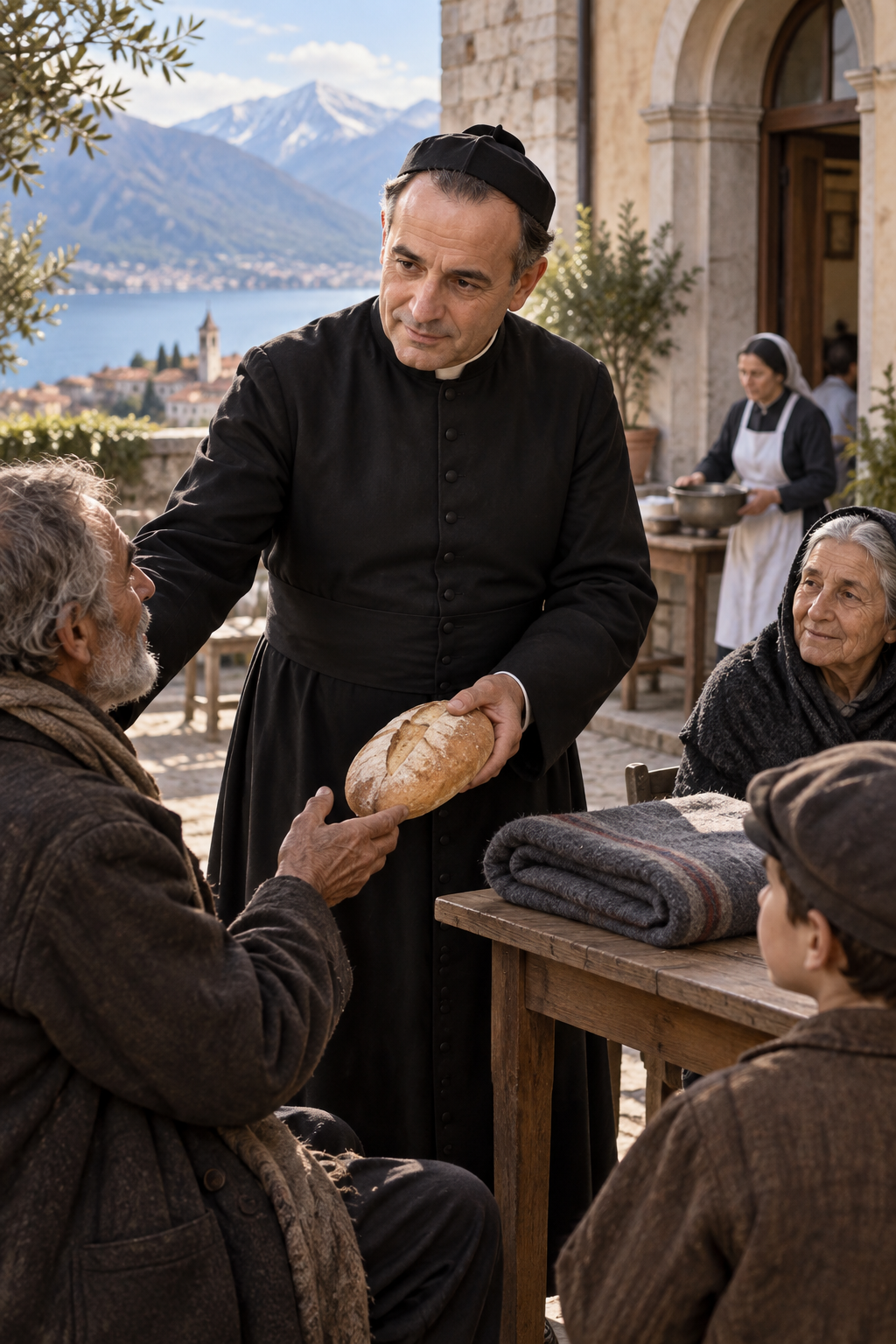
Artwork should show an elderly Italian priest in a black cassock giving bread or a blanket in a modest charity-house setting near Como. It should avoid sentimental poverty, medicalized disability, institutional logos, rendered text, halos, and any claim that the image is an exact historical likeness.
Wondering how to weigh the stories and sources? Learn how to read a saint biography.