Biography
Luigi Maria Palazzolo
About Luigi Maria Palazzolo
Luigi Maria Palazzolo was born in Bergamo on 10 December 1827. His family had means, an important part of the story because he later used family resources for work with poorer young people. The congregation he founded remembers his early attention to people who were sick or needed help. These are retrospective memories of charitable interest, not direct evidence of a child's inner motives. His later choices can be described from the institutions he built and the people who joined them. His upbringing should not be recast as poverty to make those choices appear more dramatic.
The Holy See's canonization booklet says that after his father's early death, his mother and priests helped educate him. He studied in Bergamo and entered seminary courses as an external student in 1844. That arrangement left him in the life of the city rather than a fully enclosed seminary. The official short life emphasizes his priestly calling and later service; it is a commemorative text, so its account of his inner motives should be read as religious interpretation. His path to ordination nevertheless is well documented.
Ordained on 23 June 1850, Palazzolo worked with boys at the Foppa oratory in poor Borgo San Bernardino. He expanded its rooms and offered evening classes to workers.
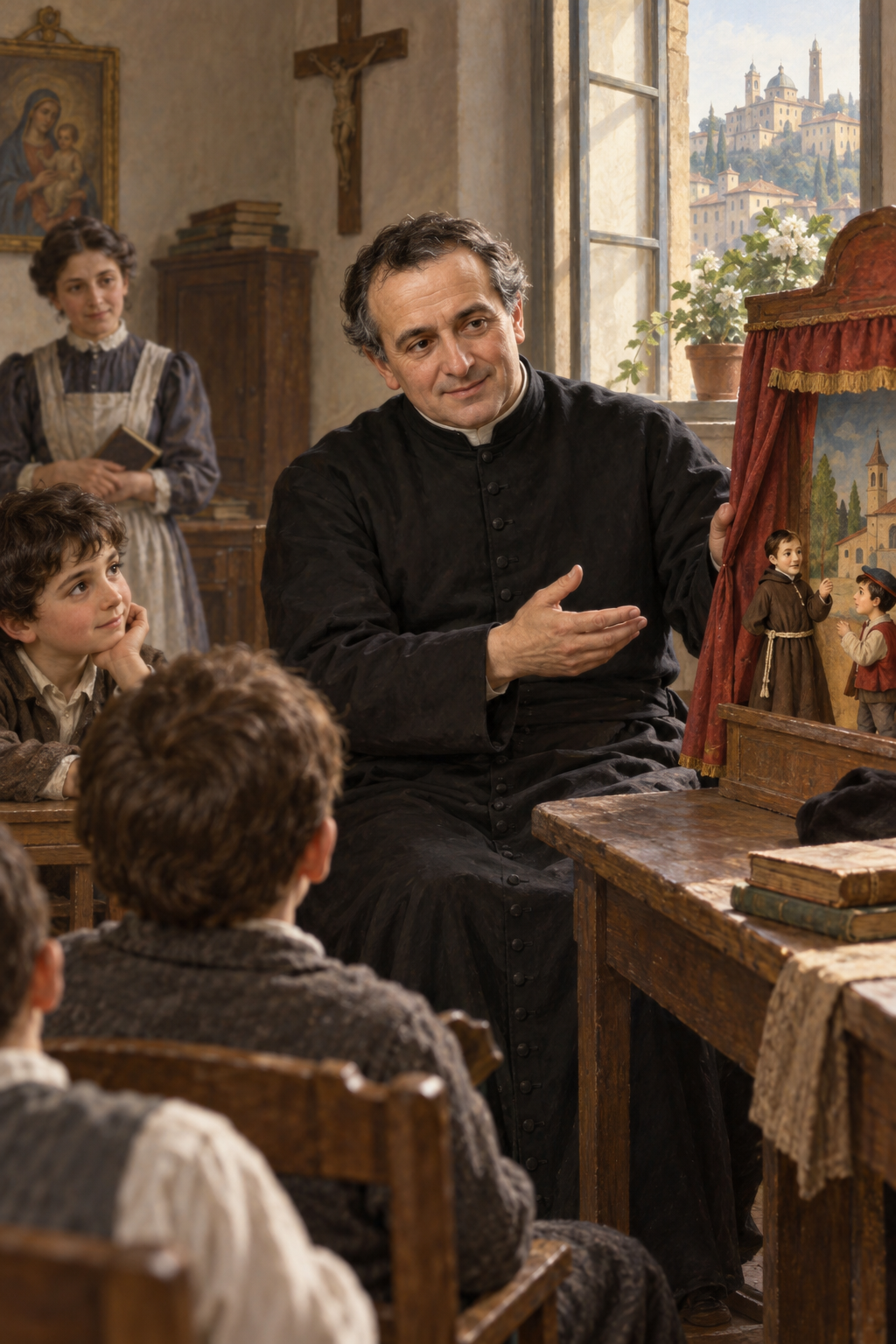
A Catholic media account describes Palazzolo using puppet performances to hold children's attention, a distinctive form of teaching also recorded in the scholarly biography. The puppets were part of an oratory that combined play with religious education. A lively method does not tell us what each child learned, but it helps explain why the oratory was more than a shelter or a lecture room. Palazzolo also used music and drama. The learning setting had to attract children before it could sustain their interest or offer regular instruction.
The upheaval surrounding Italian unification reached the oratory. Negruzzo records that its attendance fell in 1859 and that rent forced a move, while some boys kept meeting outside the city. In 1862 Palazzolo bought property for a new Saint Philip Neri oratory, with financial help from his mother. This change took resources and planning rather than a single dramatic founding moment. The account also places his work within political divisions: he was seen by some as friendly to Austrian authority, and his institution did not stand outside the conflicts of its time.
His congregation remembers a choice to live nearer poorer people instead of remaining comfortable in his original family setting. It describes a growing willingness to accept children who were orphaned or abandoned. This is the sisters' interpretation of their founder's vocation, not an independently measured account of every admission. The practical change was a commitment to live and work where the oratory operated. That proximity made daily problems visible: meals, safe rooms, instruction and care needed people on site, not simply a donor elsewhere in the city.
The work soon included girls and young women. Maria Teresa Gabrieli's own congregation says she came from a family of gardeners, studied with the Canossian sisters and qualified as a teacher. Her training made her capable of leading education, not merely assisting a priest. By the 1860s she was already active in teaching and seeking a religious form for her service. Reading the foundation through her life corrects a narrative in which the women who taught, cared and organized appear only after Palazzolo's decisions.
On 22 May 1869 Gabrieli and two companions made their professions, beginning the Sisters of the Poor community. Gabrieli's congregation describes the first house as materially modest and says a girl needing care joined them at once. The scene is preserved through the congregation's history, rather than a record of the girl's later life. The new sisters combined residence and schooling with attention to people who were ill or had disabilities. Gabrieli's leadership and the companions' commitments gave the project a continuing community of women, with their own duties and decisions.
Vatican News describes Palazzolo arranging a house for girls and entrusting its work to Gabrieli, whose teaching and religious commitment carried the project forward. A short modern profile necessarily compresses several years of cooperation, so it should not replace the more detailed historical chronology. It does capture that care for girls required a dedicated woman teacher and a community able to live in the house. The foundation was shared work, even when later accounts place the priest's name first. Its children and teachers remain essential to the history.
Palazzolo also wanted care and training for orphaned boys at Torre Boldone. His congregation describes the sisters' mission as collaboration with people who served where others could not easily reach. The boys' house developed a group of brothers, with Battista Leidi and two companions taking vows at Martinengo in 1872. Sources disagree on the later year when that community ended, so that detail should not become an exact claim here. The sisters' institute, by contrast, continued. These different outcomes remind us that a founder's intention and an institution's later survival are separate historical facts.
John XXIII beatified Palazzolo on 19 March 1963. In his homily he recalled hearing of the Bergamo priest as a child and observed that people had differed about practical forms of Palazzolo's charitable work. The pope's praise therefore need not erase local disagreement or the strain of running houses for young people. A homily is a primary record of the Church's judgment and the pope's memory, while the scholarly biography remains better for detailed dates. The community's later history belongs to teachers, sisters and brothers who carried out daily service.
Palazzolo died in Bergamo on 15 June 1886 after a period of illness and financial pressure on the houses. Francis canonized him on 15 May 2022. His work joined oratories, evening education and residential care, but it was made possible by Gabrieli, the first sisters, Leidi and many less named participants. That shared history gives a more faithful account of what endured than a portrait of an isolated founder.
Wondering how to weigh the stories and sources? Learn how to read a saint biography.