Biography
Luigi Orione
About Luigi Orione
Luigi Orione was born on June 23, 1872, at Pontecurone, near Alessandria in northern Italy. The Dicastery for the Causes of Saints presents his life as a priestly response to poor, abandoned, and suffering people.
His early vocational path was not straight. He entered the Franciscan friary at Voghera, but illness forced him to leave. That failed beginning should not be treated as wasted time; it belongs to the slower discernment through which his future work took shape.
Orione then studied at Valdocco under Don Bosco. The Vatican biography connects that Salesian formation with his later care for young people, especially boys without secure schooling or support. He entered the seminary at Tortona in 1889.
Before priestly ordination, Orione was already beginning pastoral work. In 1892 he opened his first oratory in Tortona, and in 1893 he opened a boarding school for poor boys. These were not side projects beside his vocation; they were early expressions of it.
He was ordained priest in 1895. Around him there gathered the first nucleus of the Little Work of Divine Providence. The name is important because Providence in Orione's life was not abstract. It meant trusting God while founding schools, homes, missions, and communities that answered visible needs.
The first companions and students around Orione formed a small beginning, not a finished institution. That scale matters. The public biography should let the reader see how a local oratory and school in Tortona grew into a broader apostolate through repeated practical decisions, spiritual trust, and pastoral imagination.
The Sons of Divine Providence received diocesan approval in 1903. The Vatican biography emphasizes Orione's fidelity to the Pope as part of the charism, so the public page should connect his practical charity with ecclesial communion rather than present the two as separate concerns.
The same fidelity shaped his language about the Church and his readiness to send members of the work beyond their first Italian setting. This draft should avoid political shorthand for that loyalty. In Orione's case, closeness to the Pope belonged to the spiritual identity of the congregation and to his understanding of service.
His apostolate widened beyond education. Orione served during moments of public disaster and social strain, and his communities became associated with care for people who were poor, disabled, elderly, abandoned, or otherwise left without support. This draft avoids graphic disaster detail unless the final packet uses a source with exact evidence for each event.
Because Orione's life touches disasters, migration, and disability, the final profile needs careful language. It can say he served people in severe need and organized communities for durable help, but it should not use suffering as a visual or rhetorical shortcut. The sources support a priestly pattern of care, not a catalogue of misery.
Missionary expansion also marked his life. The official profiles point to Brazil in 1913 and to later journeys in Latin America. That material should be written as pastoral and missionary outreach, not as institutional triumph or a list of territorial gains.
One of Orione's enduring works was the Little Cottolengo, homes named in memory of the Turin model of care for people in need. The page can mention the name and purpose, while avoiding present-day statistics unless a fresh, dated source is added.
The Little Cottolengo theme also connects Orione back to the charitable models he encountered in Turin as a young man. It allows the page to show continuity without claiming that he merely copied earlier works. He adapted what he had seen to the needs, collaborators, and ecclesial setting placed before him.
The sources also place Orione's ministry within the turbulence of modern Italy: urban poverty, migration, anticlerical pressure, war, disaster, and the needs of young people without stable family support. The biography should keep those contexts concrete without turning them into a generalized portrait of misery.
His spirituality joined energy and surrender. Divine Providence did not make him passive; it made him bold enough to begin works whose needs exceeded his own resources. That balance is a useful thread from the first oratory to the later homes and missions.
Orione died at Sanremo on March 12, 1940. The Dicastery records his canonization by John Paul II on May 16, 2004. For the public page, the death notice should be simple and factual, allowing the shape of the life to carry the devotional weight.
The final profile should present Luigi Orione as priest, educator, founder, and servant of vulnerable people. It should avoid flattening him into a generic philanthropist or making poor boys, migrants, and disabled people into scenery. His witness lies in organized charity rooted in priestly faith.
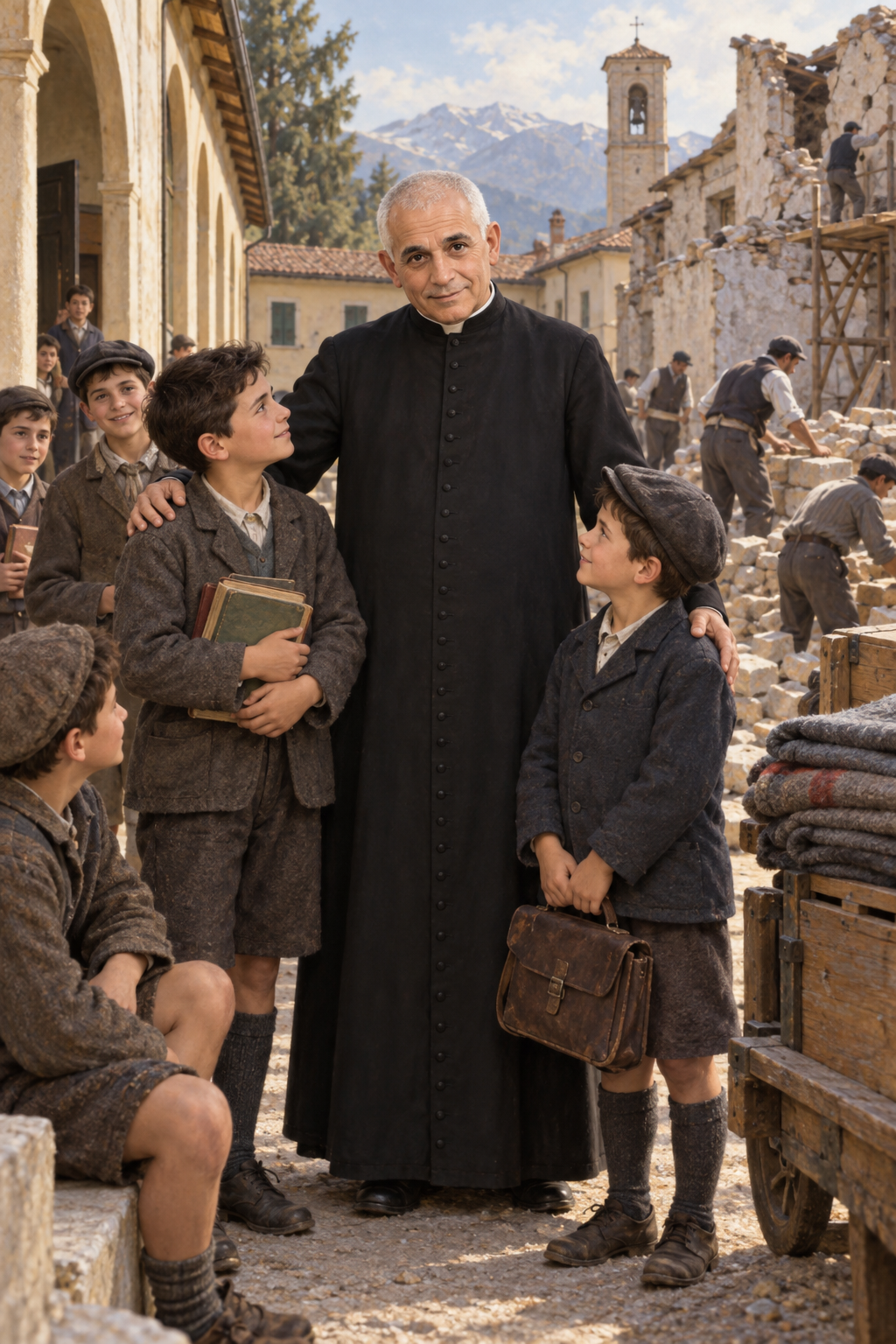
Artwork should show an Italian priest in a black cassock near a modest school and relief-work setting, with books, satchel, blankets, and repaired masonry as quiet attributes. Avoid graphic disaster imagery, sentimentalized poverty, rendered text, logos, halos, modern props, and exact-likeness claims.
Wondering how to weigh the stories and sources? Learn how to read a saint biography.