Biography
Luigi Scrosoppi
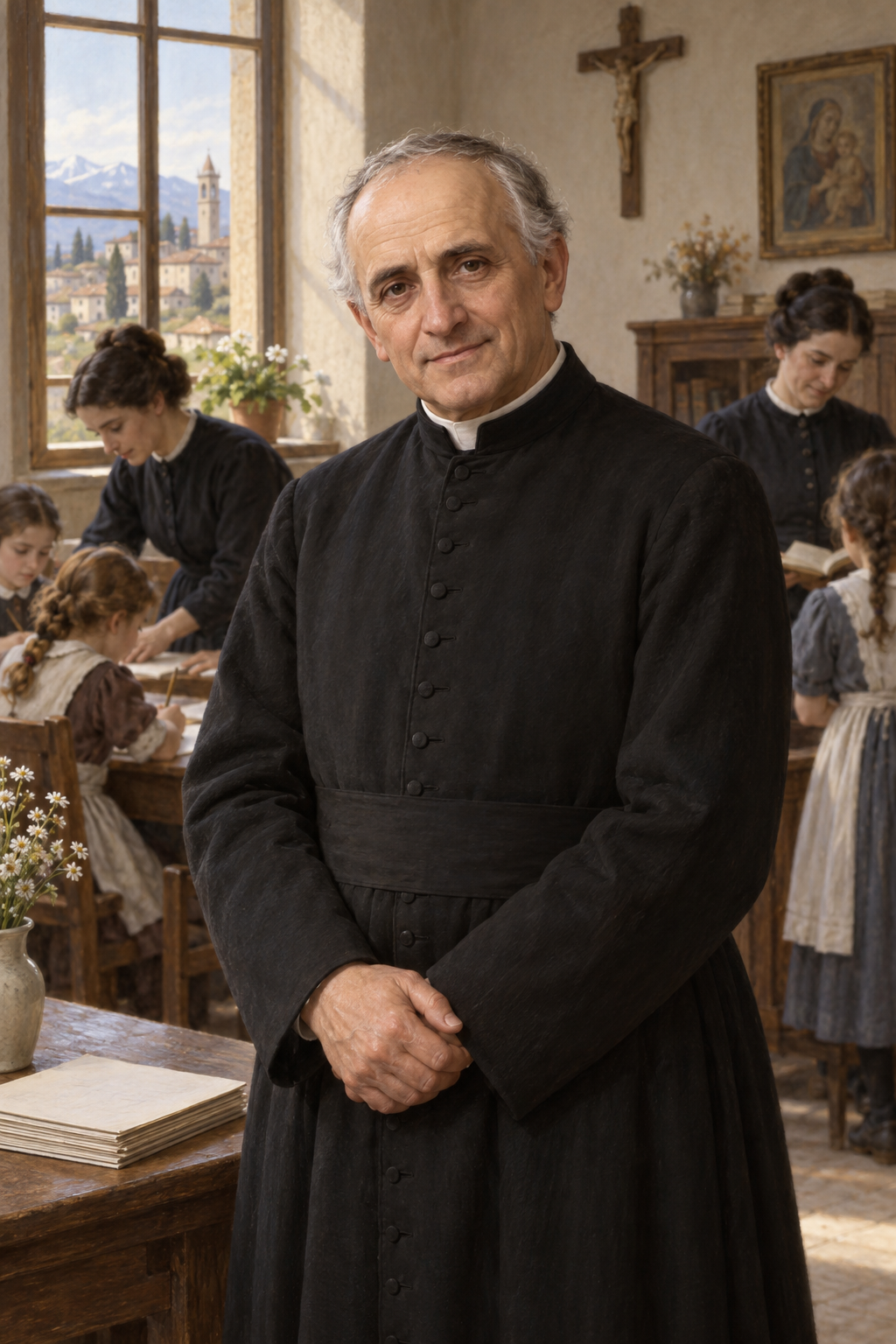
About Luigi Scrosoppi
Luigi Scrosoppi was born in Udine, in Friuli, on 4 August 1804. The Udine archdiocese's anniversary account records his ordination on 31 March 1827. He served in a city where poverty and the need for care of vulnerable children shaped religious institutions. Those public facts establish the outward path of his ministry. Church histories also read his choices as a vocation, a religious interpretation that should be distinguished from the dated events. His later work took place amid changes in government, law and local society that affected both priests and women religious.
An important girls' house in Udine existed before Scrosoppi's adult ministry. The Sisters of Providence's own historical archive says the Casa delle Derelitte opened in 1816 through the work of Gaetano Salomoni. Carlo Filaferro and then Scrosoppi followed him in its leadership. This institutional sequence matters: a later founder's deep service to an existing house is not the same act as opening it. The archive preserves records of property, administration and correspondence that can, in principle, test simplified accounts of one man's work.
John Paul II described Scrosoppi working with women teachers for poor and abandoned girls. Their training and daily presence made the educational work possible. The Pope praised the priest's service, but also named the women as participants. Girls were living and learning in an institution supported by a network of people, not by the priest's decisions alone. A careful history should not treat the girls only as examples of his charity.
The sisters' account describes Luigi's brother Carlo leading the girls' house until his death in 1854. Scrosoppi worked beside him and accepted greater responsibility afterward. This long collaboration makes a single founding moment misleading. The house began in 1816, while the community of women teachers developed later. The sisters' account recalls both the brothers and the women who served the girls; it does not supply each child's perspective. The history of the institution reaches beyond the life of one priest.
On 1 February 1837 nine women made a public commitment to poverty and shared service. John Paul II later told pilgrims that the Sisters of Providence came from women full of faith and generosity who collaborated with Scrosoppi in caring for girls without families. This papal account supports the date and recognizes the women, though it does not name each one or describe every stage of their decisions. The religious congregation grew from the long work of the earlier house and the women's commitment to continue living and teaching together.
Historian Andrea Dessardo argues that common biographies place too much weight on Scrosoppi's personal activism when explaining the sisters' expansion. In a 2022 study, he draws attention to political conditions and Archbishop Andrea Casasola's role. His conclusion is an interpretation of surviving evidence, not a reason to deny Scrosoppi's sustained work with the sisters. It asks a useful historical question: which parts of growth were decisions by women, clergy, bishops and civic authorities, and which were actions by the founder? The resulting account is more complex than a simple success story.
Scrosoppi joined the Udine Oratorians in 1846. The Holy See biography describes how this religious community became part of his priestly work and his care for poor girls.
The political setting of Friuli shaped these institutions. A scholarly biographical entry on Archbishop Andrea Casasola places the sisters in the wider Catholic response to social need and the changes surrounding Italian unification. It notes sisters' work at Portogruaro by 1857, before Casasola became archbishop of Udine. That sequence cautions against crediting a single bishop with the entire beginning. It does, however, show that the congregation expanded through church and civic networks beyond one Udine house. The sisters and local supporters were active participants in that movement.
Dessardo's analysis also draws attention to the later legal form of the sisters' congregation. A small group of teachers living under one roof did not need exactly the same rules as houses operating in several places. He reads the period around canonical recognition and new written directions in light of wider church politics. These points remain an interpretation and should be identified as such, especially where the record is incomplete. They help explain why institutional change cannot be described only as Scrosoppi's private spiritual development. The historical question includes administration, property, episcopal authority and the women doing the work.
After the extension of Italian suppression laws, officials moved against the Udine Oratorians. The sisters' archive center cites notices from December 1866 and Scrosoppi's written protest. In April 1867 property was confiscated and the church closed. Scrosoppi could not keep that house open, even as he continued his spiritual ties to Saint Philip Neri. This loss should not be conflated with the girls' house, which had a different history and legal path. The episode shows the limits of any one priest's ability to direct events amid state changes.
Scrosoppi's final years were marked by declining health. The Udine archdiocese's recent anniversary account says he died in Orzano on 3 April 1884 and chose burial there; the sisters' current website says his death was in Udine. Neither the brief Dicastery nor Holy See biographies fixes the place explicitly. Until the place is resolved against stronger local records, it is more accurate to give the certain date and leave the death-place field empty. The disagreement does not change the well-attested sequence of his service and the sisters' continuing community.
John Paul II canonized Scrosoppi on 10 June 2001. His homily focused on care for girls without families and expressly mentioned the women teachers with whom he began the religious community. That is an official Catholic judgment of his life, not a substitute for the archive's earlier 1816 history or for later historical analysis. His legacy includes the girls' house he inherited, the congregation of women that formed during his ministry and the collaborations and political pressures that shaped both.
Wondering how to weigh the stories and sources? Learn how to read a saint biography.