Biography
Luke Alonso Gorda
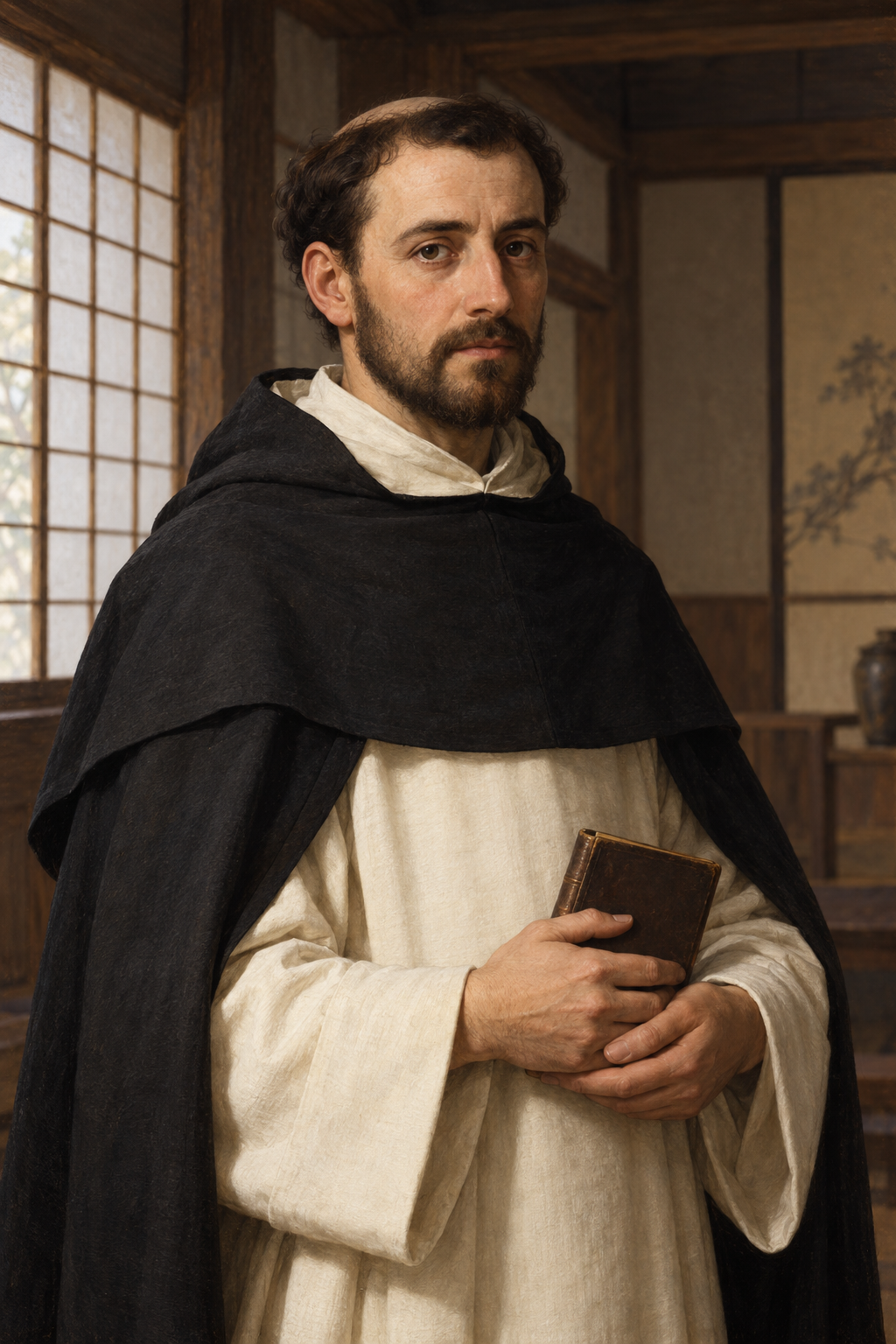
About Luke Alonso Gorda
Luke Alonso Gorda, known in religion as Lucas of the Holy Spirit, was a Spanish Dominican priest who served Christian communities in the Philippines and Japan. He was born at Carracedo de Vidriales on October 18, 1594. He entered the Dominicans in 1610 and made his profession the following year. His path eventually took him far from his home in the diocese of Astorga.
A letter written from Nagasaki on October 16, 1633 preserves his own account of that journey. Looking back near the end of his life, he recalled receiving the habit at Benavente, studying at Trianos and Valladolid, and leaving for the missions in 1617. He was ordained in Mexico that year. He then served in Nueva Segovia in the Philippines, went to Manila and reached Japan in 1623.
His brief account closes with a request for God’s forgiveness and the hope of completing his life in divine service. He also observed that he would turn thirty-nine on the feast of Saint Luke. This was a statement written before his death, not a report that he actually died on his birthday. The letter brings the distant stages of his ministry together in the words of someone preparing for an uncertain end.
In the Philippines he taught at the College of Santo Tomás in Manila and ministered in Cagayan. In 1623 he joined the mission to Japan with Dominic Ibáñez de Erquicia and other companions. His work there lasted ten years, during a period when Christian worship and missionary activity exposed both priests and their hosts to arrest.
The Dominican account in Witnesses of the Faith describes his learning Japanese after arrival and later serving in Kyoto and Osaka. It preserves memories of hiding in wooded country with little food and of letters sent to Manila about the suffering of local Christians. These accounts place Japanese believers beside the foreign missionaries: their shelter and assistance helped make the ministry possible.
Luke’s companions included Matthew Kohioye, a young Japanese catechist who joined the Dominican community, and the Jesuit priest Anthony de Sousa. The same Dominican history relates that the missionaries left their hiding place and waited in a boat, hoping to spare Christians who were being punished for refusing to reveal them. They were arrested at Osaka in September 1633 and eventually taken to Nagasaki. The account records their prayer together in prison and Luke’s final appeal for forgiveness.
He was subjected to the gallows-and-pit torture on October 18 and died the following day, October 19, 1633. His body was burned.
Pope John Paul II canonized him with the group of sixteen martyrs on October 18, 1987. The Dominican calendar commemorates the group on September 28; Luke is also remembered individually on October 19.
His memory remains part of the religious life of his home region. A diocesan report of an outdoor celebration in August 2020 explicitly identifies him as co-patron of Carracedo de Vidriales and patron of the Vidriales valley. Confraternity members and other devotees gathered for Mass in the village square, adapting the celebration to the restrictions of the pandemic. This local devotion links the missionary’s distant death with the community from which he came.
At the University of Santo Tomás, a bell dedicated to Lucas of the Holy Spirit forms part of the carillon inaugurated in 2011 to honor saints and martyrs connected with the university. The dedication report explains the choice of bells as signs of witness: their sound carries a message beyond the structure itself. Luke is remembered there among teachers and other members of a community whose history reaches across national boundaries.
Wondering how to weigh the stories and sources? Learn how to read a saint biography.