Biography
Luke Kirby
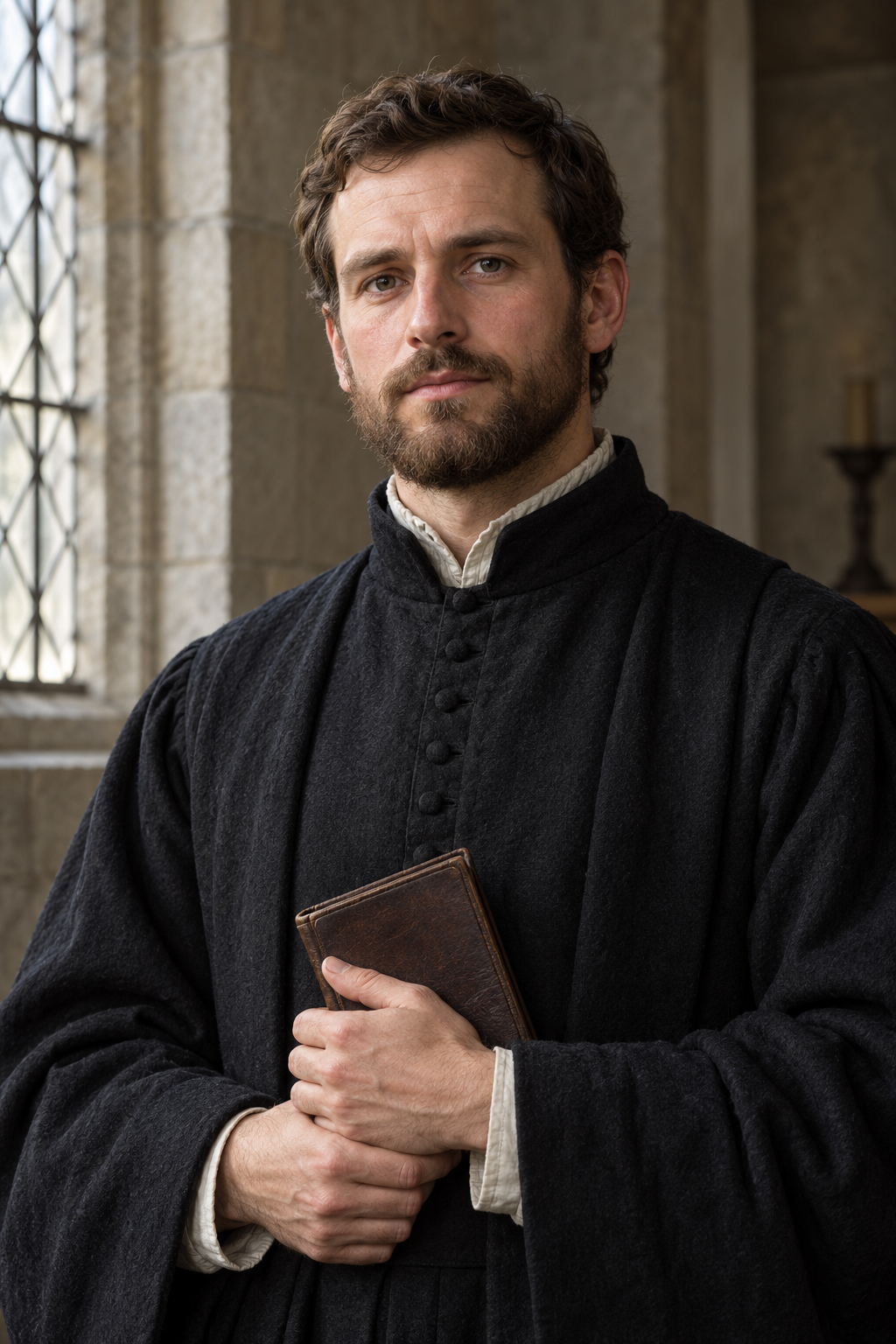
About Luke Kirby
Luke Kirby was a Catholic priest from Yorkshire who returned to England during the reign of Elizabeth I and was executed at Tyburn in 1582. Accounts place his birth around 1548 or 1549, but his early education remains uncertain. Older writers associated him with Cambridge, while the English College’s later account identifies him as a graduate of Louvain. A precise reconstruction of his student years is therefore difficult.
He entered the English College at Douai in 1576 and was ordained the following year. Wainewright’s account records a short visit to England in 1578, followed by a journey to Rome. At the English College there, Kirby took the college oath on April 23, 1579. These successive journeys brought him through the communities preparing priests for work in England.
In 1580 he left Rome with the missionary party that included Edmund Campion and Ralph Sherwin. Government agents were watching the group. The English College’s memorial article reproduces a description of Kirby as a strongly built Yorkshireman with a short beard and a slight stammer. The party separated in France before attempting the crossing to England. Such details preserve something of the individual behind the later title of martyr.
Kirby was arrested at Dover in June 1580 and imprisoned at the Gatehouse in Westminster. On December 4 he was transferred to the Tower of London, where he was tortured. In November 1581 he stood trial at Westminster Hall alongside other missionary priests. He was convicted of involvement in an alleged conspiracy abroad; the New Catholic Encyclopedia describes the supposed plot as fictitious. His execution was delayed for several months.
A letter quoted in the college memorial shows that he expected death much earlier. In January 1582 he urged that anything intended for him be sent quickly, since he believed execution was near. At the gallows he denied plotting against the queen. The same account relates that the sheriff offered to halt the execution if he rejected papal authority. Kirby refused, understanding that demand as a denial of his faith.
He died on May 30, 1582, together with the priests Thomas Cottam, William Filby and Laurence Richardson.
Pope Paul VI canonized Kirby on October 25, 1970.
A surviving piece of altar linen offers another way of approaching his story. Jesuit Collections associates a corporal with clandestine Masses celebrated by Kirby and other priests in the Tower. A corporal is the cloth placed on an altar during Mass; its ordinary liturgical use gives this object its significance. According to the collection’s account, the priest Arthur Pitts obtained it while imprisoned there and carried it out of England after his banishment in 1585. He brought it to the English College in Rome.
The priests’ names were embroidered on the cloth as a memorial. The collection also records later examination by John Morris, who worked on the martyrs’ cause. These are the custodians’ historical attributions, rather than an independently demonstrated record of every use of the linen. The object preserves a memory of worship shared in confinement, alongside the records of trial and execution.
The Diocese of Plymouth’s 2018–2019 Ordo lists May 30 for those wishing to honor Kirby individually. It also identifies May 4 as the commemoration of the Reformation martyrs together. The individual date marks his death; the shared celebration places him within the wider remembrance of Catholics who suffered during this period.
Wondering how to weigh the stories and sources? Learn how to read a saint biography.