Biography
Manuel Gómez González
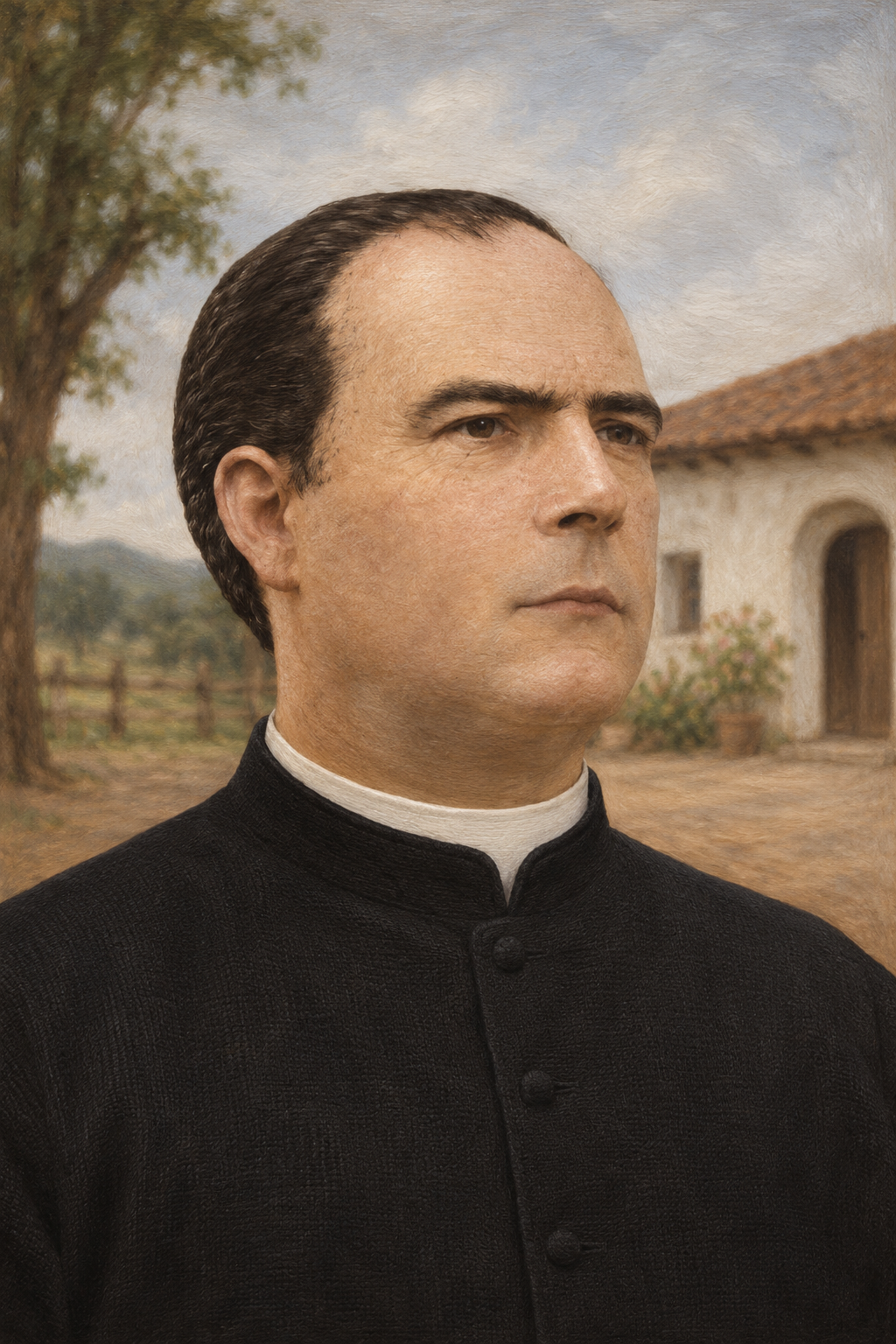
About Manuel Gómez González
Manuel Gómez González’s priestly ministry took him from Galicia through Portugal to rural southern Brazil. Born in San José de Ribarteme on 29 May 1877, he was ordained on 24 May 1902 and first served in his home diocese. He later worked in the Archdiocese of Braga. Political and religious difficulties in Portugal led to his departure for Brazil in 1913, where he began the final and longest period of his service.
In the Diocese of Santa Maria, he first served at Soledade and then took responsibility for Nonoai in 1915. The church’s martyrdom decree records a ministry that included catechesis, schooling, the sacraments and parish organization. It also describes practical efforts to improve daily life, including building work and support for farming. He was therefore addressing more than the need for occasional religious ceremonies. The community needed places to learn, reliable pastoral care and resources with which families could support themselves.
The Diocese of Tui-Vigo remembers him opening a school in his own home and teaching children and adolescents without charge. It also records a kiln for making bricks, housing for poor people and efforts to encourage the cultivation of rice and potatoes. These projects gave concrete form to his concern for the parish. They place the missionary in the work of a community trying to build homes and educate children, rather than only in the dramatic events surrounding his death.
Nonoai covered a broad territory, and his responsibilities also extended to Palmeira das Missões. His work required travel among scattered communities, including visits to Indigenous Kaingang people. The sanctuary’s history remembers teaching, catechesis and sacramental care alongside practical help for the parish. The journey on which he died belonged to that existing pattern of service across the region, rather than to an undertaking separate from his ordinary pastoral responsibilities.
One of the young people who accompanied him was Adílio Daronch, a Brazilian altar server and pupil of the school. They traveled together in May 1924 toward the Três Passos region. Cardinal José Saraiva Martins’s beatification homily remembers Manuel urging peace and mutual respect among people caught in political conflict. It also connects hostility toward him with his giving Christian burial to victims. His ministry continued amid the consequences of violence that had divided communities and made travel dangerous.
On 21 May 1924 Manuel and Adílio were killed near Três Passos after accepting an offer of guidance from armed men. The martyrdom decree describes an ambush following their search for directions at Feijão Miúdo. Manuel was forty-six, and Adílio was fifteen according to the later beatification letter’s birth date. Their deaths ended a pastoral journey, but the record of their lives includes the schooling, parish service and companionship that preceded it. The church formally recognized both as martyrs.
Their remains were transferred to Nonoai in 1964, after decades of burial in the Três Passos region. The sanctuary’s history identifies the translation as an important part of the continuing remembrance. Nonoai and Três Passos retain different connections with their story: the place from which the missionary and altar server traveled, and the area where they were killed. Annual pilgrimages keep those places linked in the devotional life of local communities.
Manuel’s home diocese also preserves that connection across the Atlantic. A 2022 report from Tui-Vigo announced the visit of Brazilian pilgrims following places associated with him in Galicia and Portugal. Their planned itinerary included his birthplace, parish church, relatives, seminary and the cathedral where he was ordained. The journey brought people from the region where he had served back to the earlier communities that had formed him, joining his European beginnings to his Brazilian ministry.
A later interview with Father Mauro Argenton of Frederico Westphalen emphasized care for people in poverty and Manuel’s opposition to war and killing. Argenton also acknowledged limits in identifying who had ordered the murders, avoiding certainty about every level of responsibility. He described plans for a pilgrim route connecting Três Passos and Nonoai, informed by journeys already undertaken. His account shows a church still working to communicate the martyrs’ history and the practical demands of peace associated with their example.
Efforts to tell that history have also involved younger readers. A diocesan project announced in 2020 proposed a comic book about the priest and altar server, produced with Estúdio NES. The sanctuary rector explained its aim of reaching families and children through an accessible account of their lives. The announcement connected their memory with education, community and peace, extending the work of remembrance beyond pilgrimage celebrations. The book itself is a later interpretation of their story.
The two were beatified in Frederico Westphalen on 21 October 2007. Their apostolic letter permits a shared feast on 21 May in the places and manner provided by church law. Manuel is honored as a blessed priest and martyr, and Adílio as a blessed lay martyr. Their recognition preserves the distinct roles of an adult pastor and a young altar server whose lives became joined through service in the same communities.
Wondering how to weigh the stories and sources? Learn how to read a saint biography.