Biography
Manuel Míguez González
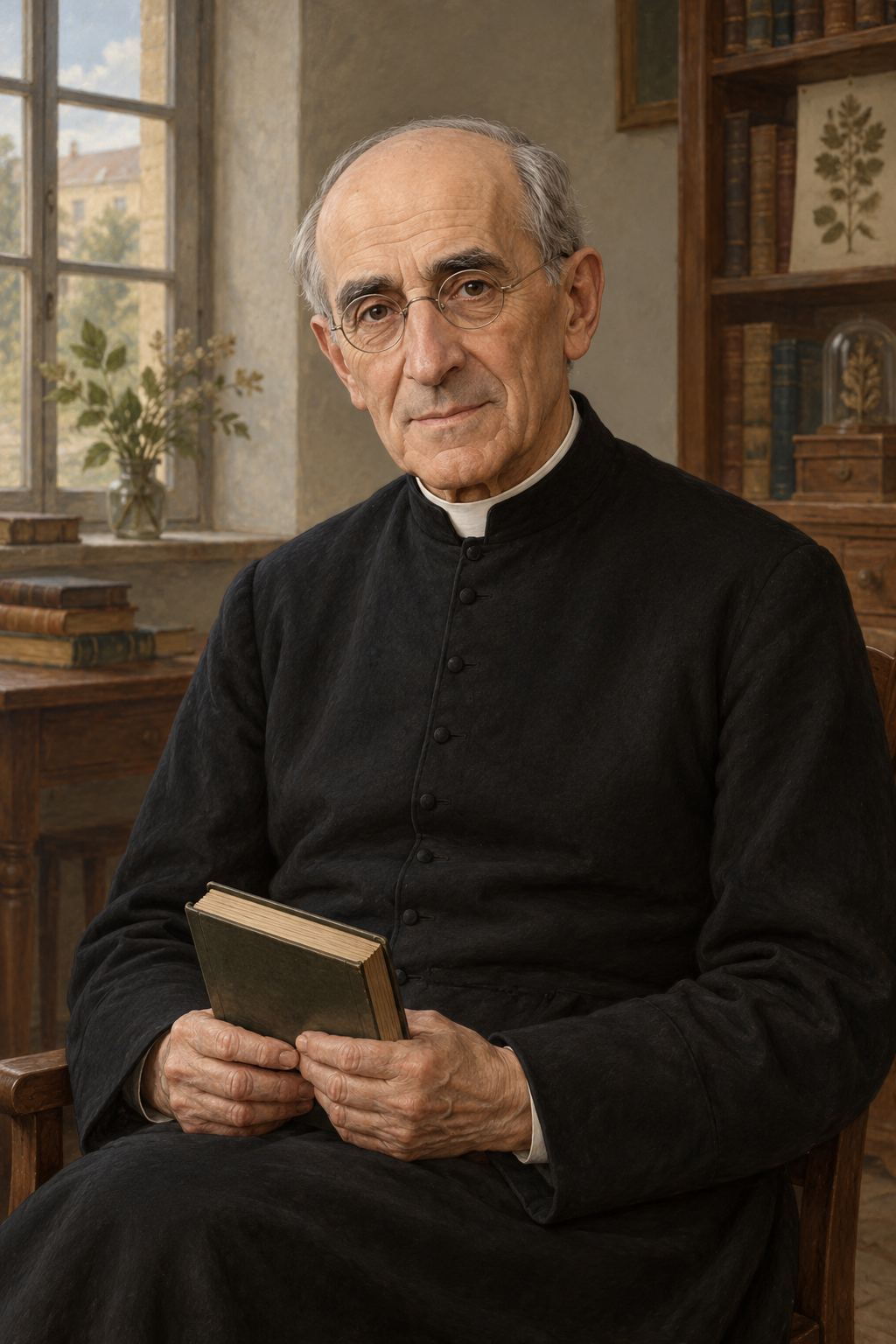
About Manuel Míguez González
Manuel Míguez González, known in religious life as Faustino of the Incarnation, was a Spanish Piarist priest, teacher and founder. He entered the Piarist novitiate in Madrid in 1850 and became a priest in 1856. His work took him through classrooms, libraries and laboratories, and eventually led him to establish a congregation devoted to girls’ education.
Born at Xamirás on March 24, 1831, he studied Latin and humanities before entering religious life. The institute he founded remembers his particular care for pupils who struggled to keep up, and his use of experiments and practical exercises. His science textbooks included introductions to natural history and terrestrial physics. Teaching was also a religious responsibility: he understood education as a means of forming the whole person and serving people whose opportunities were limited.
His ministry included extended time hearing confessions and offering spiritual direction. The institute’s account emphasizes the welcome remembered by those who approached him. He valued simplicity, poverty and charity in a priest, and understood pastoral work as close attention to people’s lives as well as service at the altar.
John Paul II later emphasized the continuity between this pastoral service and his educational vocation.
In 1857 he went to Guanabacoa, Cuba, to teach future schoolteachers. Almudena Béjar Sánchez’s study places this foundation within Spanish colonial policy: the government wanted to retain control over teacher training while improving schooling. Míguez taught scientific subjects and helped organize teaching collections. His interest in medicinal plants grew through observing local people’s use of them. This work belonged to the scientific and colonial setting of his time.
After returning to Spain, he taught in several communities. At Sanlúcar de Barrameda, the town council commissioned him to analyze its waters. He later served as librarian at El Escorial and rector at Monforte de Lemos. Returning to Sanlúcar, he founded the Calasancian Daughters of the Divine Shepherdess on January 2, 1885, with ecclesiastical approval. The congregation followed the educational example of Joseph Calasanz and sought to provide girls with intellectual, religious and personal formation.
His water analysis included repeated tests, some performed by pupils without knowing his results. He also asked for medical review of his therapeutic recommendations, acknowledging the limits of his own expertise.
His medical activity also brought conflict. Béjar Sánchez records complaints from physicians to his superiors, and connects his transfer to Getafe in 1888 with both his work with the new congregation and his treatment of patients. He was prohibited from attending the sick and preparing medicines, and spent his first four years there away from that work. The study also describes the later involvement of the sisters, including Sagrario Martín, who trained in pharmacy and became the laboratory’s first technical director. These episodes complicate an account concerned only with successful remedies and public praise.
The laboratory became part of the congregation’s continuing work. In a 2017 interview, its director, Sacramento Calderón, described the sisters’ pharmaceutical training and the collection of formulas they had inherited. She explained that proceeds were assigned to maintaining the laboratory, Masses for the dead and support for women without the means to pursue university study. The arrangement connected a specialized practical activity with the educational purpose of the community.
Calderón also described a period of reorganization: the laboratory was seeking renewed authorization to market four medicines that year. Her account records the institution’s circumstances in 2017, rather than establishing the present availability or effectiveness of its products. The historical evidence shows Míguez’s concern for sick people and his investment in botanical study; it does not provide modern clinical evidence for particular remedies.
Míguez died in Getafe on March 8, 1925. The institute preserves documents, photographs, books and personal objects in a museum opened there in 2000. These materials retain traces of the different parts of his work, from teaching and study to the religious community he established.
At his beatification in 1998, John Paul II interpreted those activities as expressions of a single Christian vocation: educating children, offering spiritual guidance and responding to bodily suffering. The pope emphasized the formation of the whole person and linked Míguez’s concern for girls’ schooling with his understanding of women’s importance within family and society. The homily presents the Church’s religious interpretation of his life and the task entrusted to the educators who continued his work.
Sanlúcar remembered him publicly after his canonization in 2017. The municipality awarded him its gold insignia posthumously, recognizing his response to the exclusion of girls from basic education. A representative of the institute accepted the honor and presented the town with a facsimile of his pedagogical address. This civic recognition reflected the lasting local importance of his educational foundation.
Calasancian schools also remember him as their patron. The Ourense school’s 2020–21 annual plan explicitly names this patronage and connects his celebration with care for children and people in need. His liturgical memorial falls on March 8.
Wondering how to weigh the stories and sources? Learn how to read a saint biography.