Biography
Marcellin Champagnat
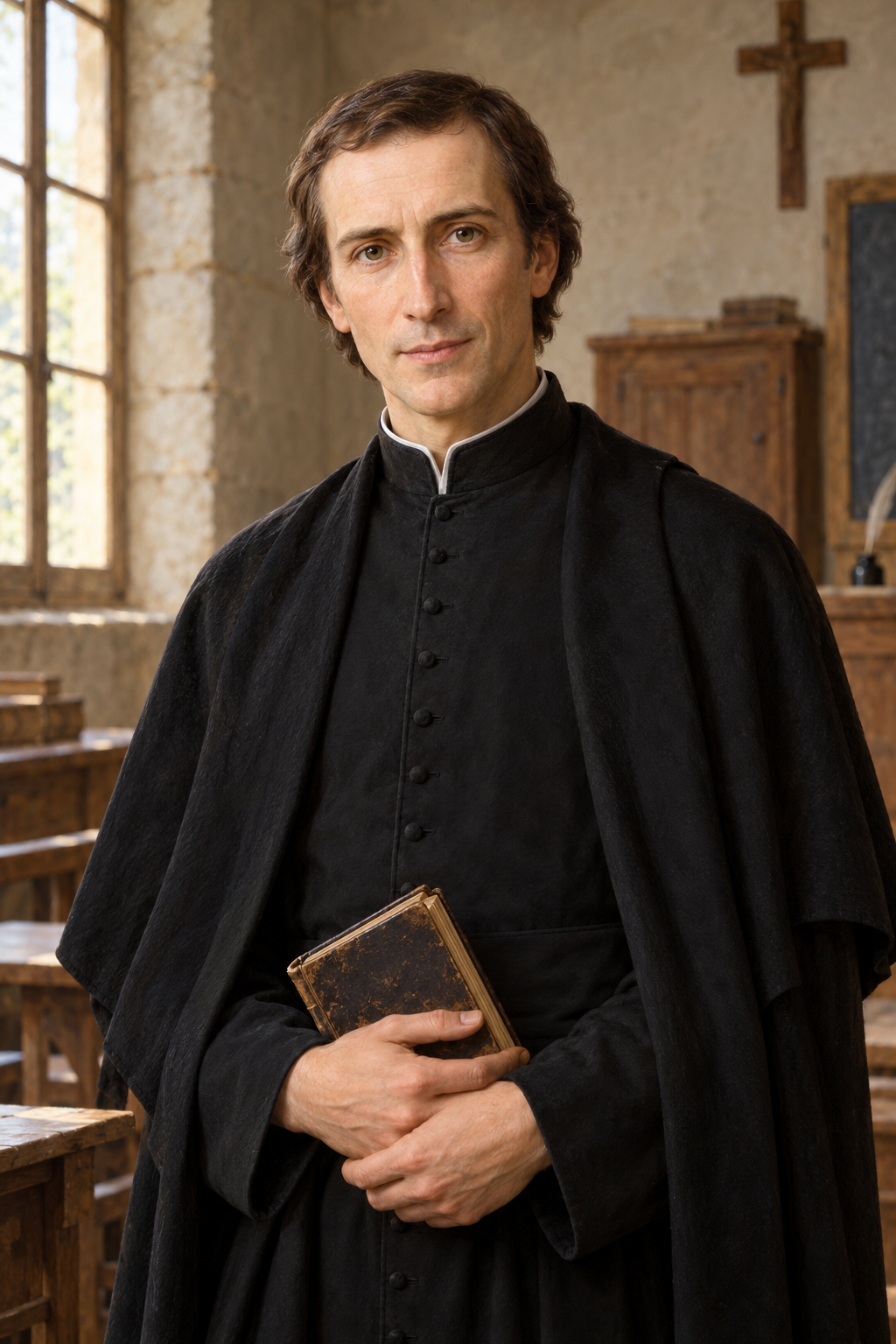
About Marcellin Champagnat
Marcellin Champagnat was a French priest who founded the Marist Brothers to provide Christian education for children, particularly in rural communities. Born on May 20, 1789, at Rosey in the parish of Marlhes, he grew up during the upheavals of the French Revolution. His own limited early schooling made the difficulties of learning familiar to him.
His mother and an aunt who was a religious sister helped form his faith. He entered the minor seminary at Verrières in 1805 and later continued his studies in Lyon. Among his fellow seminarians were men who hoped to establish a society devoted to Mary. Champagnat insisted that teaching brothers should have a place in that undertaking, serving children whose families had few educational opportunities.
After his ordination on July 22, 1816, he became a curate at La Valla. On January 2, 1817, he gathered his first two brothers. Their preparation combined religious formation with the elementary subjects they would teach. Champagnat worked alongside these young men and gradually built a community whose service depended on learning how to educate others.
Trust in Mary remained central to his religious life. The Holy See’s biography describes his desire to make Christ known and loved through education. Prayer and community life supported the service he expected the brothers to offer children.
A familiar story connects the foundation with his visit to a dying boy who knew little about Christianity. The encounter became a powerful image of the educational needs that concerned him. Its familiar details, however, require care. In a study of the early accounts, Marist historian Michael Green shows that the boy’s identification as Jean-Baptiste Montagne emerged much later. The witnesses differed over his age and the timing of the visit. The specific identification and the usual October 1816 setting cannot simply be treated as established facts.
Green also shows that Champagnat’s work was wider than this single remembered encounter. Recollections describe his catechism lessons, attended by girls as well as other parishioners. For the brothers’ classroom preparation, he brought in Claude Maisonneuve, a former De La Salle brother. Religious instruction and practical teaching methods developed together within the early community.
The schools had to fit the circumstances of rural families. John McMahon’s historical study describes arrangements allowing small communities of brothers and contributions from parents who could afford them. Some early schools operated in winter so that children could work on family farms in warmer months. These compromises helped make instruction available where a larger, more expensive establishment would have been difficult to maintain.
The results were not uniformly impressive. McMahon reproduces an official assessment that found the brothers less well prepared than other teachers, while recognizing that some villages would otherwise have had none. The institute had expanded quickly. Its need for stronger training was real, and enthusiasm alone did not supply the skills required in a classroom.
The community’s new house, Notre Dame de l’Hermitage, became both a monastery and a center for forming teachers. The Marist educational document In the Footsteps of Marcellin Champagnat describes continuing study there, alongside spiritual formation. Brothers returned to a common life intended to sustain their work in a growing network of schools. Keeping charges low also meant accepting austere living conditions themselves.
Founding schools required more than teaching. Champagnat negotiated over property, adapted buildings and sought official recognition for the brothers. The same Marist account notes his concern about their liability for military conscription. His letters and personal appeals sought help from Church and civil authorities. Administrative work, building work and religious leadership all formed part of his responsibilities.
The brothers’ preparation continued during school holidays through individual study, group work and conferences. Those taking responsibility for schools also needed instruction in administration and accounting. The aim was to prepare religious educators for the ordinary responsibilities of running a school.
The mission also extended overseas. In 1836 three brothers sailed to the Pacific with Marist priests. As Champagnat’s health failed, preparations were made for a successor, and Brother François was elected in 1839. McMahon records that Champagnat was still arranging training for brothers to educate deaf children shortly before his death.
Champagnat died at Notre Dame de l’Hermitage on June 6, 1840. He was beatified in 1955 and canonized on April 18, 1999. His feast is June 6. The congregation he founded carried his educational work beyond the rural French communities in which it began.
His patronage reflects that inheritance. The Diocese of Burlington names him a patron of education. Marist Schools Australia calls him the patron of its communities and reports that Australian Catholic University chose him as patron of students, learning and teachers in 2014. Those university roles belong to a specific institutional designation. In the same letter, Michael Green emphasizes that Champagnat’s concern for relationships went together with attention to effective teaching, including the methods used to teach reading.
Wondering how to weigh the stories and sources? Learn how to read a saint biography.