Biography
Marko Krizin
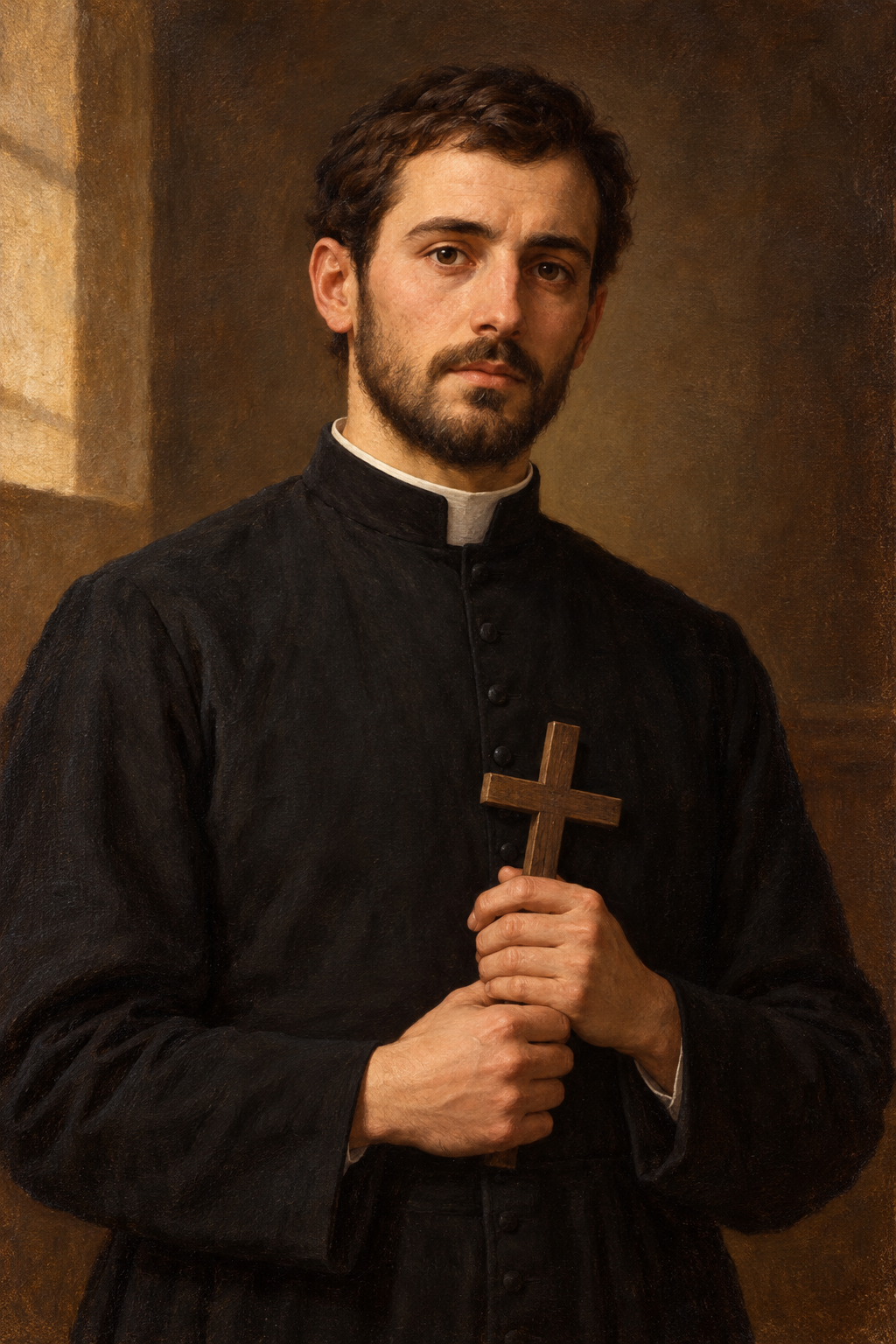
About Marko Krizin
Marko Krizin, also known as Marko Križevčanin, was a Croatian priest killed at Košice in 1619. His life crossed several languages and territories: he studied in Vienna, Graz and Rome before serving communities in the Hungarian kingdom. The Croatian Biographical Lexicon places his birth at Križevci around 1588. He was ordained in 1615 and initially worked in the Križevci area.
His later responsibilities were both pastoral and administrative. He became a canon at Trnava and administered the former Benedictine abbey at Széplak, now Krásna nad Hornádom. The work did not necessarily suit him: in 1619 he unsuccessfully asked to be released from that administration. This request gives a glimpse of an ordinary difficulty within a short life often remembered chiefly through its violent ending.
Archbishop Péter Pázmány drew him into the work of educating clergy. The diocesan account describes his teaching and leadership at the seminary in Trnava. Marko had been educated by Jesuits, but he was a secular priest, rather than a member of their order. His association with Jesuit companions later became central to the way he was remembered.
The city where he died had already experienced religious coercion under different rulers. In his historical study, Cyril Hišem describes how imperial authorities took churches from Protestants in 1604 and restricted their worship. A Protestant citizen was arrested after arranging a service, and preachers were ordered to leave. These actions formed part of a struggle in which control of buildings and public religious practice changed with political power.
Hišem also records the reversal that followed the advance of Stephen Bocskai’s forces: churches were returned to Protestants, while soldiers plundered Catholic homes and those of wealthy Protestants. In 1619, another conflict brought the forces of Gabriel Bethlen and George Rákóczi to the region. This setting helps explain the danger surrounding Marko and his companions without making an entire religious community responsible for the actions of particular soldiers or officials.
At Košice, Marko was associated with two Jesuit priests, Stephen Pongrácz and Melchior Grodziecki. The Vatican’s account places their arrest during the city’s capture by Rákóczi’s forces. Their captors pressured them to abandon their Catholic faith. Marko was offered possession of the abbey property if he would change his allegiance, but he refused. He was tortured and beheaded on September 7, 1619.
The Vatican account also records opposition to the killings among Protestants. This detail matters to the history of their remembrance: the violence was not simply an expression of unanimous hostility between two communities. Marko and his companions were subsequently honored as martyrs because of their refusal to renounce their faith. Pope Pius X beatified the three priests in 1905.
The Croatian Biographical Lexicon traces the subsequent movement of the relics. It records their transfer to the Poor Clares at Trnava in 1635 and to the Ursulines in 1784, with Marko’s skull preserved at Esztergom.
John Paul II canonized them at Košice on July 2, 1995. Looking back on the visit at his general audience three days later, he identified Marko as a Croatian canon of Esztergom, alongside his Hungarian and Polish Jesuit companions. Their shared remembrance brought together people of different origins whose lives had converged in the same city.
The pope also spoke of reconciliation with other Christians. During that journey he met Protestant representatives and prayed at a monument in Prešov commemorating Reformed Christians executed in the seventeenth century. He recalled the suffering caused when rulers imposed their own religion on their subjects. His account placed the celebration of Catholic martyrs beside an acknowledgment of violence suffered by other Christians, inviting remembrance that could serve reconciliation rather than renewed hostility.
For John Paul II, the martyrs’ fidelity was a witness to Christ. His visit did not end with the canonization ceremony: the meetings and prayer that accompanied it expressed a hope for closer relations between divided Christians. The memory of suffering could become an occasion to seek that closeness.
In Croatia, the Diocese of Bjelovar-Križevci names Marko as its patron. Its account also recalls the development of local devotion, including the establishment of a Zagreb parish in 1937 and pilgrimages associated with the anniversary of his death in 1969. These practices gave his memory a continuing place in parish life, well beyond the immediate circumstances of his martyrdom.
The Križevci Tourist Board identifies him as patron of the city and of Koprivnica-Križevci County. These are specific local associations, rooted in the remembrance of a priest who came from Križevci. The Diocese of Varaždin likewise honors him as its patron: its report of the September 7, 2010 celebration describes clergy gathering for his feast. Through these communities, Marko remains part of a living calendar of worship as well as the history of early modern religious conflict.
Their annual feast offers a recurring occasion for that remembrance in local church life.
Wondering how to weigh the stories and sources? Learn how to read a saint biography.