Biography
Martin of León
About Martin of León
Martin of León, known locally as Santo Martino, was a priest and Augustinian canon associated with San Isidoro in León. He died there on January 12, 1203. His medieval biography was written by Lucas of Tuy, who belonged to the same religious house later. Much of Martin’s remembered life comes through this account, including stories of travel, prayer and extraordinary help. His birth belongs to the early twelfth century, but its precise year is uncertain.
Prisciliano Cordero del Castillo emphasizes that Lucas’s life of Martin presents a model for other canons to imitate. It follows familiar patterns of medieval saints’ lives, with accounts of asceticism, pilgrimage, miracles and a foreseen death. Such a work preserves a community’s memory and ideals; its stories should not all be treated as independently verified episodes.
The chronology of Martin’s journeys remains debated. Historian Alexander Marx points out that Lucas places a visit to Rome during the pontificate of Urban III, in the 1180s, rather than the earlier dates often repeated in modern biographies. The account then describes two years of service with the Hospitallers in the Holy Land and further journeys before Martin returned to León. Marx’s reading therefore challenges a settled timetable for his entry into San Isidoro.
Martin’s writings survive in a large manuscript made up of two volumes. Marx describes its tables of contents, running headings and pointers that helped readers locate useful passages. The collection presents itself as a book of sermons, drawing together preaching and biblical interpretation. Its arrangement suggests a practical resource that other clergy could use, rather than merely a record of one man’s private study.
Queen Berengaria supported the costly production of the manuscript. Marx dates its preparation to the final years of Martin’s life and describes the copying as a collaborative undertaking, involving scribes under his supervision. The surviving books thus also preserve the work of a community.
The writings also contain difficult material. In his study of Martin’s response to the fall of Jerusalem in 1187, Marx identifies a call supporting the Third Crusade. Martin disputed the suggestion that the heavenly Jerusalem had fallen alongside the earthly city. He used biblical interpretation to explain the loss and to encourage a Christian response. This preaching belonged to the religious mobilization surrounding an armed expedition.
His argument included anti-Jewish rhetoric. Marx explains that Martin addressed a Christian audience as though they were Jews, warning that they too could lose their favored standing. This depended on a hostile Christian interpretation of Jewish history and belief. Recognizing that rhetoric is part of understanding his work; it should not be repeated as a judgment about Jewish people. His intellectual legacy includes these polemics as well as his contribution to preaching.
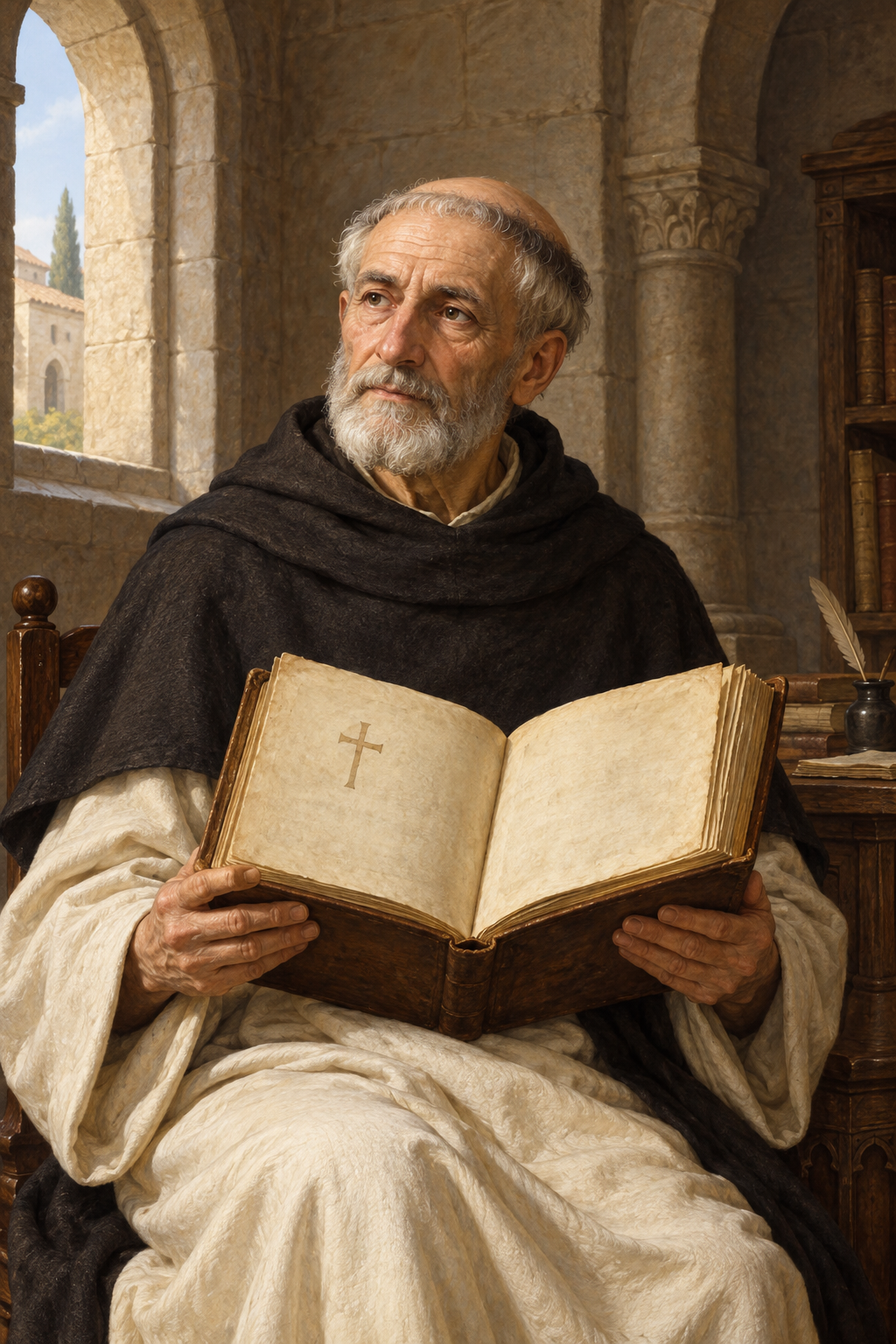
Material traces of his religious life remain at San Isidoro. Art historian Etelvina Fernández González discusses the chapel of the Trinity and its consecration inscription, dated to 1190. She also identifies an image of Martin in his manuscript: he holds an open book bearing a cross, an allusion to his religious name, “of the Holy Cross.” The image connects the writer’s identity with the devotional subjects of his work.
The basilica continues to celebrate his feast on January 12. Its 2024 notice announced Masses, choral participation and veneration of a relic. It also described his remembered care for sick people and his combination of learning with charity. His body is preserved in a sixteenth-century chapel bearing his name, beside the earlier chapel associated with him. These places link current worship with the community in which his memory developed.
A different form of remembrance connects Martin with learning later in life. In a 2008 address at Alicante, Cordero described how the University of Experience programme adopted him as patron in June 1995. Antonio Viñayo had proposed the choice. Cordero also explicitly celebrated Martin’s patronage of Alicante’s Permanent University, addressing students whose continued studies gave his medieval example a new setting.
The University of Alicante explains this association through Martin’s persistent interest in theology, languages and culture. Its account acknowledges that the particular schools he attended are not securely documented. The emphasis falls instead on the desire to keep learning at a mature age. In 2008, the university used his remembrance to honor the older students of its Diploma Senior programme as it marked a decade of activity.
Alicante’s account presents this continuing education as a means of personal development and participation in cultural life. The patronage gives that modern purpose a historical point of reference, without requiring students to share every outlook found in Martin’s writings.
The University of León likewise names him as patron of its Interuniversity Programme of Experience. A January 2023 report describes an academic celebration that brought together students, former students and university representatives. These documented associations concern particular programmes for older learners. They show how communities can find meaning in a medieval scholar’s memory while continuing to examine the evidence, tensions and limitations within his life and writings.
Wondering how to weigh the stories and sources? Learn how to read a saint biography.