Biography
Mary Euphrasia Pelletier
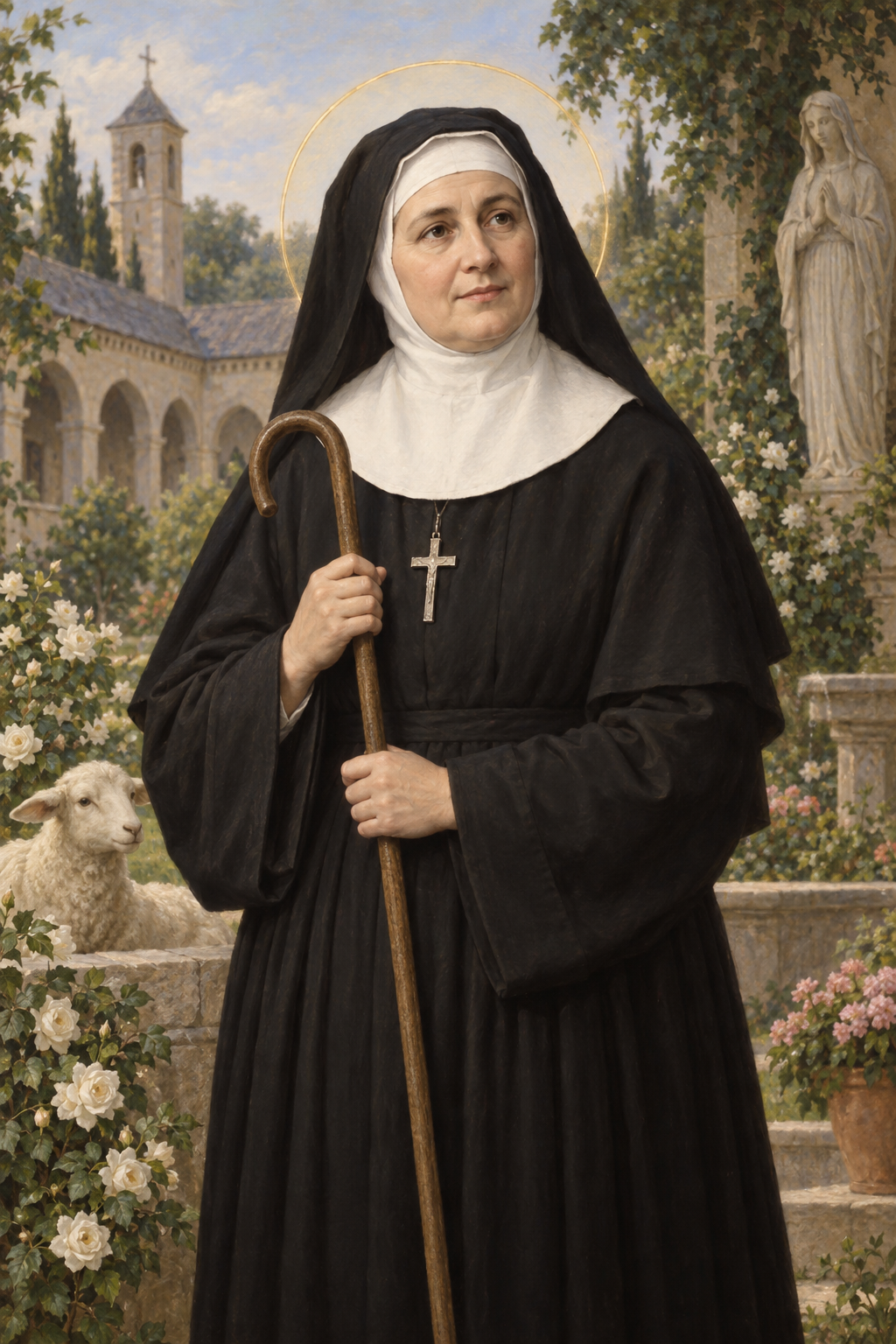
About Mary Euphrasia Pelletier
Rose Virginie Pelletier, later known as Mary of Saint Euphrasia, was born on Noirmoutier in the Vendée on 31 July 1796. The Holy See gives these names, date, and place, and records her death at Angers on 24 April 1868. Her life unfolded after the French Revolution and amid Catholic efforts to respond to poverty and social vulnerability.
Pelletier’s early surroundings influenced her religious formation. The Vatican biography says she was educated by Ursulines at Chavagnes and attended an association school in Tours. At sixteen she entered the monastery of Our Lady of Charity of the Refuge in Tours as a postulant. The older congregation, founded by John Eudes, served young women and girls considered to be in moral danger. The institutional setting helped shape her later work, although the terms used by historical sources reflect their own period and are not neutral descriptions of the women served.
In 1817 Pelletier professed religious vows and took the name Mary of Saint Euphrasia. The Dicastery’s biography says that she founded a “Magdalen” community in Tours for women who wanted to live a religious life with a contemplative rule. The Good Shepherd Sisters’ own account likewise says Pelletier formed a contemplative group for former residents who wished to embrace prayer and community life. This initiative sat alongside the congregation’s work with women and girls; it did not simply duplicate that work, but offered an additional vocation to women who chose it.
Pelletier became superior at Tours while still a young woman. The 1910 Catholic Encyclopedia reports that she was elected superior around 1824, while the Vatican account gives the general sequence rather than a precise date. Her leadership developed in a religious institute organized as autonomous houses. Over time she concluded that a shared administrative structure could better coordinate new foundations. The later sources connect this conviction to requests for additional communities, but the evidence does not warrant presenting her decision as uncontested or effortless.
In 1829, at the bishop of Angers’s request, Pelletier went there to establish a house of Our Lady of Charity. The congregation’s history confirms this foundation as a turning point in the Good Shepherd mission. In 1831 she became superior of the Angers house. Early objections arose from authorities and houses that wished to preserve their autonomy.
The proposal for a generalate sought to coordinate communities while preserving their common religious purpose. The Catholic Encyclopedia describes the need for central government and notes that Pelletier’s plan faced formidable opposition. The Dicastery likewise records resistance from authorities and monasteries. Accounts from the congregation describe the new governance as a way to answer requests for missions more flexibly. Her role is therefore best understood as organizational and spiritual leadership within a contested institutional process, rather than as the unilateral creation of a completely unrelated order.
Pope Gregory XVI approved the new Institute of Our Lady of Charity of the Good Shepherd of Angers on 3 April 1835. The date is given by the Holy See and by the Catholic Encyclopedia. Pelletier became its first superior general, a responsibility she held until her death. The Good Shepherd Sisters’ present history identifies 1835 as the beginning of their congregation and explains that its houses spread in France and beyond. The approval made the Angers mother house a center from which new communities could be organized.
The institute’s mission focused on women and girls in difficult circumstances, including those who needed shelter, education, or a path into religious life. The Vatican biography describes care, religious and moral education, intellectual and technical instruction, and continuing support for women after they left the institution. The congregation’s modern history frames this work as support for women and girls in times of need. Historical institutions and terminology have since changed, and this account avoids implying that every practice of the nineteenth-century houses would be accepted unchanged today.
Pelletier directed the congregation as it expanded. The Dicastery credits her with establishing 111 houses between 1829 and 1868 and reports that at her death the Institute counted 2,376 sisters and 15,000 girls in its care. The current congregation history confirms international expansion, though it does not repeat those exact totals. These figures are attributed to the Vatican account rather than treated as independently audited statistics.
Pelletier died in Angers on 24 April 1868. The Vatican’s Dicastery records the date and reports that the congregation’s work continued to grow after her death. The Sisters of the Good Shepherd preserve her memory as foundress and recount the expansion of the communities. The immediate historical record in these sources is stronger for the institutional legacy than for private details of her final illness, so no unsupported medical narrative is supplied.
Pope Pius XI beatified Pelletier on 30 April 1933, and Pope Pius XII canonized her on 2 May 1940. The Holy See lists those dates and identifies 24 April as her liturgical memorial. Her lasting significance lies in founding a congregation that coordinated local communities and in shaping forms of education, shelter, and religious life for women. That legacy is historically important while remaining open to critical study of how institutions of care operated in their own eras.
Wondering how to weigh the stories and sources? Learn how to read a saint biography.