Biography
Melchior Grodziecki
About Melchior Grodziecki
Melchior Grodziecki was a Jesuit priest from Cieszyn whose work carried him through several communities of central Europe. He studied with the Jesuits in Vienna, entered their novitiate at Brno in 1603 and was ordained in Prague in 1614. His ministry included the care of poor students at the Clementinum. He is remembered among the three priests killed at Košice in September 1619.
His early life is less certain than many traditional biographies suggest. Historian Wacław Gojniczek challenges the familiar claim that he belonged to the noble Grodziecki family of Brody. Family genealogies, inheritance records and documents concerning orphaned children do not name him where such a relationship would lead one to expect his inclusion. The historian also notes that early Jesuit records do not give him a noble title. Gojniczek suggests that the shared Latin form of the surname helped later writers connect the Jesuit with an otherwise well-known noble family.
Gojniczek instead proposes a possible connection with a child named Melchior Grodski in Cieszyn’s municipal records. That identification remains a hypothesis. He also reports an admission record describing the novice in 1603 as twenty-two years old, which points earlier than the frequently printed birth year 1584. The evidence supports his origin in Cieszyn more securely than a precise birthday or named parents.
Teaching occupied an important part of his religious life. The Catholic secondary school in Cieszyn that honors him as its patron describes his work in Brno and Kłodzko and his later responsibility for poor students in Prague. It also remembers his direction of their choir and his preaching in Czech. His service joined education with pastoral care, among young people whose limited means could otherwise restrict their opportunities.
His work was interrupted by the outbreak of the Thirty Years’ War. Teresa Szymik’s study places his movements within the wider struggle involving the Habsburg monarchy and its opponents. Expelled from Prague with other Jesuits in 1618, he eventually reached Košice as a military chaplain. The religious and political divisions of the period shaped the circumstances in which he served; they should not be reduced to a private disagreement between individuals.
At Košice he was imprisoned with fellow Jesuit Stephen Pongrácz and the diocesan priest Marko Krizin. The Brno encyclopedia records their refusal to abandon Catholicism and their violent deaths on September 7, 1619. Melchior’s death belongs to the history of confessional persecution in a city caught in war. The Catholic remembrance of the three priests centers on their fidelity under coercion.
John Paul II canonized the three companions at Košice on July 2, 1995. Their Catholic feast is September 7.
The memory of that violence has also become an occasion for reconciliation. Szymik examines Melchior’s place in contemporary Cieszyn, where Catholics and Evangelical Christians share a culturally diverse community. Her interpretation of the 2019 anniversary emphasizes meeting, dialogue and the healing of painful historical memories. She presents education for peace as an active task: learning to understand others and resist the prejudices that can turn religious differences into hostility. This is a modern reading of his legacy, rather than a claim that every participant in the seventeenth-century conflict shared those ideals.
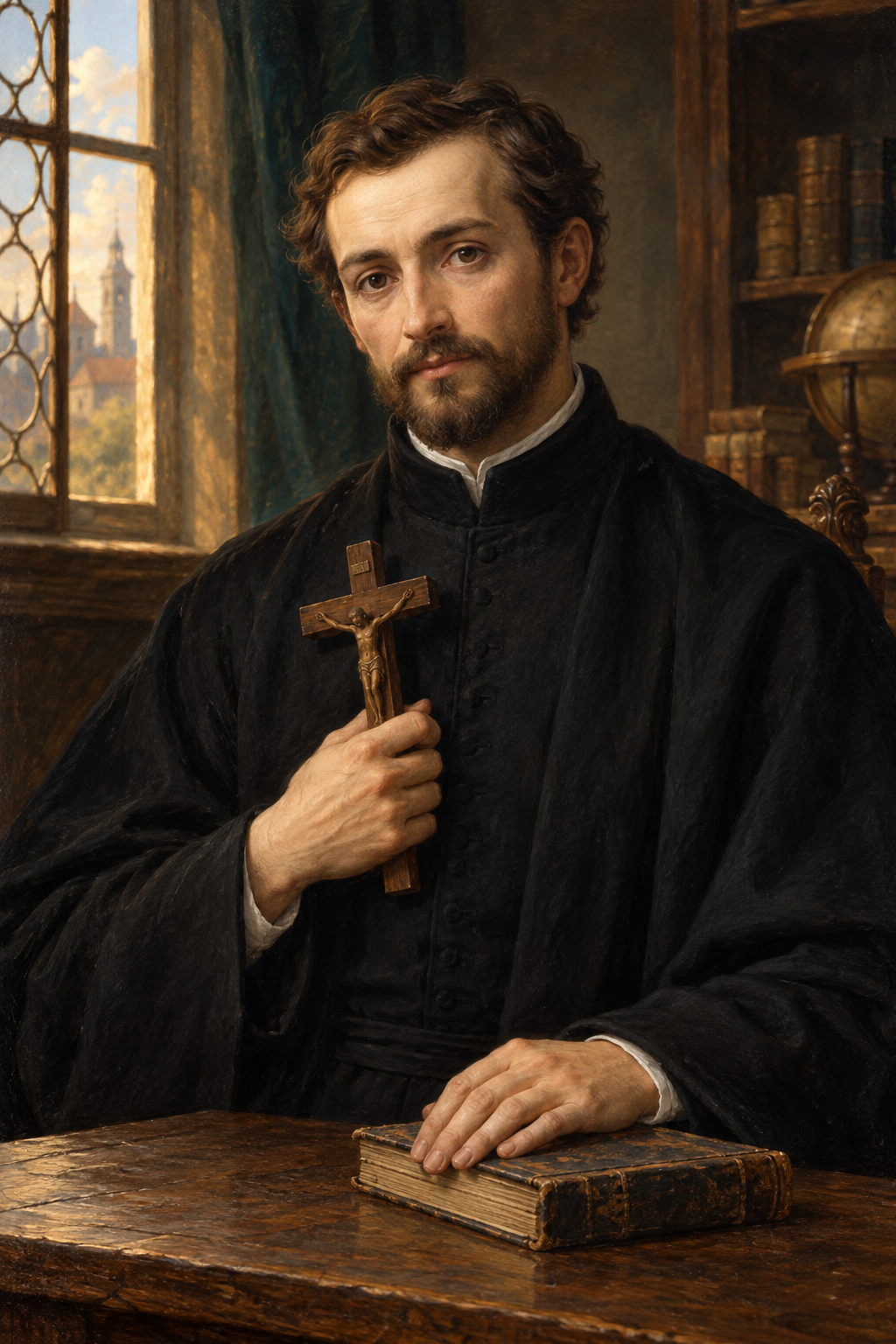
A diocesan report gives a concrete example of that remembrance. On September 1, 2019, participants from Cieszyn and Český Těšín met at the Friendship Bridge over the Olza and joined a procession with his relics. Polish and Czech bishops took part. The preaching acknowledged a shared history that included painful divisions and encouraged service across boundaries. In the same celebration, Melchior was explicitly identified as a patron of the Diocese of Bielsko-Żywiec. The report also describes an image in Saint Mary Magdalene’s church showing him holding the cross to his heart. In his homily, Bishop Tadeusz Kusy used that image to connect personal fidelity with the work of reconciliation.
Earlier that year, Bishop Roman Pindel had urged the diocese to learn more about a saint who was still unfamiliar to many local Catholics. His pastoral letter connected Melchior’s frequent moves and changes of work with the experience of young people seeking education and employment abroad. It also announced a journey of the relics through the diocese and encouraged common prayer. The comparison offered a way to approach a distant life through recognizable questions of vocation, responsibility and change. Pindel also presented the anniversary as a chance to recognize the religious and cultural contribution of Cieszyn Silesia within a diverse wider region.
For the Catholic secondary school in Cieszyn, his patronage has an educational purpose. Its account asks students to see in him perseverance in Christian commitments when choices are difficult. The school also remembers the multilingual character of his ministry. This local use of his example keeps attention on the teacher and priest who lived before the final crisis, not only on the manner of his death.
Wondering how to weigh the stories and sources? Learn how to read a saint biography.