Biography
Melchizedek
About Melchizedek
Melchizedek enters Scripture briefly and without a conventional life story. Genesis 14 names him king of Salem and priest of God Most High, but supplies no parentage, birth, reign length, death, or succession. The episode is set within the ancestral narrative of Abram, not a datable royal archive. The USCCB note associates Salem with Jerusalem and explains that ancient kings could exercise priestly functions. That makes a historical ruler-priest plausible within the story's world, but it does not permit exact dates or a reconstructed dynasty. This account therefore leaves his birth and death unset and marks the narrated encounter as scriptural tradition.
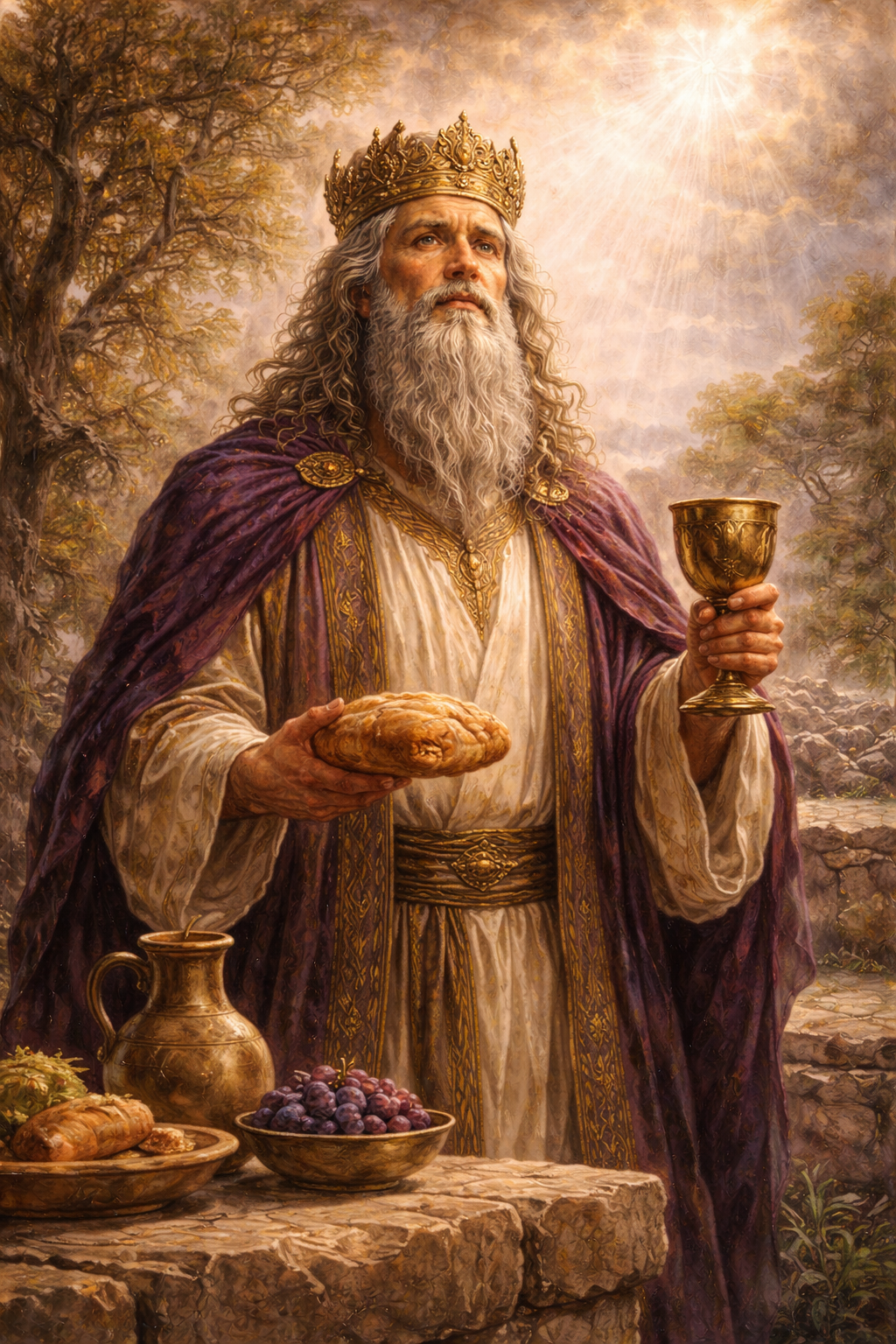
Abram has returned from defeating a coalition that captured Lot when kings meet him in the Valley of Shaveh. Melchizedek brings bread and wine, blesses Abram in the name of God Most High, creator of heaven and earth, and blesses God for delivering Abram's enemies. Abram then gives him a tenth of the recovered goods. Genesis offers no speech from Abram to Melchizedek and no description of the priest-king's appearance, ethnicity, age, household, or later conduct. The scene's significance lies in hospitality, blessing, worship, and a tithe, not in details later imagination might supply.
The chapter stands in a violent setting. Abram's force has pursued and struck enemies, captives and property have been recovered, and the king of Sodom negotiates over people and goods. Melchizedek does not join the fighting in the narrated scene. He provides food and speaks blessing after the battle. That action can demonstrate hospitality and peacemaking without turning the surrounding warfare into a virtue. Nor does the bread and wine prove by itself that he celebrated a Christian Eucharist. Christian tradition later reads the gifts typologically, but Genesis describes a feast for the returning victor and must first be heard in that literary context.
Psalm 110 gives Melchizedek a second scriptural afterlife. In a royal psalm, an oracle declares the king a priest forever in Melchizedek's manner. The USCCB introduction describes the poem as a court song that combines victory, adopted sonship, priestly status, and military imagery. Its note recalls the king of Salem as a ruler who performed priestly functions. The psalm does not narrate another event in Melchizedek's life, identify his descendants, or announce that he never died. It uses his remembered royal-priestly identity to speak about another king. Later Jewish and Christian interpretation developed that compressed comparison in different directions.
Hebrews 5–7 gives the fullest Christian interpretation. It applies Psalm 110 to Jesus, whose priesthood does not depend on descent from Levi. Hebrews reads the meanings of Melchizedek's name and Salem as ‘king of righteousness’ and ‘king of peace,’ emphasizes that he blesses Abraham and receives a tithe, and builds an argument from Genesis's silence about genealogy and death. The USCCB note explains the interpretive convention: what Torah does not mention can be treated rhetorically as absent. The claim that Melchizedek is ‘without father’ or beginning therefore concerns the scriptural presentation; it is not biological documentation or proof that he was immortal.
Hebrews carefully says Melchizedek is made like the Son of God. The direction of comparison matters. Jesus is not said to be a disguised Melchizedek visiting Abram, and Melchizedek is not called an incarnation of Christ. Instead, the sparse Genesis portrait becomes a type through which Hebrews explains Christ's enduring priesthood and a covenant not grounded in hereditary succession. The letter's argument is theological reception, not newly discovered information about the ancient king's private life. Claims that Melchizedek was Shem, an angel, or a pre-incarnate appearance belong to later interpretive traditions and are not entered here as historical identity.
Christian liturgy and art frequently connect Melchizedek's bread and wine with the Eucharist. The Orthodox Church in America explicitly describes the offering as foreshadowing the Church's Liturgy and draws on a homily attributed to Jacob of Serugh. This is an attributable traditional reading rather than the plain historical content of Genesis. The same OCA account rejects a literal inference from the missing genealogy: Melchizedek must have been born and died, while Scripture conceals both. Holding those levels together prevents devotion from becoming pseudo-history. A type can shape Christian prayer and theology without supplying a fuller recoverable biography of the person used as the type.
The OCA commemorates the Righteous Melchizedek, King of Salem, on May 22 and also remembers him on the Sunday of the Forefathers. Those observances document Orthodox reception, not the date of his birth, death, or encounter with Abram. No universal Christian feast is inferred from them. His names and titles likewise require restraint: ‘Melchizedek,’ ‘king of Salem,’ and ‘priest of God Most High’ come from Scripture; ‘saint’ or ‘righteous’ expresses later ecclesial veneration. Salem may be represented at settlement level as Jerusalem by the authoritative note, while the Valley of Shaveh remains an unlocated narrative meeting place with no invented coordinates.
Melchizedek's witness is powerful precisely because it is bounded. He receives a returning stranger with food, directs praise beyond military achievement, blesses without seeking the king of Sodom's bargain, and joins sacred and civic responsibility in one compressed scene. Readers should not fill the silence with certainty or recruit him to erase Jewish priestly tradition. Hebrews uses him in a specifically Christian argument about Jesus; Genesis preserves an enigmatic non-Israelite priest who recognizes God Most High. His practical challenge is therefore modest and demanding: offer peace after conflict, acknowledge gifts without possessing the giver, and let mystery remain mystery when evidence ends.
Wondering how to weigh the stories and sources? Learn how to read a saint biography.