Biography
Michael de Sanctis
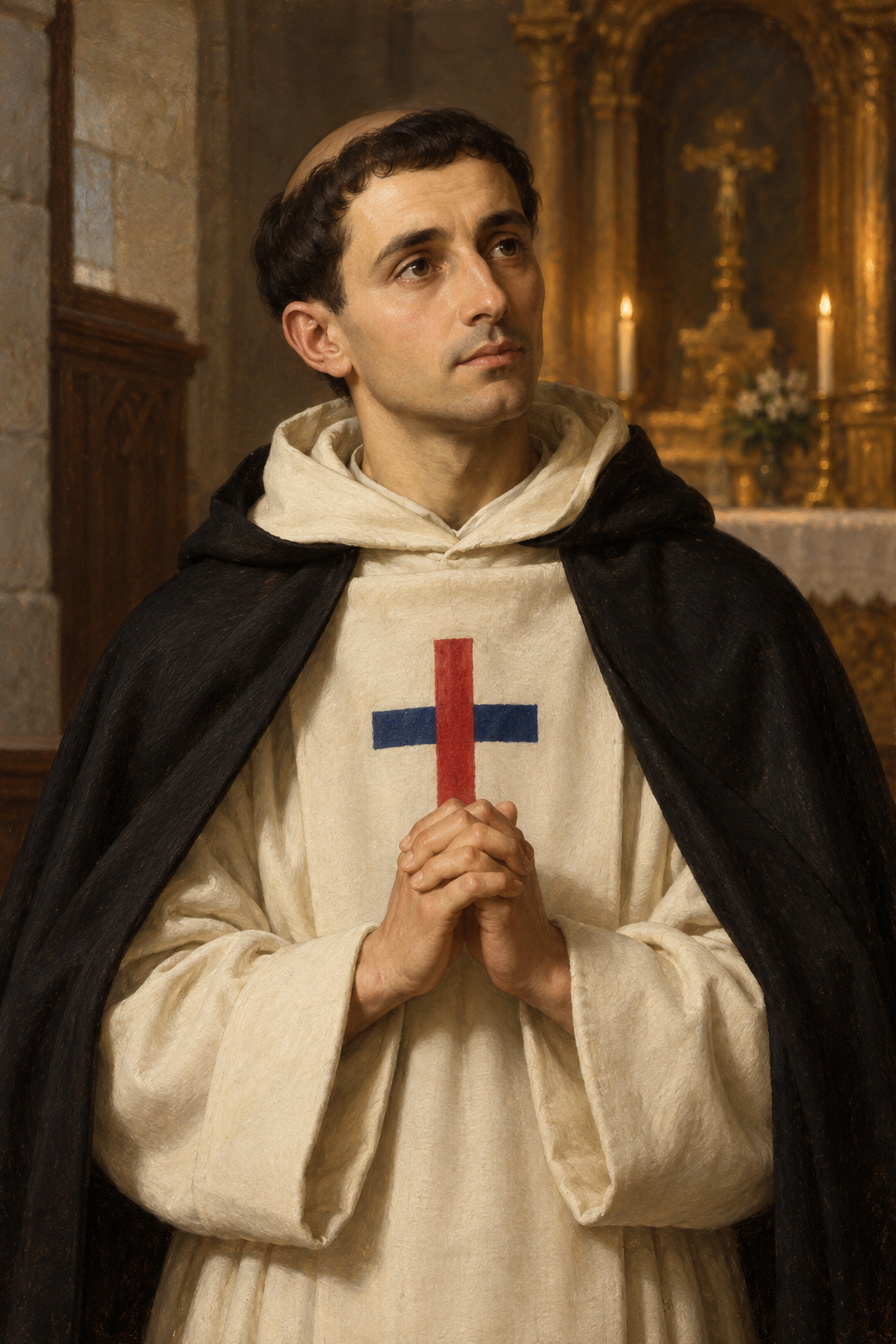
About Michael de Sanctis
Michael de Sanctis, also called Michael of the Saints, was a Catalan Trinitarian priest remembered for prayer, preaching and an intense devotion to the Eucharist. He was born at Vic on September 29, 1591. As a boy he sought admission to the Trinitarians in Barcelona, beginning a religious life that would take him far from his birthplace.
He first belonged to the older branch of the order. After meeting a friar of the Discalced Trinitarians, he asked permission to join their more austere reform. Michael Ott’s Catholic Encyclopedia account describes a new novitiate in Madrid and profession at Alcalá. Michael subsequently became a priest and served as superior at Valladolid. His search for a stricter observance took place within the order rather than through the creation of a separate community of his own.
The order’s biographer, Isidoro Murciego Murciego, remembers his studies at Baeza and Salamanca and the combination of contemplation with active service. He also describes practical kindness toward poor and isolated people, including the discreet delivery of food. These quieter acts stand alongside the extraordinary experiences emphasized in much of Michael’s devotional literature.
That literature needs to be read with care. The New Catholic Encyclopedia reports stories of ecstasy and levitation as claims made about him, rather than as independently established events. It also describes his preaching on the ransom of Christian captives, a central concern of his religious order. The contrast is useful: reports of unusual prayer experiences formed part of his reputation, while his ministry also addressed a concrete form of human suffering.
His surviving letters disclose a more ordinary struggle to remain in touch with relatives. In one letter he complains that messages have gone unanswered and asks for a dependable forwarding address through Barcelona. He hopes to see his family again. More sharply, he urges them to look after their brother Jacinto, whose apparent neglect has caused him distress. Religious separation had not erased his concern about their treatment of one another.
A second letter, written at Baeza on July 4, 1618, addresses his sister Magdalena after their brother Agustín’s death. Michael speaks of prayers and Masses offered for him. At the same time, he sets out a severe understanding of religious renunciation, describing family ties as something surrendered to God. Yet he again expresses hope for a visit. The letter holds affection and distance together, without resolving their tension into an uncomplicated portrait of family life.
His spiritual world included practices that can seem severe today. Murciego’s account describes a public penitential procession at Salamanca during carnival, involving friars who scourged themselves while a companion preached. The episode belongs to the ascetic culture in which Michael lived. The same biography stresses his cheerfulness and dislike of seeing others discouraged, reminding readers that severity is only one element of the tradition about him.
Michael died at Valladolid on April 10, 1625. Pius IX canonized him on June 8, 1862.
His patronages preserve several different aspects of his remembrance. The Trinitarian order identifies him as patron of its young people. Its United States province explicitly honors him as patron of people with cancer. The province recounts a healing attributed to his intercession during the canonization history; that is a claim of religious testimony, not a basis for promising a medical outcome. Its listed feast is June 8.
Vic, his birthplace, honors him as the city’s patron on July 5. The municipal account describes a procession from the house associated with his birth to the cathedral, where Mass is celebrated and songs of praise are sung. The wider festival includes community activities and traditional celebrations. Local civic remembrance and religious devotion meet around a figure whose adult life was largely spent elsewhere.
The letters also show the practical advice he gave: choose good companions, receive the sacraments and meditate on Christ’s Passion. They preserve his own voice alongside the accounts written about him. The two letters were published together in 1891.
Art historian Andrzej Witko traces changes in Michael’s image after his death. Early portraits were followed by representations of mystical experiences, and later by scenes of Eucharistic worship and heavenly glory. A monstrance, a lily and sometimes a book became identifying attributes. Witko notes that both branches of the Trinitarian order developed images of him. These works document the growth of devotion; a painted scene of levitation does not independently verify the event it portrays.
Witko singles out a copperplate engraving by Marcos Orozco from 1687 as an influential model for later artists. The changing imagery followed stages in the recognition of Michael’s cult, rather than simply repeating one scene. In Catalonia, the historian finds a particularly strong artistic memory of him. His white habit, colored cross and dark cloak identify his religious family, while the Eucharistic objects express the devotion for which he became known.
Wondering how to weigh the stories and sources? Learn how to read a saint biography.