Biography
Michael McGivney
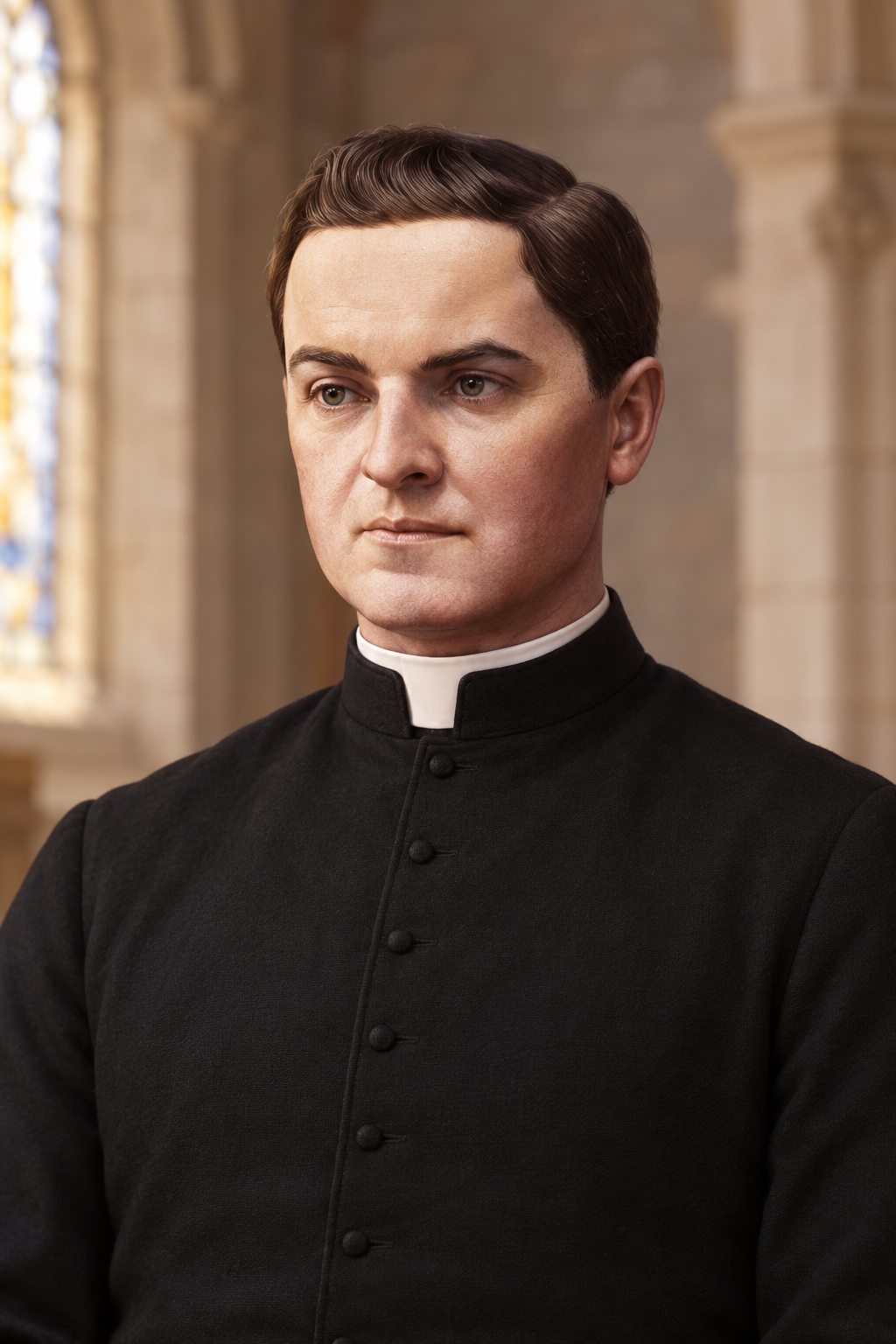
About Michael McGivney
Michael Joseph McGivney grew up in Waterbury, Connecticut, in a large family of Irish immigrants. His preparation for the priesthood took him to seminaries in Canada and the United States, where Vincentian and Sulpician teachers helped shape his formation.
He was the eldest of thirteen children. Six of his younger siblings died early, bringing repeated bereavement into the family. The account prepared for his cause describes a household that gave him his early Christian education, alongside the schooling he received before entering the seminary.
When his father died in 1873, the cost of continuing his studies became a serious obstacle. Support from the bishop of Hartford enabled him to complete his training at Saint Mary’s Seminary in Baltimore.
He was ordained in Baltimore on December 22, 1877, and became an assistant priest at Saint Mary’s Church in New Haven. His parish work brought him into contact with families whose security depended on the earnings of a single worker.
His parish responsibilities included work with young people and assistance to the poor. The beatification letter also records his promotion of a parish association intended to counter alcoholism among workers.
His first parish assignment was demanding. In an October 1878 letter to his former seminary teacher Alphonse Magnien, reproduced in Kevin Coyne’s study of his surviving writings, McGivney described carrying the parish’s work through the summer without a day’s vacation. Coyne places the letter against the background of an ill pastor and substantial parish debt. The correspondence presents a young priest already occupied with responsibilities that extended beyond celebrating services.
McGivney and lay parishioners organized a Catholic mutual-benefit society that received its Connecticut charter on March 29, 1882. The Knights of Columbus offered a way for Catholic men to support one another and provide financial help for widows and children after a member’s death. The society developed amid prejudice against immigrants and suspicion of Catholicism as a foreign influence. McGivney initially proposed calling the association the Sons of Columbus; the members chose Knights instead.
The choice of Columbus also carried a public message. The decree examining McGivney’s life explains the name as an assertion that Catholic faith and immigration belonged within American history. Its account places his support for lay associations alongside the difficulties immigrants faced in maintaining their religious identity and finding a place in their new society.
The new association did not grow effortlessly. Coyne traces McGivney’s changing assessments in his letters: an appeal to Connecticut priests in April 1882, disappointment about the slow beginning two months later, and encouragement when men in Meriden asked how to establish a council. In replying to them, McGivney linked mutual assistance with his desire to keep Catholics from joining secret societies. By August 1883 he could report gradual progress. These letters show him recruiting support, responding to setbacks and explaining the society’s religious purpose, rather than simply announcing an institution whose success was assured.
Joseph G. Daley, a priest who met him in New Haven in 1883, later remembered an approachable man without pretension. Writing in 1900, Daley was explicit that he had seen McGivney only once. His account also drew on conversations with others, including a seminary companion, Richard Foley, who recalled McGivney’s orderliness, religious devotion and humor. Daley described speaking with Daniel Colwell, an early Knight, whose recollections of the founder remained affectionate. These memories suggest the importance of personal relationships in McGivney’s parish and organizational work. They are recollections preserved after his death, rather than a diary of his daily activities. The distinction matters because Daley combined specific encounters with sweeping expressions of admiration. His article is useful for the people and conversations it identifies without requiring every judgment in it to be treated as an independently established fact.
In 1884 he moved to Saint Thomas Church in Thomaston. Although he gave up his role as the association’s secretary, he continued serving as its chaplain while carrying out his parish responsibilities.
He died in Thomaston on August 14, 1890, two days after his thirty-eighth birthday.
The Catholic Church’s later examination of his life emphasized the connection between his priestly ministry and the material needs of working families.
The recognition process also examined a reported healing associated with prayers for his intercession. According to the Congregation’s decree, a child in Tennessee was born in 2015 after a serious prenatal condition had disappeared. Medical advisers reviewed the case, followed by theologians and then the cardinals and bishops responsible for the cause. In May 2020, Pope Francis authorized the decree recognizing the healing as a miracle attributed to McGivney’s intercession. This is the Catholic Church’s judgment recorded in the cause documents.
His beatification took place in Hartford on October 31, 2020. The papal letter authorizing his recognition as blessed set August 13 for his annual liturgical observance where permitted by church law.
The Archdiocese of Hartford continues to remember him on that date, connecting his local ministry with an association whose work outlived him.
Wondering how to weigh the stories and sources? Learn how to read a saint biography.