Biography
Michel Garicoïts
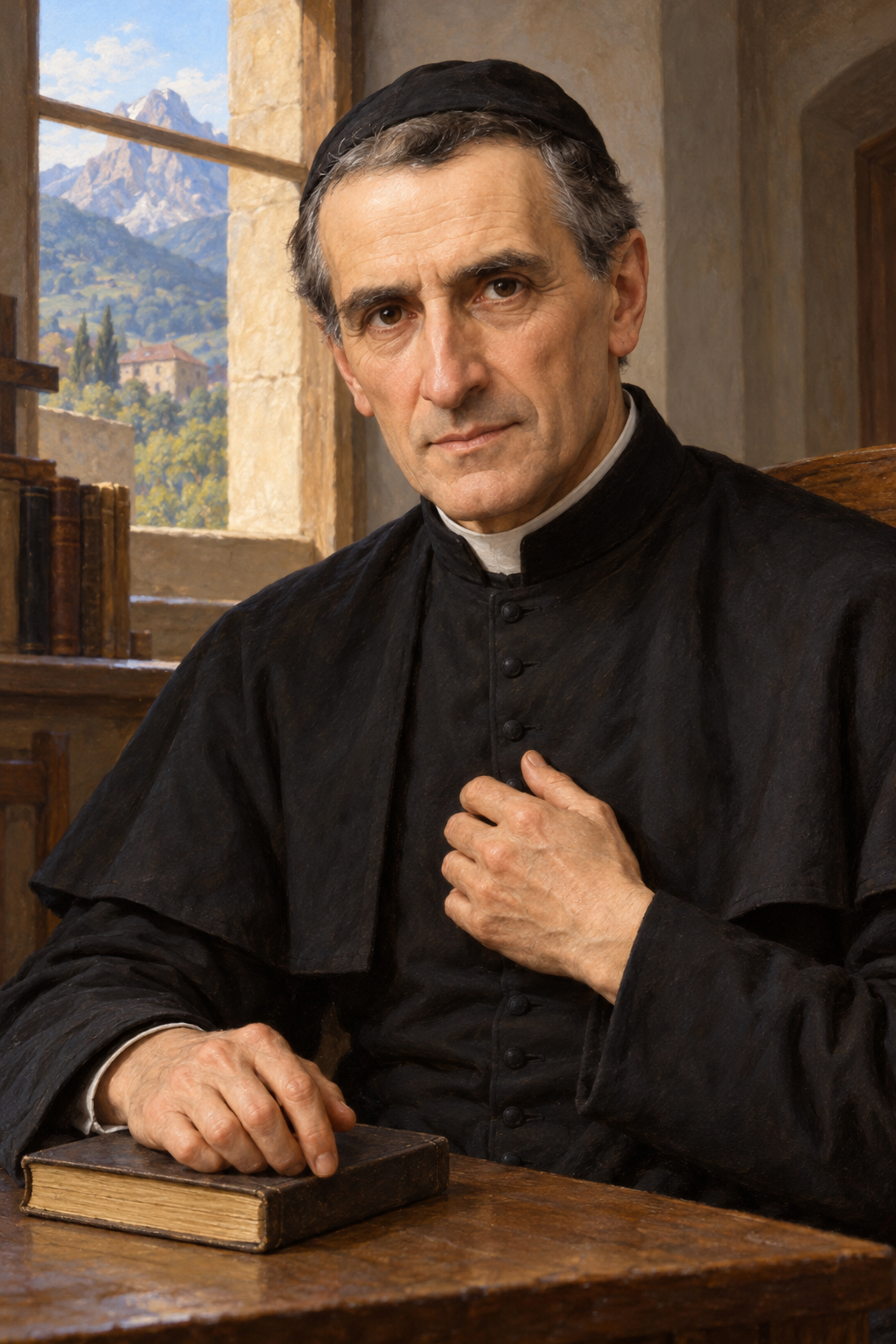
About Michel Garicoïts
Michel Garicoïts was born at Ibarre in the French Basque country on April 15, 1797. His family had little money, and work as a shepherd interrupted his schooling. He wanted to become a priest, but the cost of education stood in the way. The vocation that eventually led him to found the Priests of the Sacred Heart of Jesus of Bétharram grew out of this rural setting and the religious convictions of his family.
His childhood was not remembered as an uninterrupted example of gentleness. A devotional biography by Dom Antoine Marie recounts his throwing a stone at a woman whom he believed had harmed his mother, and stealing small objects. It also preserves his memory of taking an apple from his younger brother and being challenged to consider how he would feel if someone treated him that way. The account presents self-control and regard for other people as things he had to learn.
His grandmother helped him find a way forward by arranging domestic work with a priest at Saint-Palais. This allowed him to study while supporting himself. Sister Pascale’s account describes his subsequent service at the bishop’s residence in Bayonne, followed by studies at Aire and work at Larressore. These stages combined the ordinary tasks of a servant with preparation for ministry. He was ordained on December 20, 1823, and began parish work at Cambo.
At Cambo, Michel served under a parish priest who was paralyzed, taking on much of the practical ministry. The Basque encyclopedia records his accessible preaching, work as a confessor and establishment of a Sacred Heart confraternity whose statutes he wrote in Basque. In 1825 he moved to the seminary at Bétharram to teach philosophy. He also became responsible for its material administration and helped restore discipline. His teaching opposed Jansenist rigorism and the ideas of Lamennais, while encouraging frequent Communion.
The seminary’s gradual transfer to Bayonne left him with a new problem: what should become of the buildings and his work there? He gathered companions during the 1830s, and the congregation dates its foundation to 1835. Its purpose included preaching missions and educating young people. His service as confessor to the Daughters of the Cross at Igon had also brought him into close contact with religious community life.
Education did not win unanimous support within his own circle. When he opened a primary school at Bétharram in 1837, some companions wanted to concentrate their resources on missions. A further dispute concerned governance: Bishop Lacroix’s rule limited the force of the community’s vows and reserved powers that Michel believed belonged to its superior. He submitted to the bishop’s authority but repeatedly raised his objections.
The work nevertheless expanded. The congregation developed schools and workshops for brothers practicing trades such as carpentry, shoemaking and tailoring. In 1856 it sent missionaries to Argentina to accompany Basque emigrants. Michel’s health had begun to fail in 1853, but he resumed his responsibilities after that first serious illness. A further attack followed in 1859. He died at Bétharram on May 14, 1863, before the institute received its later recognition from Rome.
Bishop Lacroix presided at his funeral. The sermon excerpt preserved by Sister Pascale praised Michel’s faith, humility, simplicity and obedience, comparing his charitable work with that of Francis of Assisi and Vincent de Paul. The bishop presented a man concerned with doing good rather than winning approval. This tribute records the favorable judgment he expressed publicly at the end of Michel’s life.
In a letter marking the bicentenary of his birth, John Paul II described availability to God’s will as the central principle of Michel’s ministry. His characteristic expression, Ecce venio, meant readiness to respond to God. The pope connected that readiness with prayer, the sacraments, study and spiritual direction. He also stressed that Michel continued to deepen his knowledge of philosophy and theology: preparation for teaching was an ongoing responsibility. Religious community life, in this interpretation of his legacy, supported the work entrusted to each member.
Pius XII canonized Michel on July 6, 1947. His usual feast is May 14.
His patronage has taken concrete local forms. The Colegio San Miguel Garicoïts in La Plata, founded in 1984, names him as its patron and connects its educational aims with service, responsibility and respect for each student’s dignity.
The French Basque Centre in Buenos Aires adopted him as patron in 1948, a choice remembered at its anniversary celebrations.
The parish of Saint Michel Garicoïts du Labourd also explicitly names him as patron. Its bulletin gives May 15 as his local liturgical celebration and announces pilgrimage to Ibarre in his honor.
John Paul II also recalled Michel’s devotion to Mary, especially her steadfast presence beside the cross. His anniversary letter encouraged the congregation to carry its founder’s willingness to serve into new needs, including care for families and people facing poverty.
Wondering how to weigh the stories and sources? Learn how to read a saint biography.