Biography
Nicholas Pieck
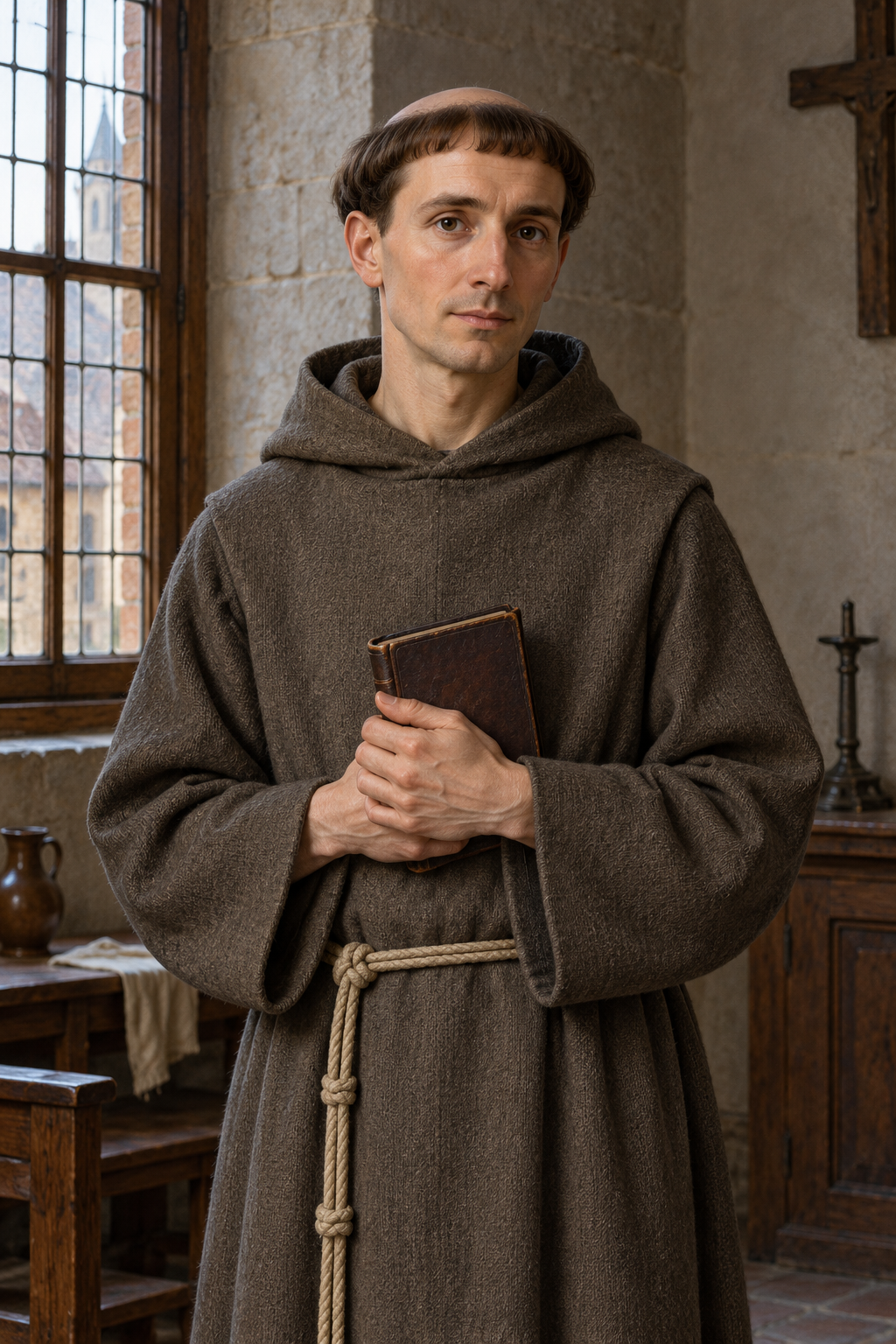
About Nicholas Pieck
Nicholas Pieck was a Franciscan priest and guardian of the friary in his native Gorkum. Ferdinand Heckmann’s biographical account dates his birth to August 29, 1534. After studying at ’s-Hertogenbosch, he entered the Franciscans there and continued his studies at Leuven. Ordained in 1558, he preached in towns of the Low Countries before taking responsibility for the Gorkum community. His preaching defended Catholic teaching, particularly Christ’s presence in the Eucharist, against the growing influence of Calvinism. His own family was divided by these religious changes: the account describes his efforts to persuade two brothers to return to Catholic belief.
Henrik Roelvink’s account emphasizes the responsibilities Nicholas carried within the friary. He had encouraged stricter observance of the Franciscan rule and felt particular concern for younger members. When the Sea Beggars approached Gorkum, news of violence against Franciscans at Alkmaar heightened the danger. Nicholas permitted members of his community to leave. Some took that opportunity; others remained with him. His decision to stay did not become a demand that everyone else make the same choice. In captivity, he and the deputy guardian took a leading part in religious arguments, supporting companions who were less equipped for theological debate. Roelvink also records uncertainty and fear among the prisoners, including appeals to relatives and pleas for mercy. This account remembers their courage alongside the difficulty of their circumstances, rather than presenting the group as uniformly fearless.
Heckmann also records attempts by Nicholas’ two brothers to obtain the prisoners’ release. The account presents freedom as conditional on abandoning papal authority, a condition Nicholas would not accept. These efforts place his relatives within the story as people trying to save him, despite the religious differences that had already divided their family before his imprisonment.
The arrests took place during the Dutch revolt against Spanish rule. The New Catholic Encyclopedia describes the Sea Beggars’ seizure of Gorkum and the prisoners’ subsequent transfer to Brielle. Their captors demanded that they abandon Catholic beliefs concerning the Eucharist and papal authority. Gorkum’s magistrates and the Prince of Orange sought their release, but the commander refused. Nicholas was among nineteen priests and religious hanged at a deserted monastery outside Brielle on July 9, 1572. The group included Franciscans, other religious and diocesan priests. Their shared remembrance became known as that of the Martyrs of Gorcum. They were beatified in 1675 and canonized on June 29, 1867. Their feast is on July 9.
Much of the story reached later readers through Nicholas’ family. The biographical dictionary entry for Willem van Est, known as Estius, identifies him and his brother Rutger as Nicholas’ nephews. Rutger had been imprisoned with his uncle and escaped. He subsequently interviewed witnesses and visited places connected with the deaths. Willem’s history appeared in 1603 and was included among the records used in the cause for recognition of the martyrs. Many later Dutch lives were adaptations of that work. The same dictionary notes that an earlier short account had been printed in 1572 without Willem’s approval and contained inaccuracies. This history of transmission matters: several later retellings can depend on one account, rather than provide independent confirmation. The relationship of the writers to Nicholas also forms part of the evidence’s context. Their work preserves testimony and family remembrance together.
The short narrative had been sent to a friend in Cologne. Its publication without the author’s consent, followed by a more extensive history decades later, shows why the versions should not be treated as interchangeable.
Nicholas’ friary has left traces apart from these narratives. An account by city archivist A. J. Busch, preserved by Gorinchem’s municipal archaeological service, describes its church, grounds and burial area. A painting of the town from 1568 identifies the Franciscan church by name and shows its tower. Historical maps help locate the complex, although Busch cautions that the exact position of the church cannot be established from them alone. Excavations uncovered graves in the former courtyard. These remains illuminate the community’s physical setting; they are not presented as the graves of Nicholas and his companions, who died elsewhere. The distinction allows local archaeology to contribute to the history without making an unsupported identification.
A parish in the Diocese of Rotterdam carries the name of Nicholas Pieck and his companions. Its own account dates the union of six churches to 2010 and identifies communities in Brielle, Hellevoetsluis, Hoogvliet, Rhoon, Rozenburg and Spijkenisse. In describing Nicholas, it stresses a Franciscan understanding of poverty: dependence on gifts, rejection of personal luxury and books held for the community rather than as private possessions. That portrait explains why his name can speak to the daily responsibilities of a parish as well as to the memory of his death.
The nineteen martyrs also give their name to the Franciscan province in the Low Countries. This is a collective dedication, shared by Nicholas with his companions.
Wondering how to weigh the stories and sources? Learn how to read a saint biography.