Biography
Nicholas Tavelic
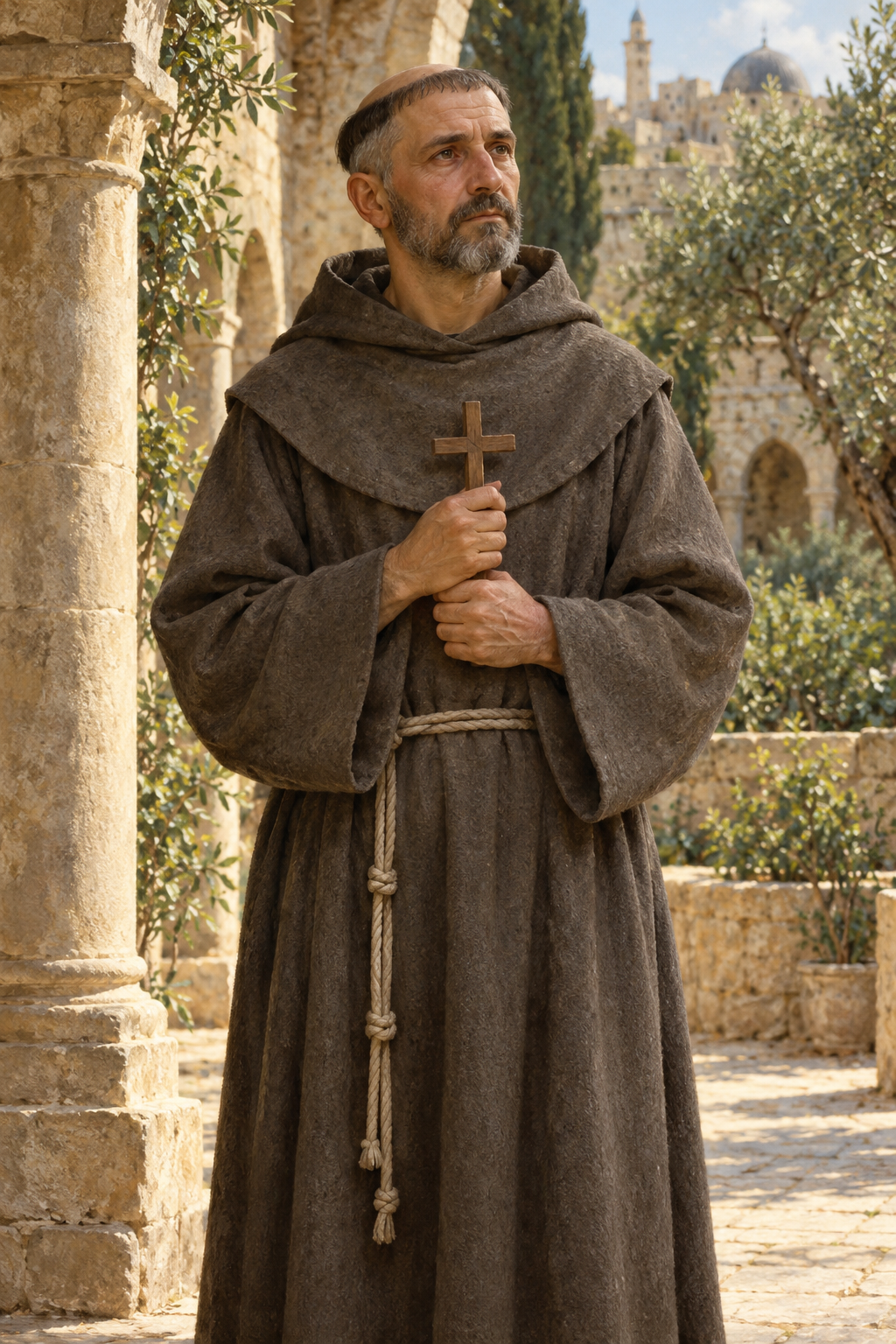
About Nicholas Tavelic
Nicholas Tavelic was a Croatian Franciscan priest from Šibenik, born around 1340. His ministry took him to Bosnia and then to Jerusalem, where he died in 1391. He is remembered as the first Croatian to receive a formal canonization. His feast is celebrated on November 14. The outline is clear, but the surviving evidence gives far more detail about his final days than about his childhood or education.
His approximate birth year is a reconstruction, not a surviving birth record. Ivan Bradarić explains that historians worked backward from the years of missionary service and the Franciscan requirements governing priestly ministry. The earliest substantial account concerns his death: Gerard Calvet, guardian of the Jerusalem friary, sent reports to Europe in January 1392. One reached the Franciscan house at Šibenik. It records twelve years of ministry in Bosnia before Nicholas went to the Holy Land.
In Jerusalem he lived with the friars on Mount Zion. His companions in the final confrontation were Deodatus, Peter of Narbonne and Stephen of Cuneo. Noel Muscat’s study translates the account attributed to their guardian. It describes a prepared statement carried to the Muslim authorities, with an Arabic version so that its meaning could be understood. The friars denounced Islam and Muhammad and called for conversion to Christianity. This was a deliberate religious confrontation, with consequences they knew could be fatal.
The judge questioned them and demanded that they retract their statements and accept Islam. They refused. After imprisonment, the four were killed on November 14, 1391. The canonization document records that their bodies were burned. Their death became the central event through which the Catholic Church remembered their faith; the confrontational circumstances remained part of the record, rather than disappearing from it.
The report also describes the burden that followed for the surviving friars. News of the executions traveled through a network that included the Catalan consul at Damascus, while the Jerusalem community faced financial demands and insecurity. Muscat preserves this aftermath alongside the account of the four deaths. It widens the perspective beyond the martyrs themselves: their decision affected companions who remained responsible for the fragile Franciscan presence in the Holy Land.
The historian Ivan Jurković cautions against treating their action as an impulsive desire for death. He points to their years of ministry, preparation and consultation with their community. He interprets the episode as a serious, if dangerous, attempt to bring about conversion. At the same time, his study identifies the hostile Christian literature about Islam that shaped their approach. Their understanding of another religion came through a polemical tradition. This interpretation helps explain their choices, but it cannot provide direct access to their private thoughts.
Paul VI addressed the difficulty openly when he canonized the four on June 21, 1970. He acknowledged that they had voluntarily exposed themselves to death and discussed the question of whether deliberately provoking death could constitute martyrdom. He understood their action through their faith and hope for others’ conversion, while recognizing that their calculation had failed. His homily did not present the episode as permission to intensify religious conflict. Referring to the Second Vatican Council, he called instead for Christians and Muslims to pursue peace, justice and freedom together. That distinction is essential to reading his judgment fairly.
The formal recognition had developed over a long period. The canonization letter records confirmation of Nicholas’s cult in 1889 and that of his companions in 1966, before the four were canonized together. Their shared recognition joined the local remembrance of the Croatian friar to the history of the other men who died beside him.
His patronage is visible in particular communities. The Croatian Catholic Mission in the Netherlands celebrates him as its patron. An account from 2008 describes a community formed through different migrations: workers arriving during the 1960s and refugees from Bosnia and Herzegovina during the wars of the 1990s. Franciscans from the Bosna Srebrena province served the mission. His name accompanied people building a religious home away from their homeland.
In Brnaze, a community dedicated to him was established in 1973; its new church first hosted his patronal celebration in 2023. Repušnica parish also names him as its patron. Its worship began in a donated farm building before a new church was blessed in 1998. These local histories show how devotion became part of the ordinary work of gathering, building and sustaining a parish.
Other dedications include the memorial basilica and Franciscan monastery at Tomislavgrad, the church in Lišani and the filial church at Modran. The Lišani church was destroyed during the Croatian war and rebuilt, with completion reported in 2003. At Modran, the 2024 celebration brought worshippers together for Mass and a meal in a new community hall. Such associations are specific local patronages; they do not establish a universal patronage over every Croatian person or institution.
Wondering how to weigh the stories and sources? Learn how to read a saint biography.