Biography
Nicolás Alberca
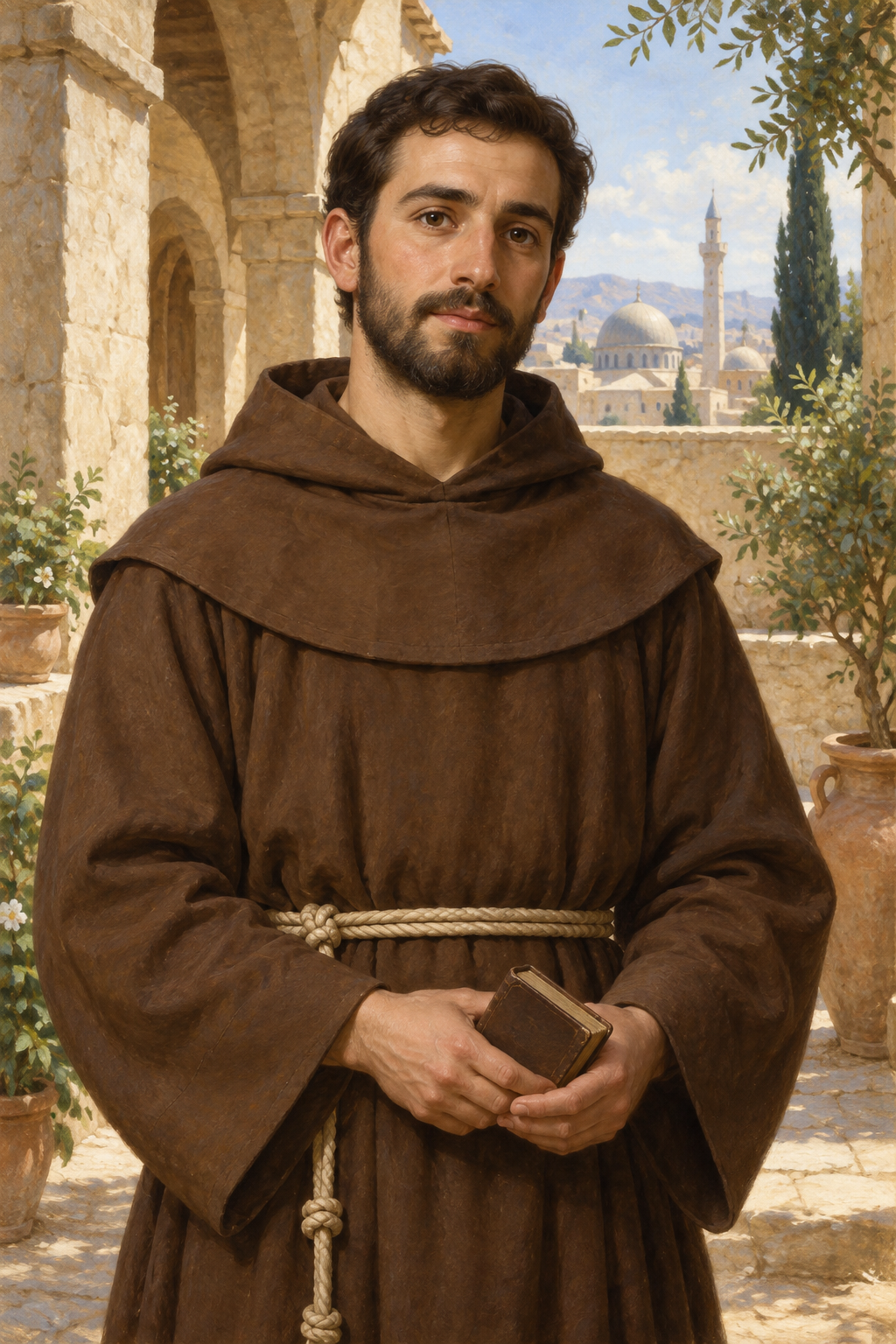
About Nicolás Alberca
Nicolás Alberca was a Spanish Franciscan priest whose surviving letters show the family concerns behind his decision to become a missionary. Born at Aguilar de la Frontera on September 10, 1830, he came from a household of limited means. Before entering the Franciscans, he served with the Brothers of the Hospital of Jesús Nazareno in Córdoba. His responsibilities included collecting alms, and in 1854 the hospital sent him to Madrid to represent its interests. He continued studying alongside that work.
In Madrid he joined the School of Christ, an association promoting prayer and faithful attention to ordinary responsibilities. A Franciscan missionary college opened at Priego in 1856, giving him the opportunity he had sought. He received the habit that July and was ordained at Segorbe on February 27, 1858. In 1859 he traveled to the Holy Land and was assigned to Damascus to learn Arabic. His preparation for missionary work was still underway when violence overtook the city the following year.
His correspondence does not portray separation from home as effortless. Writing to his mother on January 5, 1858, he admitted how much her prolonged silence worried him. He could not explain why no letter had come and found himself imagining possible causes. Although he tried to accept uncertainty through faith, he also insisted on the ordinary affection of a son who wanted news of his parents. The passage preserves both his religious language and his need for reassurance, without making one cancel the other.
Practical advice appears just as clearly. In a letter of September 10, 1858, he considered his younger brother Francisco Javier’s wish to become a priest. Nicolás advised him to keep his honest employment while continuing to study Latin whenever time allowed. A vocation, in this account, did not require abandoning present duties before another path was possible. His counsel joined patience with preparation: his brother could preserve the hope of priesthood and still take responsibility for earning a living.
Departure brought another disappointment. In January 1859 he wrote to explain that he could not visit his mother before leaving Spain. His farewell asked the family to remain at peace with one another and to overlook each other’s faults. He urged his siblings to take particular care of their mother’s health and to comfort her in sorrow. He also asked them to pray for their deceased father and sisters Carmen and Manuela. The letter ends with a reciprocal blessing: he asks his mother’s blessing as her son and gives his own as a priest. These requests keep the household itself at the center of a letter about going far away.
Shortly before sailing, another letter told his mother how he intended to remember those at home. With his superior’s permission, he would offer Mass during the journey for family members, deceased relatives, friends and benefactors in turn. He asked them to pray for him as well. His account of the voyage therefore begins with the people whose support had helped make it possible.
In March 1860 his mother was anxious about Francisco Javier’s possible military service. Nicolás answered by remembering soldiers he had encountered in Madrid. He had seen them at prayer, in the School of Christ and helping sick people in hospitals. His examples included men from different branches and ranks. He did not describe military life as free from temptation; he contrasted their conduct with the choices of less disciplined companions. The point of the recollection was to reassure his mother that religious commitment could survive in circumstances she feared for her son.
Nicolás was killed in Damascus on July 10, 1860, at twenty-nine. He belonged to the Franciscan community later honored with three Maronite brothers as the eleven martyrs of Damascus. The Church’s account remembers his refusal to renounce his faith when threatened. The Franciscans and the Maronite brothers were beatified together in 1926, and Pope Francis canonized them on October 20, 2024.
At Aguilar, his remembrance has a local setting. The confraternity dedicated to him is based at Santa María del Soterraño. Its official directory identifies him as its titular saint and describes the statue used in its worship, a wooden image from a religious workshop in Tarragona. The confraternity cares for his chapel and organizes services near July 10. This is a specific devotional association with the community that bears his name.
In July 2025 the town council unanimously approved a posthumous civic honor naming him a favored son of Aguilar. The local association of confraternities reported that descendants had initiated the proposal, supported by religious groups and individual residents. Its account distinguishes the street where he was born from the later family home on Calle Pintada, where the annual procession pauses. The civic recognition adds a modern chapter to his local memory; it is separate from the Church’s canonization and from any formal designation as patron of the town.
Wondering how to weigh the stories and sources? Learn how to read a saint biography.